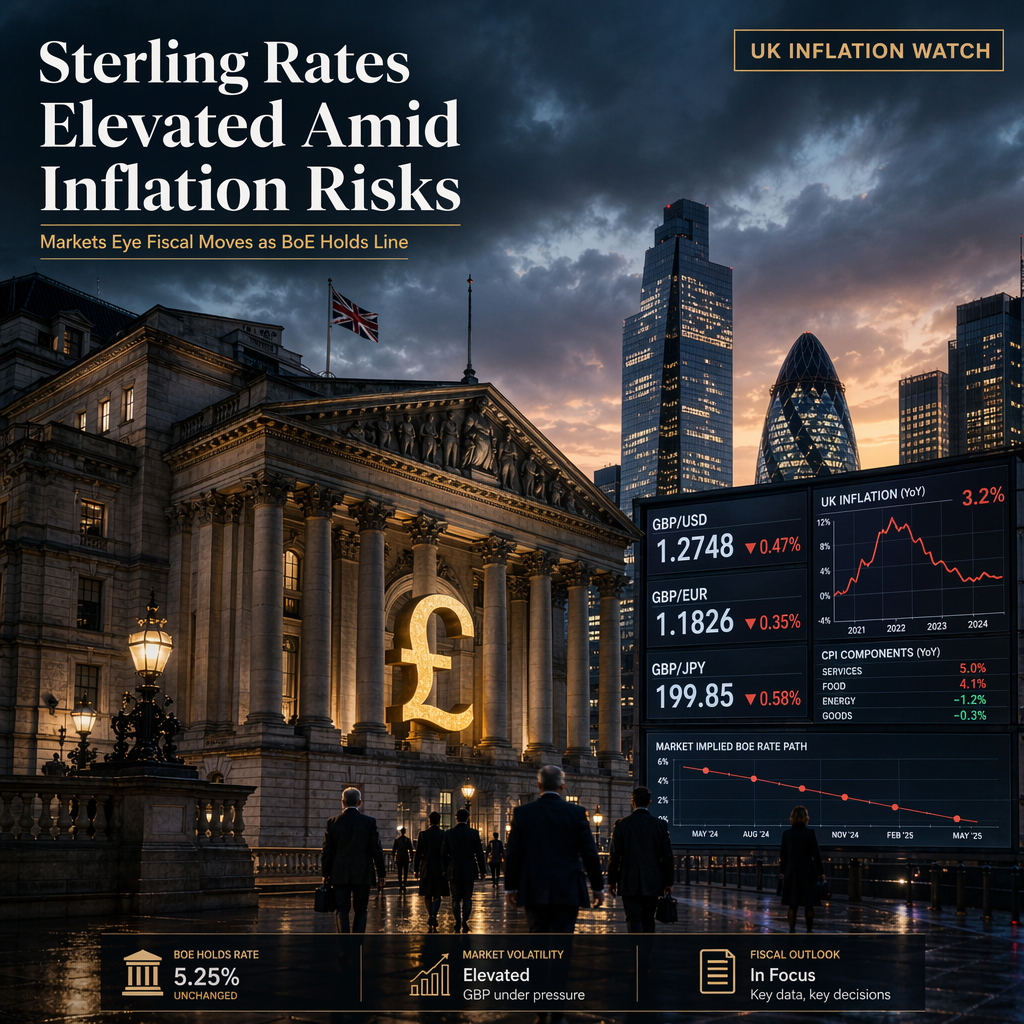
ING strategists Michiel Tukker and Padhraic Garvey emphasize that the British Pound (GBP) markets are highly sensitive to UK inflation risks, particularly in the context of near-term fiscal spending plans [1]. They note that any sizeable immediate government spending could drive GBP rates higher, as markets are currently more focused on inflation outlook and Bank of England (BoE) policy than on sovereign risk [1].
The strategists highlight that inflation remains the primary threat to UK government bonds (gilts), and that the BoE has not yet succeeded in returning inflation to its 2% target [1]. They point out that markets are still pricing in a terminal BoE rate around 4%, which is above the current bank rate of 3.75% [1]. This elevated rate environment is expected to persist until a more disinflationary environment emerges, which ING anticipates could occur next year [1].
According to ING, the market impact of fiscal plans, such as the currently debated defence spending, depends heavily on the timing of the expenditure. Near-term spending initiatives are expected to push GBP rates up more significantly than commitments for future years [1]. The strategists also mention that when oil prices previously surged above $100, markets quickly priced in a significant tightening cycle for the BoE, more so than for the European Central Bank (ECB) [1].
Overall, the analysis suggests that sterling markets will remain volatile and sensitive to inflation risks, with any near-term fiscal expansion likely to have a pronounced upward effect on GBP rates, while longer-term spending plans are expected to have a more muted impact [1].
CONCLUSION
Sterling markets continue to react strongly to UK inflation risks, with near-term fiscal spending likely to push GBP rates higher. Until inflation returns to target and a disinflationary environment emerges, market sensitivity is expected to persist.