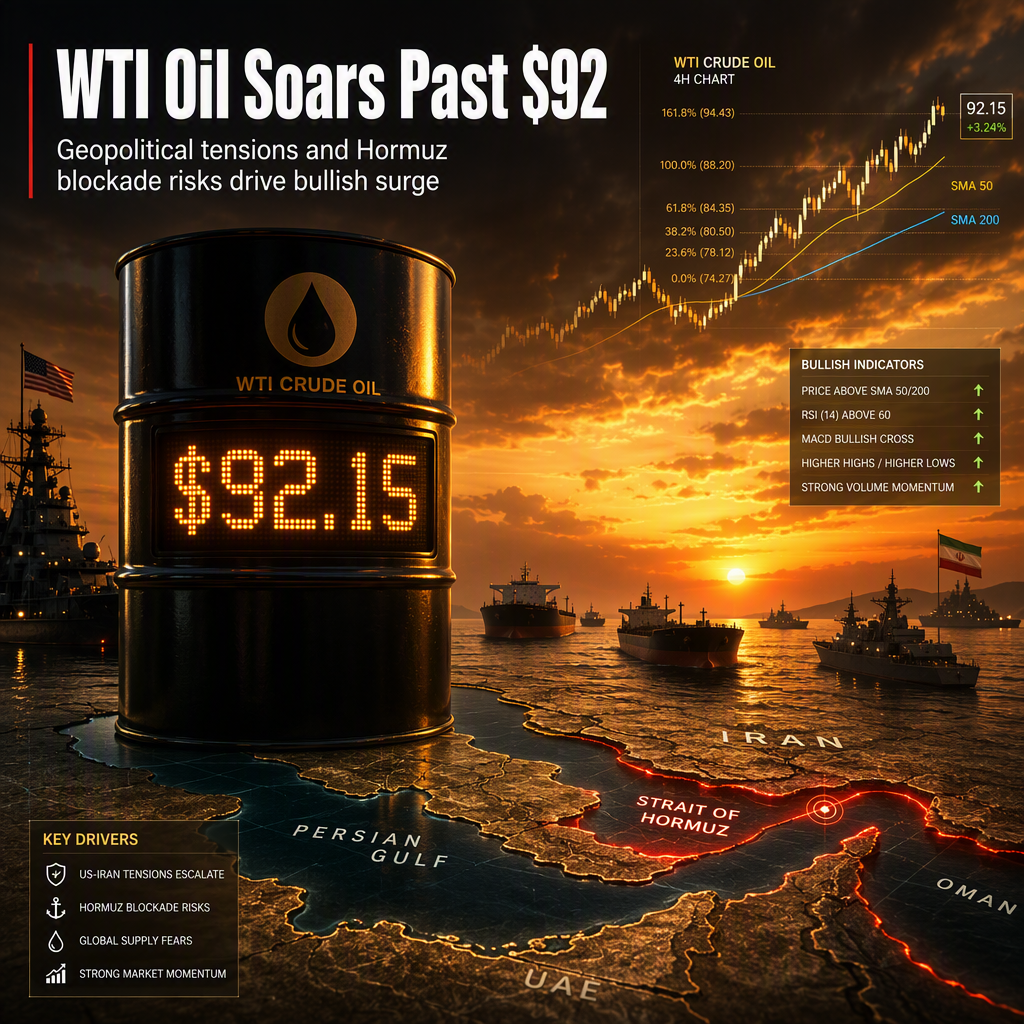
West Texas Intermediate (WTI), the benchmark US crude oil price, advanced above $92.00, reaching its highest level since July 23 during the early European session on Tuesday, driven by escalating tensions between the US and Iran [1]. The rally marks the second consecutive day of follow-through buying, as geopolitical risks in the Middle East continue to underpin the oil risk premium [1]. Over the weekend, US forces struck and disabled three Iranian oil tankers in retaliation for an Islamic Revolutionary Guard Corps (IRGC) ballistic missile attack targeting two US Navy warships, further intensifying supply concerns [1].
Commodity strategists at TD Securities highlighted that renewed hostilities between the US and Iran reinforce the fragility of the current détente in energy markets, emphasizing how quickly sentiment around supply security can shift without a durable agreement [1]. Iran has threatened to retaliate against any new US attacks on its assets, warning that energy infrastructure across the Gulf is vulnerable. Iran’s security chief, Mohsen Rezaei, stated that Tehran is preparing to enforce a full blockade around the Strait of Hormuz in response to economic sanctions, raising fears of a prolonged disruption to oil supplies [1].
Technical analysis indicates a bullish near-term bias for WTI, as it holds above the 100-day Simple Moving Average (SMA) at roughly $85.24 and has reclaimed the 61.8% Fibonacci retracement at about $91.59. Momentum indicators remain constructive, with the Relative Strength Index (14) pressing into the mid-60s and the MACD line above zero, suggesting persistent upside pressure [1]. Immediate resistance is seen at the July swing high around $93.25, and a sustained break higher could expose the 78.6% Fibonacci retracement at approximately $98.44, with the prior swing high at $107.16 acting as a further upside target [1].
On the downside, initial support is now seen at the 50% retracement around $86.78 and the 100-day SMA at $85.24, forming a broader demand zone if prices correct lower [1]. Analysts suggest that any corrective pullback is likely to be bought into and remain limited, validating the positive outlook for crude oil prices in the near term [1].
CONCLUSION
WTI crude oil prices have surged above $92.00, fueled by heightened US-Iran tensions and threats to block the Strait of Hormuz, which have significantly increased supply concerns. Technical indicators and analyst commentary point to a bullish outlook, with further upside possible if resistance levels are breached. The market is likely to remain sensitive to developments in the region, with any pullbacks expected to be limited.