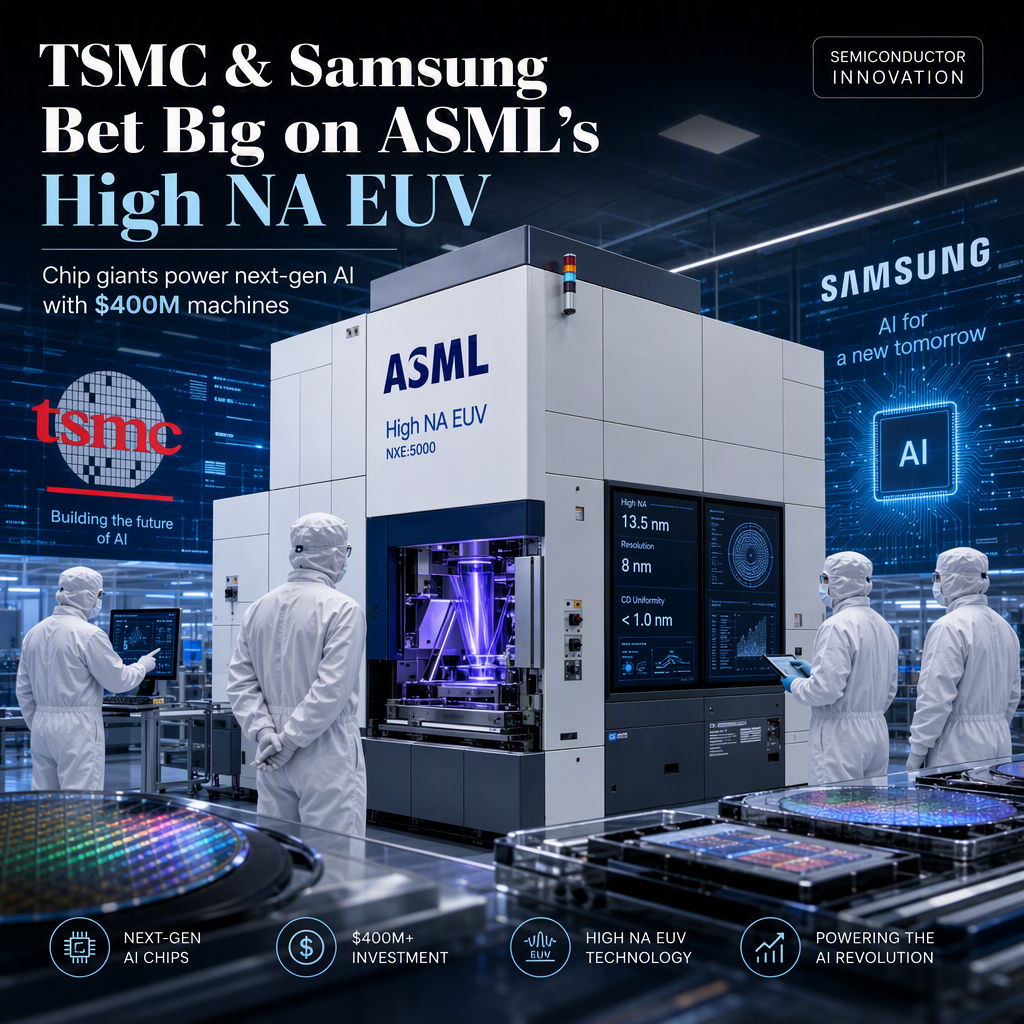
TSMC and Samsung, the world's two largest chipmakers, have announced their commitment to adopting ASML's High NA extreme ultraviolet (EUV) lithography machines, responding to the growing demand for advanced chips used in artificial intelligence applications [1]. ASML's High NA EUV machines, which cost approximately $400 million each, are capable of printing smaller and more intricate circuit patterns onto silicon wafers, a critical advancement for next-generation chip manufacturing [1].
Samsung revealed plans to utilize ASML's High NA machines for DRAM production starting in 2028, with further adoption targeted for 2030. The company aims to extend its DRAM scaling roadmap and enhance process efficiency through this technology [1]. TSMC, meanwhile, intends to deploy ASML's tools for advanced chips, anticipating increased use of High NA machines due to the complex transistor architectures required for AI applications [1]. Both companies will also participate in an industry initiative with ASML to develop next-generation 12-inch photomask technology, which promises improved productivity and reduced chipmaking costs compared to the current 6-inch format [1].
Investors view the success of High NA EUV machines as pivotal to ASML's future growth, with the stock having surged 120% over the past year. Barclays analysts commented that these commitments provide greater visibility on adoption, which has been a key debate, and described the news as "a positive." Despite this, shares of ASML traded flat-to-lower in early Tuesday trading [1]. Barclays further noted that ASML faces a significant decision on whether to expand EUV capacity beyond its recently increased targets, as demand remains strong [1].
ASML has not issued a recent forecast for the number of High NA machines it expects to sell but has stated plans to increase EUV capacity by about 30% in 2027. Samsung and TSMC join Intel as customers for ASML's High NA machines, with Intel confirmed to be using the technology for advanced chip manufacturing since July [1].
CONCLUSION
TSMC and Samsung's commitment to ASML's High NA EUV machines underscores robust demand for advanced chipmaking tools driven by AI applications. The announcements provide ASML with greater visibility for future planning and capacity expansion, reinforcing its position as a key supplier in the semiconductor industry. Despite strong demand and positive analyst sentiment, ASML shares showed little immediate movement, suggesting investors may be awaiting further clarity on sales forecasts and capacity decisions.