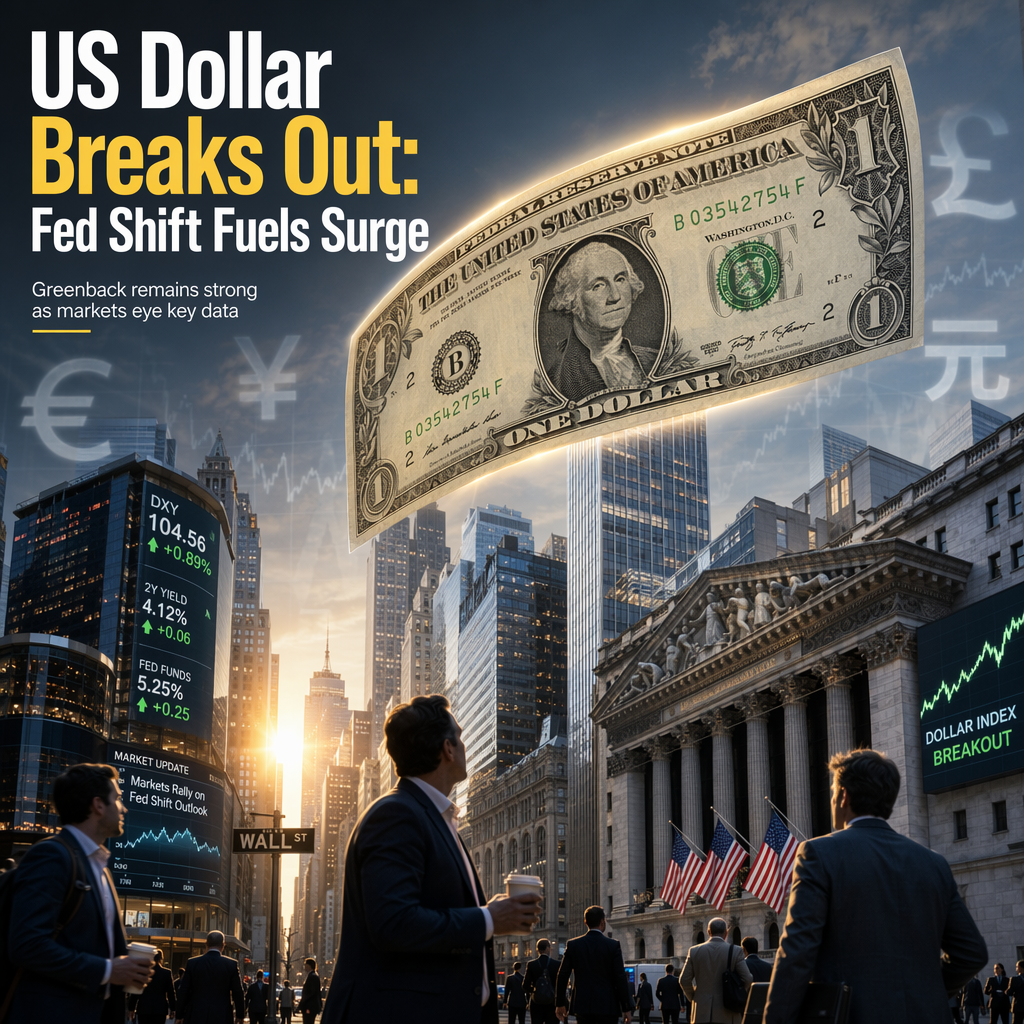
The US Dollar (USD) has recently broken out of its prior G10 trading ranges, driven by a combination of an interim US–Iran peace agreement and a notable shift in Federal Reserve (Fed) messaging, according to HSBC strategists. This shift has led to a hawkish repricing of US rate expectations, underpinned by resilient US economic growth, which is expected to support further USD strength in the near term. The US Dollar Index (DXY) has moved above 101 as of June 26, reflecting this breakout and the end of rangebound moves in many G10 FX pairs [1].
Despite the easing of geopolitical tensions, which typically reduces demand for the USD as a 'safe haven,' the main driver for the currency now appears to be the increasingly hawkish stance of the Fed. HSBC notes that Fed policy is anchored in continued US economic resilience, contrasting with stagflation concerns in other G10 economies [1].
Market data shows that the DXY lost some momentum on Monday, trading near 101.10 but remaining close to recent highs as investors took profits ahead of key US labor market data later in the week. The Greenback remains supported by firm Treasury yields and expectations that the Fed could keep policy restrictive for longer [3]. On the day, the USD was the strongest against the Japanese Yen (+0.11%) and showed mixed performance against other major currencies, such as a decline of 0.36% against the Euro and 0.48% against the British Pound [3].
In the USD/CNH pair, UOB’s Senior Technical Strategist expects the Dollar to remain in a tight near-term range between 6.7950 and 6.8100, with a possible move toward 6.8300 if the 6.7900 support holds. On a 1–3 month horizon, a break above the 21-week EMA at 6.8430 would be needed to signal a sustained recovery for the USD against the Chinese Yuan [2].
Looking ahead, market participants are focused on upcoming US jobs data, the ECB Forum, and China PMIs for further direction. ECB President Christine Lagarde commented that Europe’s resilience gives the ECB room to raise rates without creating financial stress, while the wide policy gap between the Fed and the Bank of Japan continues to pressure the Japanese Yen, with USD/JPY trading near multi-decade highs at 161.90 [3].
CONCLUSION
The US Dollar has broken out of its previous trading range, buoyed by a hawkish Fed shift and resilient US growth, despite easing geopolitical tensions. While the DXY has eased slightly ahead of key data releases, the overall outlook remains positive, with further USD strength expected if current trends persist. Market attention now turns to upcoming US labor data and central bank commentary for additional cues.