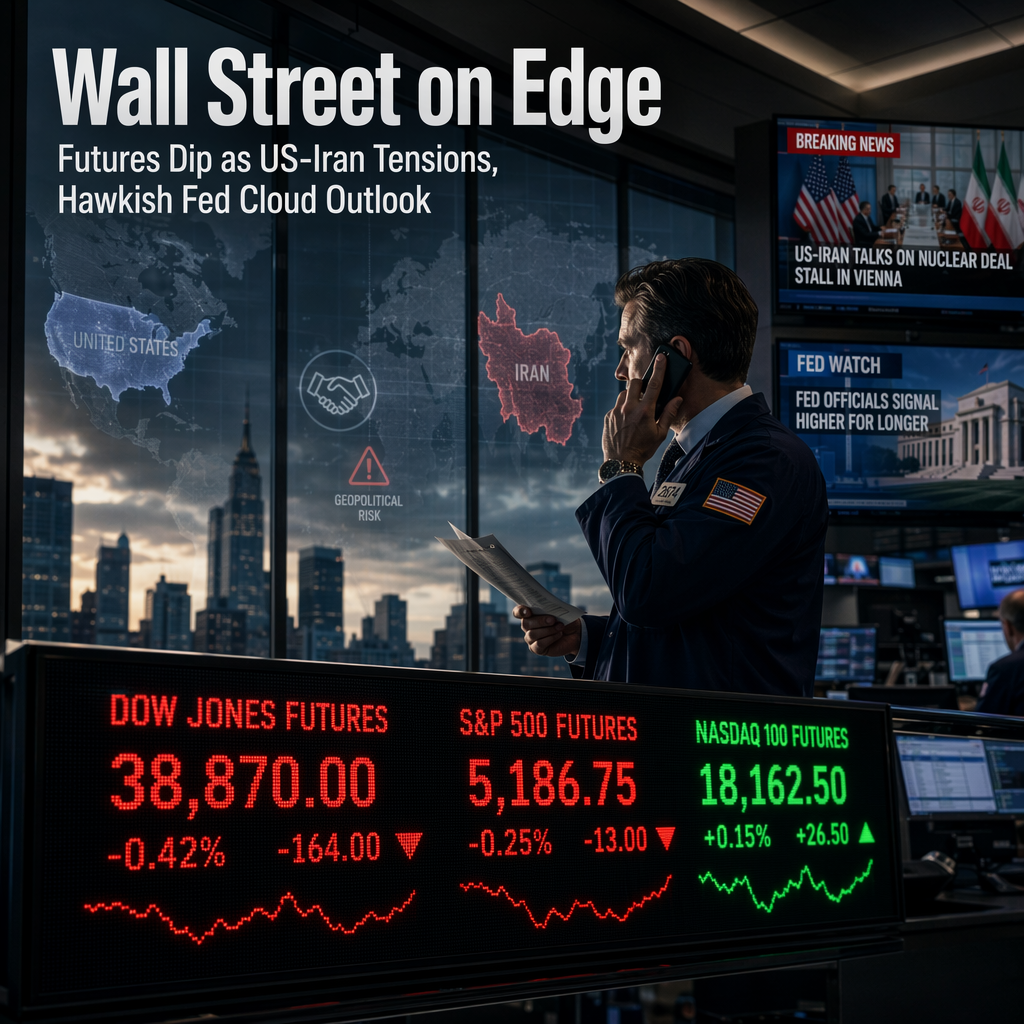
Dow Jones futures traded slightly lower by nearly 0.05%, hovering around 51,980 during European hours on Monday, while S&P 500 futures declined by 0.09% to approximately 7,560. In contrast, Nasdaq 100 futures advanced 0.14%, reaching near 30,760 at the time of writing [1]. The mixed performance in US stock futures reflects investor caution amid renewed uncertainty surrounding US-Iran peace talks and a more hawkish outlook from the Federal Reserve [1].
Market sentiment was initially dampened after reports indicated that US President Donald Trump threatened direct strikes on Iran if proxy attacks on Israel persisted. This warning cast doubt on the prospects for diplomatic progress and threatened to undermine the current peace framework, particularly impacting the first round of interim talks between Vice President JD Vance and Iranian officials [1]. However, risk aversion eased somewhat following a joint statement from mediators Qatar and Pakistan in Switzerland, announcing that both Washington and Tehran have agreed to a formal roadmap aimed at securing a final peace agreement within the next 60 days [1].
On the macroeconomic front, investors are closely watching the upcoming release of the US PCE price index, the Federal Reserve's preferred inflation gauge. This follows last week's Fed meeting, where policymakers kept interest rates unchanged but signaled a hawkish shift. Notably, 9 out of 19 FOMC members now anticipate at least one rate hike this year, leading market participants to price in a potential increase as early as September [1].
In corporate news, the earnings calendar features key reports from Micron Technology (MU), FedEx (FDX), and its new spinoff, FedEx Freight. Micron's results are expected to serve as a major indicator for memory plays, chip-gear suppliers, and the broader artificial intelligence ecosystem [1].
CONCLUSION
US stock futures are trading with a downward bias as geopolitical tensions and a hawkish Fed outlook weigh on sentiment. The market is awaiting critical inflation data and earnings reports from major companies, which could further influence investor direction. Overall, uncertainty remains elevated, with risk aversion partially offset by diplomatic progress in US-Iran talks.