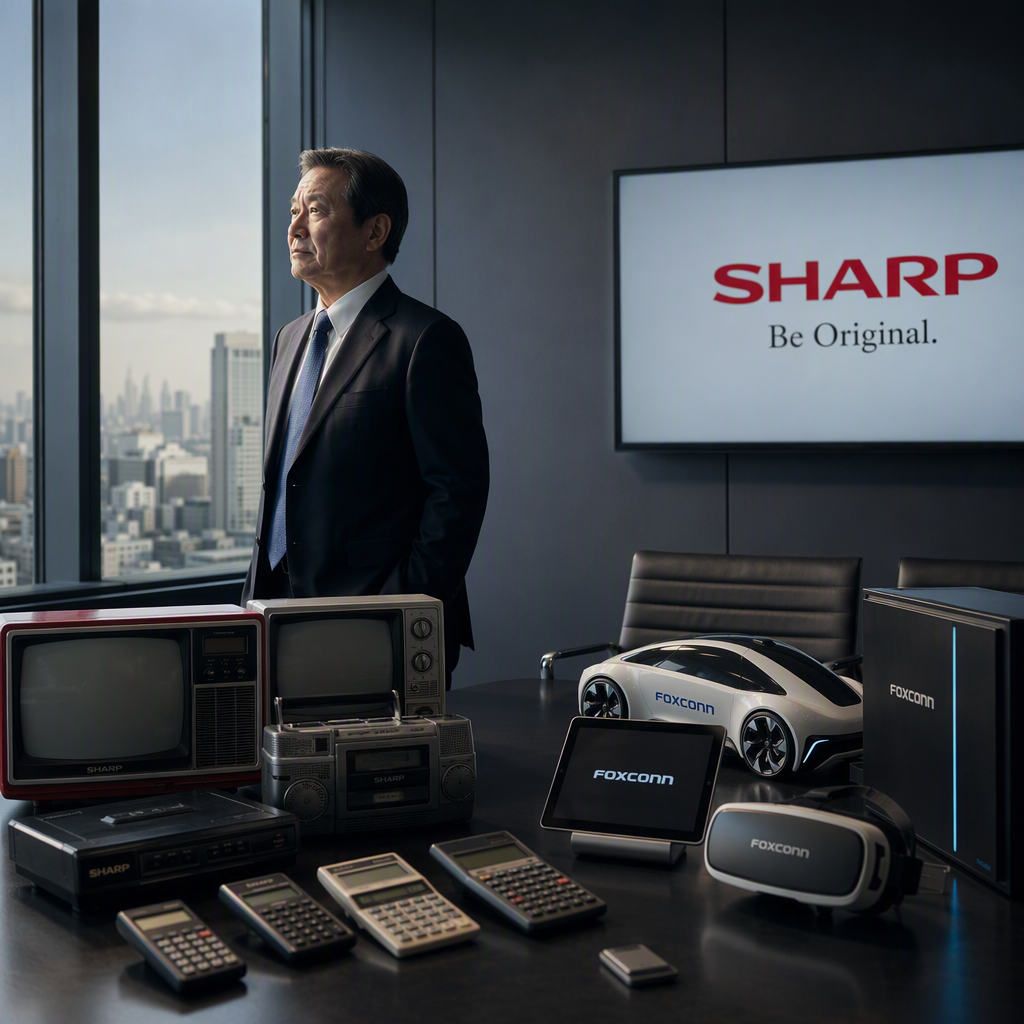
Former Sharp President and Chairman Katsuhiko Machida has described the decade since Sharp's acquisition by Taiwan's Foxconn (Hon Hai Precision Industry) in 2016 as 'negative' for the Japanese electronics maker [1]. In an interview, Machida emphasized that Sharp has moved away from its historical focus on developing original technologies and new product categories, a shift he attributes to the fundamentally different business philosophies between Foxconn, a contract manufacturer, and Sharp, which traditionally prioritized product design and innovation [1].
Machida stated, 'The mindset of a contract manufacturer like Foxconn is fundamentally different from a company that pursues unique product design,' suggesting that this divergence has slowed Sharp's innovation and diluted its brand identity over the past ten years [1]. He acknowledged that Foxconn brought financial resources and supply chain management expertise to Sharp, but argued these strengths did not lead to a revival of Sharp's core competencies [1].
Machida warned that without a renewed focus on innovation, Sharp risks further erosion of its competitive edge in the global electronics market [1]. The interview highlights ongoing debates within Japan's electronics industry regarding the long-term impact of foreign acquisitions, especially when the acquiring and target companies have contrasting business strategies and corporate cultures [1].
No specific market reactions, analyst opinions, or forward-looking statements from other stakeholders were mentioned in the article [1].
CONCLUSION
The former Sharp president's remarks underscore concerns about the impact of Foxconn's ownership on Sharp's innovation and brand identity. While Foxconn provided financial and operational strengths, Machida believes these have not compensated for the loss of Sharp's traditional focus, raising questions about the company's future competitiveness.