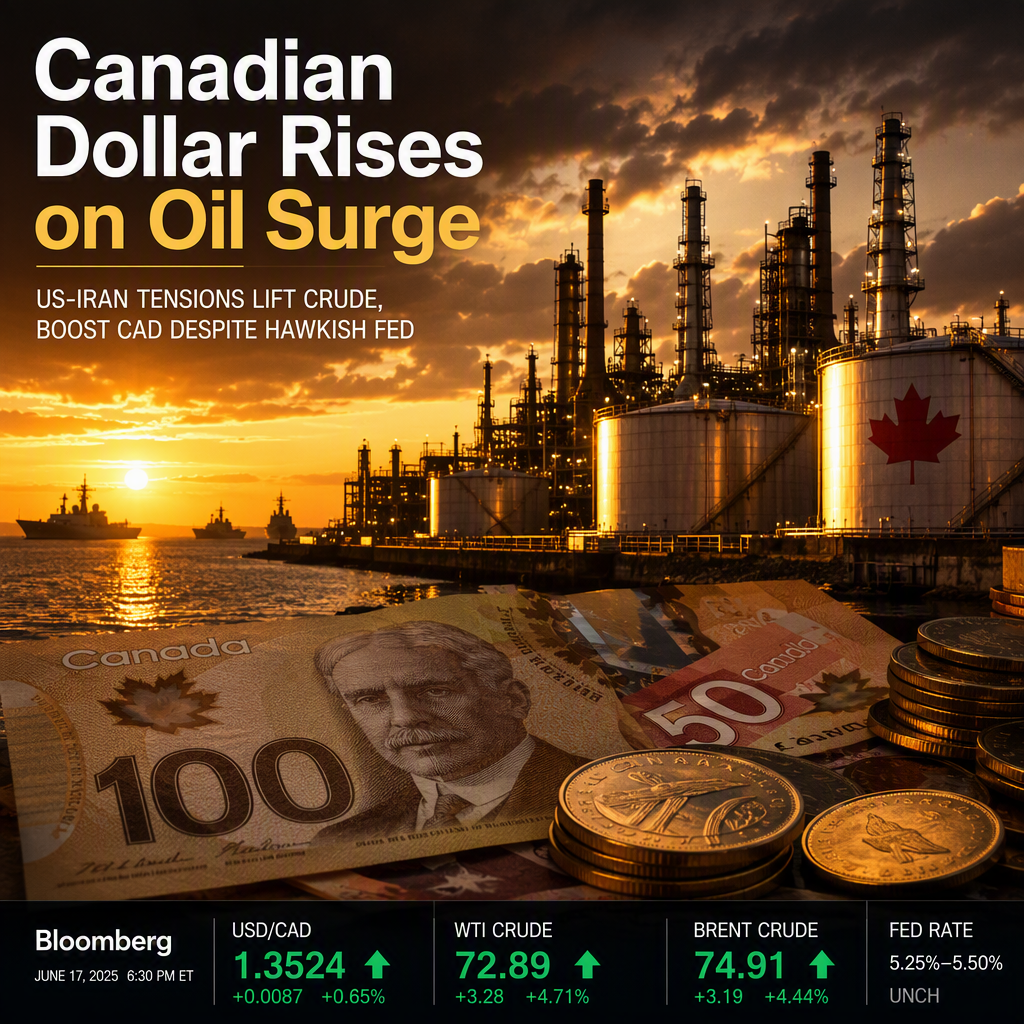
The Canadian Dollar (CAD) strengthened against the US Dollar (USD), with the USD/CAD pair edging lower to around 1.3890 during Asian trading hours on Monday [1]. This move was supported by a rise in crude oil prices, which benefited the commodity-linked CAD following renewed tensions between the US and Iran. Specifically, US officials reported that American forces struck two Iranian launchers on Iran's Larak island, marking the first known US strikes on Iran since late July. Iran’s Islamic Revolutionary Guard Corps (IRGC) stated that the attack resulted in casualties and promised retaliation, while the Iranian military claimed to have launched an attack on US military targets in Jordan [1].
Canada, as a major oil exporter, typically sees its currency supported by higher crude prices. The anticipation of upcoming employment reports from both the US and Canada, due on Friday, is also influencing market sentiment [1]. Scotiabank strategists noted that recent Canadian economic data have consistently exceeded expectations, suggesting that much of the positive news is already reflected in the CAD. However, they indicated that upcoming growth figures could provide modest additional support for the currency in the short term [1].
On the US side, hawkish rhetoric from Federal Reserve Chairman Kevin Warsh at the Jackson Hole symposium provided some support to the US Dollar. Warsh emphasized that inflation is not slowing significantly and stated that the Fed has 'work to do' unless policymakers become confident in inflation's trajectory. The FXS Speechtracker score for Warsh's remarks was 7.4/10, above the baseline of 6.5/10, highlighting increased concern about price stability. Warsh reaffirmed the Fed's 2% PCE target and noted that financial conditions remain loose, suggesting a bias toward further tightening if inflation progress stalls. The FXS Fed Sentiment Index remained unchanged at a high level of 129.70, maintaining a hawkish policy tone [1].
CONCLUSION
The Canadian Dollar's recent strength is attributed to rising oil prices amid escalating US-Iran tensions, while hawkish signals from the Federal Reserve provide some counterbalance in favor of the US Dollar. Market participants are closely watching upcoming employment data from both countries for further direction. Overall, the CAD remains supported in the short term, but the broader narrative is shaped by ongoing geopolitical risks and central bank policy outlooks.