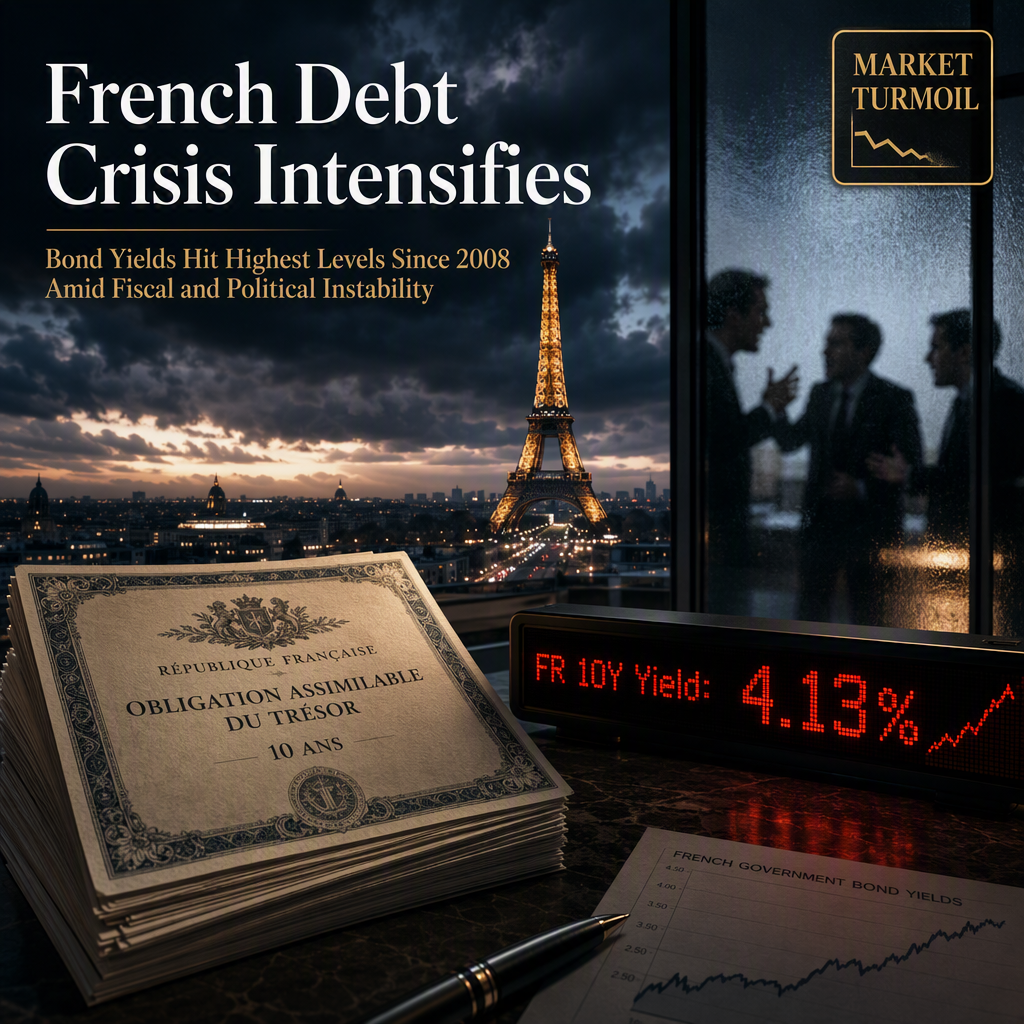
French government bond yields have surged to their highest levels since 2008, with the benchmark 10-year yield rising above 4.13% last week and remaining near 4.1% on Friday, reflecting heightened investor concerns over France's fiscal and political stability [1]. The sharp increase in borrowing costs comes as France faces mounting fiscal strain, recurring political instability, and a looming battle over the 2027 budget and presidential election [1].
France's public finances have deteriorated significantly, with the country repeatedly breaching European Commission rules on budget deficits and debt limits. In 2025, France's deficit reached 5.1% of GDP, and its debt-to-GDP ratio surpassed 115% [1]. The IMF projected in July that France's gross government debt would reach about 118.5% of GDP in 2026 and exceed 120% in 2027, remaining above that level through 2030 [1]. The European Union has placed France under its excessive deficit procedure, recommending that the country end its excessive deficit by 2029, but significant progress is still needed [1].
Political deadlock has exacerbated market anxiety, with the French National Assembly deeply divided and frequent no-confidence votes leading to government collapses and budget impasses [1]. Prime Minister Sebastien Lecornu, the fifth person to hold the role in two years, resigned just 27 days into his tenure due to political discord but was reappointed days later [1]. France is expected to submit its 2027 budget plans to parliament by early October, following last year's contentious process that saw the budget forced through after months of delays [1].
The upcoming 2027 presidential election adds another layer of uncertainty, with far-right candidate Marine Le Pen currently the frontrunner [1]. The combination of fiscal challenges, political instability, and external factors such as the U.S.-Iran war's impact on global borrowing costs has made France the 'poster child' of sovereign debt problems in the euro area, resulting in some of the highest government borrowing costs among G7 nations [1].
CONCLUSION
France's surging government bond yields underscore deep investor concerns about the country's fiscal trajectory and political gridlock. With debt levels projected to rise further and key political events on the horizon, market volatility is likely to persist as France faces significant challenges in restoring confidence and stabilizing its public finances.