
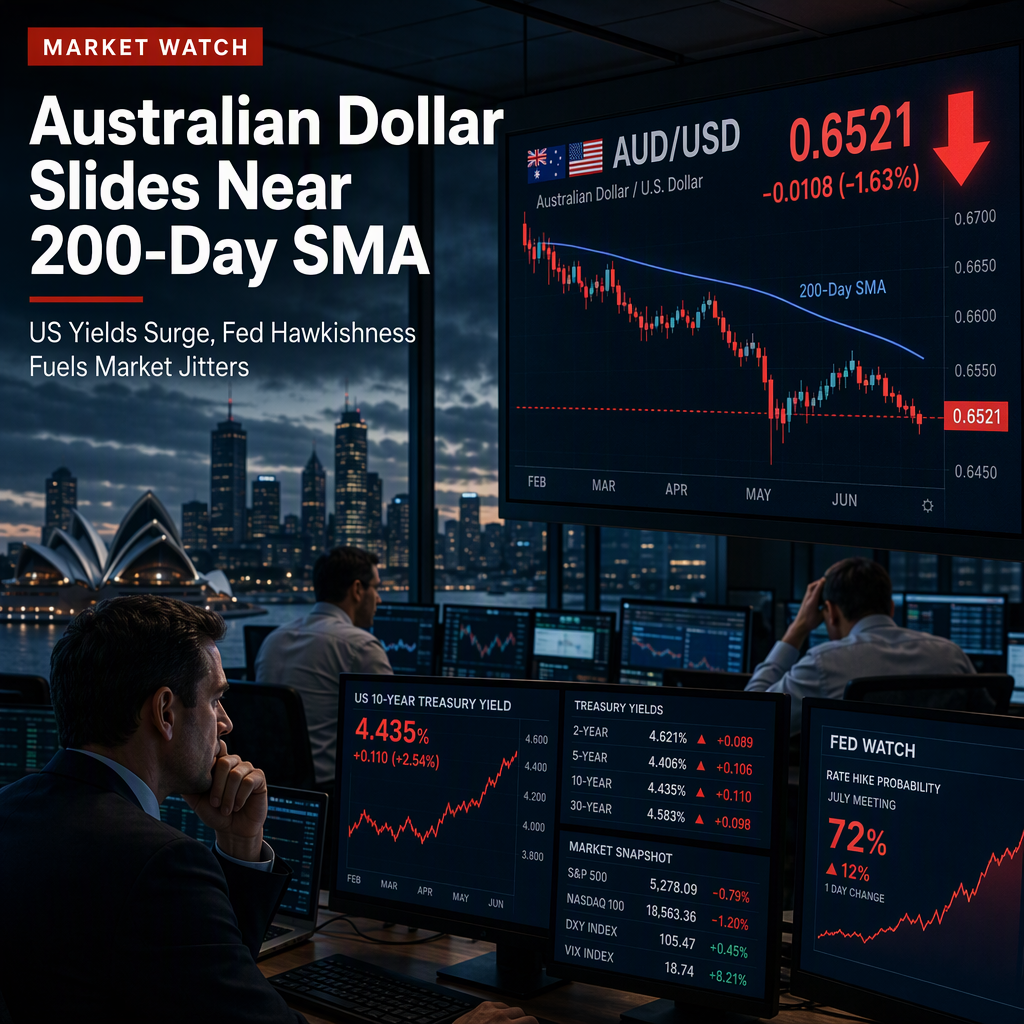
The Australian Dollar (AUD) declined for the third consecutive day, falling 0.37% against the US Dollar (USD) and trading at 0.7012, close to the 200-day Simple Moving Average (SMA) of 0.7021 [1]. This move comes amid a surge in US Treasury yields, with the 10-year yield finishing at 5.208%, up nearly 10 basis points, as investors increased their expectations for further Federal Reserve tightening. Money markets have priced in a 68% probability of a rate hike in October and a 94% chance of another increase in December [1].
The US Dollar extended its gains for the fourth straight day, supported by rising oil prices—West Texas Intermediate crude climbed nearly 1.90% to $93.21—and persistent inflation pressures. US equity markets ended the session lower as market sentiment deteriorated, partly due to the lack of progress in US-Iran negotiations [1].
Recent US economic data showed New Home Sales in August rebounding by 6.4% month-over-month after a previous decline of -4.3%. Initial Jobless Claims for the week ending September 19 came in at 197,000, below both the prior week's 198,000 and forecasts of 201,000 [1]. Fed officials, including New York Fed's John Williams and Philadelphia Fed's Anna Paulson, signaled the possibility of additional rate hikes this year, with Cleveland Fed's Beth Hammack warning of rising inflation pressures [1].
In Australia, traders are focused on the upcoming Reserve Bank of Australia (RBA) monetary policy decision scheduled for September 29, with Prime Terminal data indicating a 93% probability of a 25-basis-point rate hike to 4.60%. Australia's inflation data is also expected on September 30 [1]. Technically, AUD/USD remains under pressure, trading below key moving averages and trend lines, with the Relative Strength Index (RSI) at 32.37, just above oversold territory, indicating continued selling pressure [1].
CONCLUSION
The Australian Dollar's decline reflects heightened expectations for US rate hikes and rising US yields, which have strengthened the US Dollar. With the RBA decision and Australian inflation data approaching, market participants remain cautious, and technical indicators suggest further downside risk for AUD/USD in the near term.