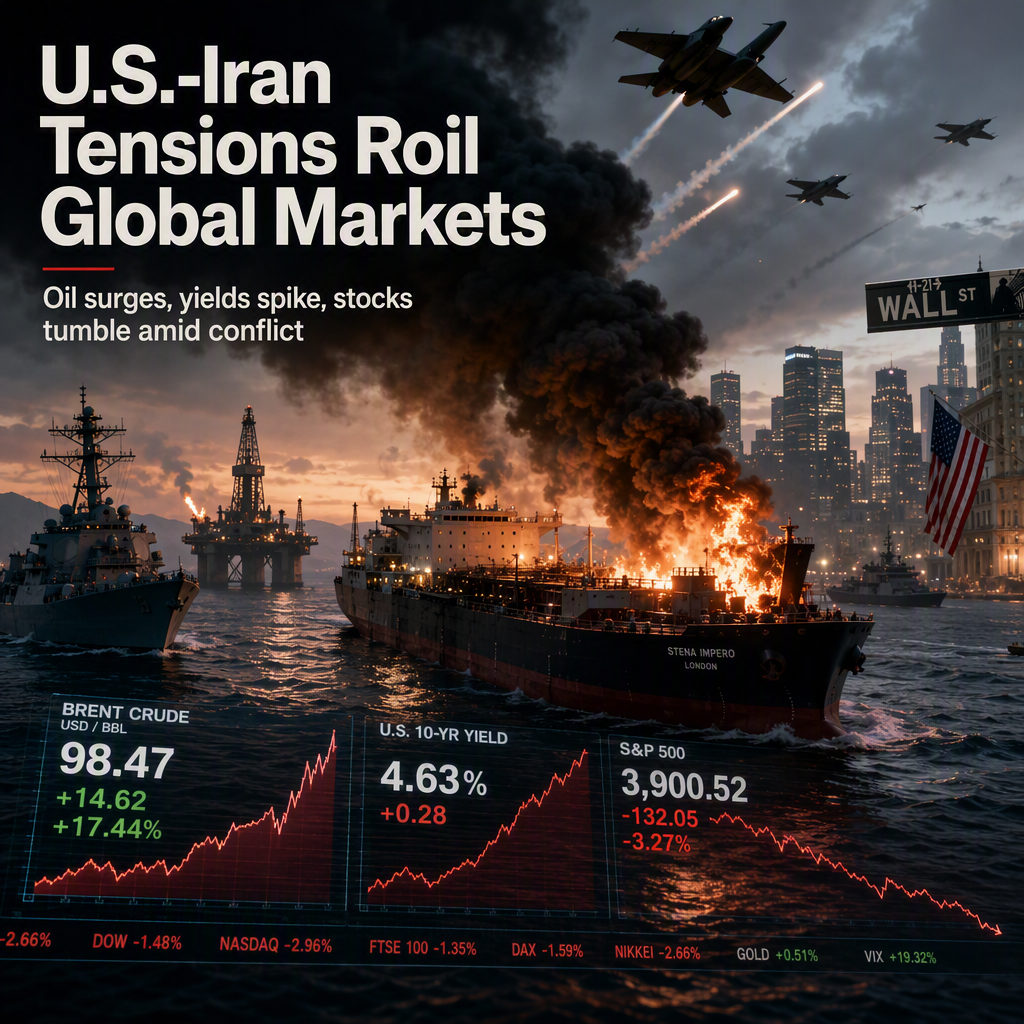
A renewed escalation between the U.S. and Iran this week has sent shockwaves through global financial markets, impacting oil, bonds, equities, and commodities. The conflict reignited after the expiration of a ceasefire signed in June, with U.S. forces striking two IRGC rocket launcher positions on Larak Island in the Strait of Hormuz on Sunday. U.S. officials stated that Iranian forces were attempting to lay new sea mines in recently cleared waters. Iran retaliated by firing missiles at two U.S. airbases in Jordan, though most were reportedly intercepted. The situation intensified when two supertankers, the Sidran and Senegal Prosperity, each carrying about 2 million barrels of Saudi crude, were struck by unknown projectiles near Oman while exiting the Strait on Monday. The conflict escalated further on Tuesday as U.S. CENTCOM confirmed a second round of strikes targeting Iranian air defense systems, radar installations, maritime assets, and communications infrastructure, with Iran responding with additional missile and drone attacks on U.S. bases in Jordan and Bahrain [1].
The market reaction was swift and significant. WTI crude oil prices surged above $90 per barrel, reflecting concerns over supply disruptions in the critical Strait of Hormuz. Treasury yields also spiked, with the 10-year yield climbing to 4.796% on Tuesday, its highest level since January 2025, as traders anticipated that higher energy costs would keep inflation elevated and potentially force the Federal Reserve to maintain or even raise interest rates. The CME FedWatch Tool showed that the odds of a September Fed rate hike briefly reached about 68%. Fed Governor Michael Barr reinforced this outlook, stating that the Fed could raise rates if inflation does not cool sufficiently [1].
Equity markets responded negatively to the rising yields and heightened geopolitical risk. The Nasdaq fell 1.03% on Tuesday, while the Russell 2000 dropped 1.23%. Gold, typically a safe-haven asset, was also impacted by the rate repricing, falling roughly 3% on Tuesday and bringing its two-session decline to about 6% following a speech by Warsh on Friday [1].
Former President Trump commented on the situation, warning that if Iran responds further, "they’ll be hit much harder," and that a third round of escalation could result in Iran being "totally wiped out as a country" [1].
CONCLUSION
The renewed U.S.-Iran conflict has triggered a sharp rise in oil prices, Treasury yields, and market volatility, with equities and gold both experiencing significant declines. The market is now pricing in a higher likelihood of sustained or increased U.S. interest rates, reflecting concerns that the conflict-driven oil shock will keep inflation elevated.