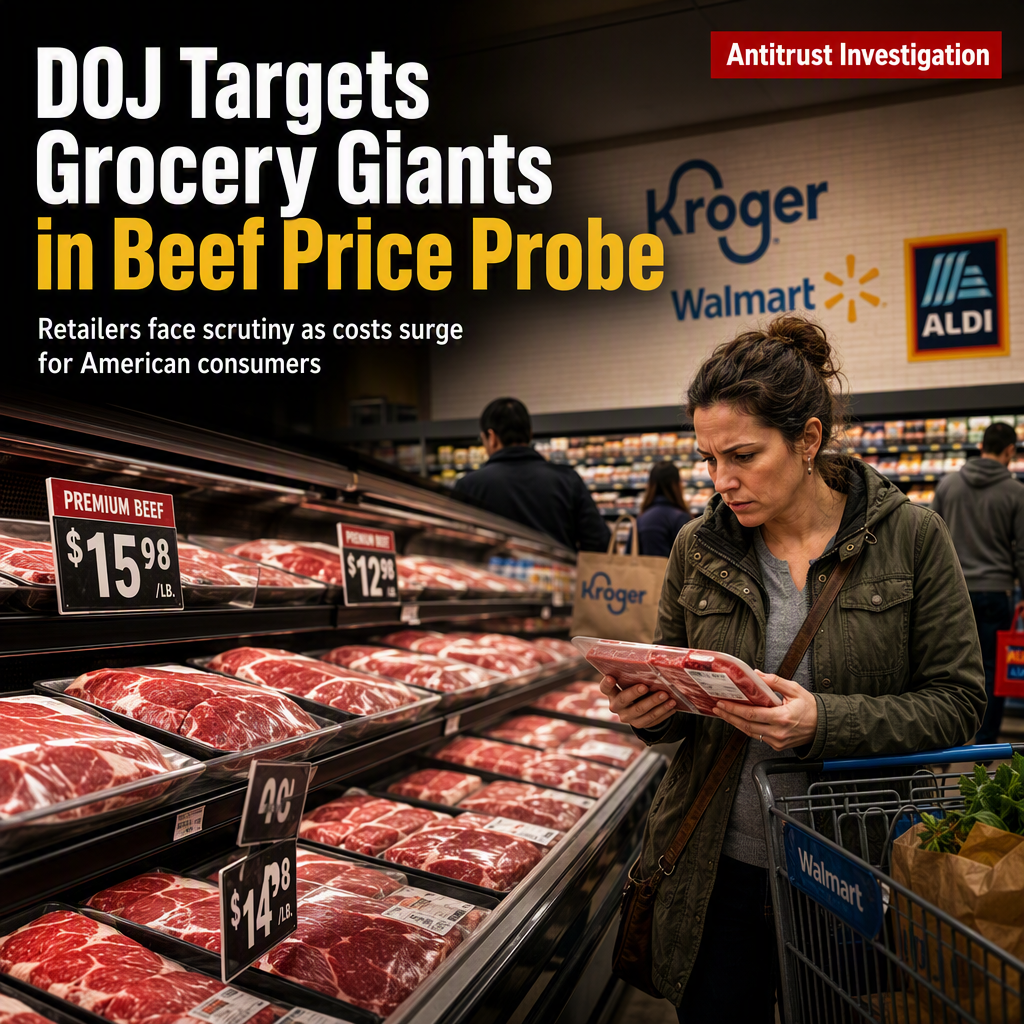
The Department of Justice (DOJ) Antitrust Division announced on Tuesday that it has expanded its investigation into beef affordability to include eight of the largest grocery retailers in the United States, following its initial probe into the 'Big Four' meatpackers—JBS, Cargill, Tyson Foods, and National Beef—which collectively control more than 85% of the U.S. beef processing market [1]. The retailers now under scrutiny are Kroger, Publix, Walmart, Albertsons, Aldi, Ahold Delhaize, Costco, and Amazon [1].
This expansion marks a significant escalation in the federal government's efforts to address rising beef prices, shifting focus from meatpackers to the retail level of the food supply chain [1]. Associate Attorney General Stanley E. Woodward Jr. sent letters to the eight companies regarding 'recent increases in the retail price for beef,' emphasizing that beef prices are a critical concern for Americans and a priority for the Justice Department [1].
The DOJ stated that, since launching its antitrust investigation in May, it has been reviewing more than 3 million documents and interviewing industry participants to determine whether concentration in the meatpacking industry has contributed to high beef prices [1]. Attorney General Todd Blanche highlighted the department's whistleblower rewards program, noting that individuals who provide information leading to successful enforcement actions could receive 15% to 30% of any criminal penalty exceeding $1 million [1].
Agriculture Secretary Brooke Rollins linked the probe to broader concerns about food security and declining domestic cattle supplies, reporting that the U.S. had about 86.2 million head of cattle and calves as of January 1, the lowest since the 1950s [1]. Last week, President Donald Trump announced plans to authorize legal measures allowing farmers and ranchers to process their own food, aiming to break what he described as a 'nasty monopoly' in the meat industry and provide ranchers with alternatives to the dominant meatpacking companies [1].
CONCLUSION
The DOJ's expanded investigation into major grocery retailers signals heightened regulatory scrutiny of the entire beef supply chain amid rising prices and concerns over market concentration. This development could have significant implications for both meatpackers and retailers, as well as for consumers facing higher beef costs. The market is likely to remain attentive to further actions and findings from the DOJ's ongoing probe.