
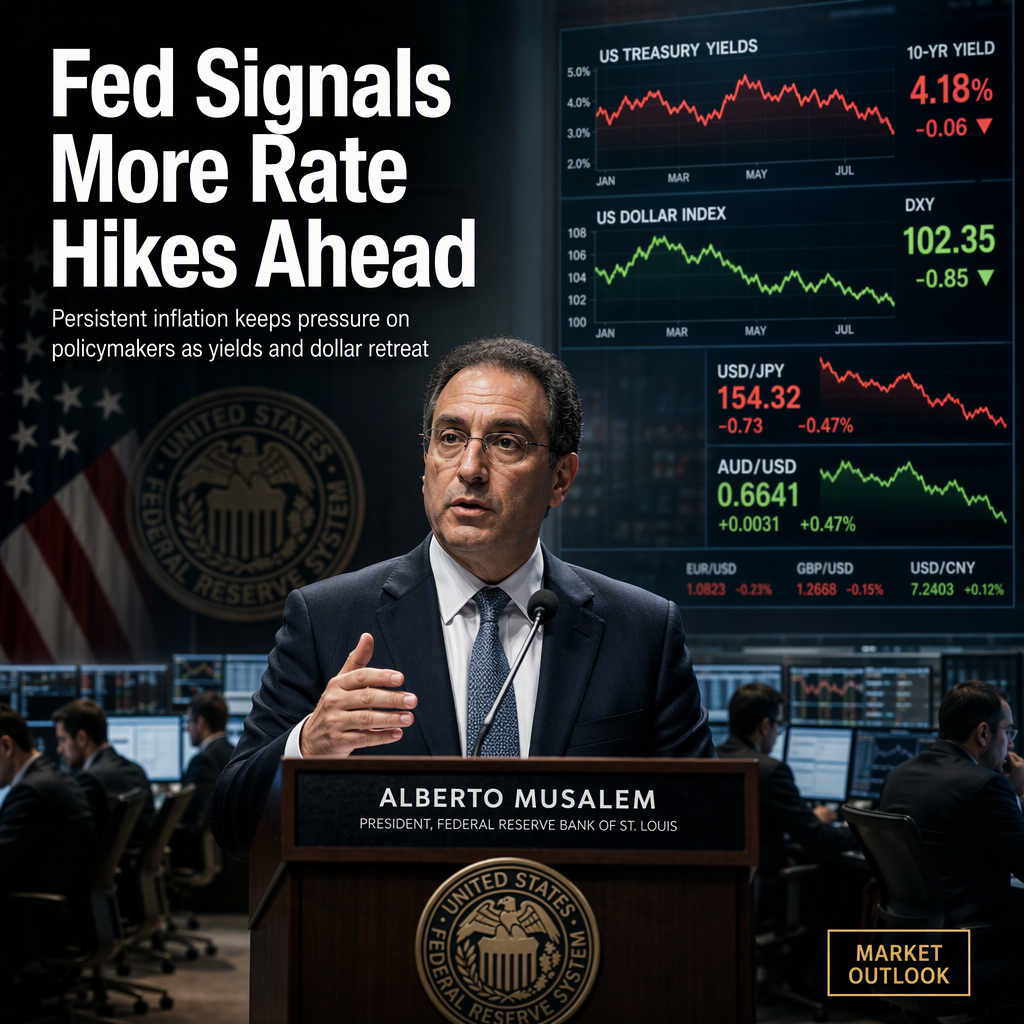
On Thursday, St. Louis Federal Reserve President Alberto Musalem stated that inflation remains elevated and emphasized the need for 'more monetary policy firming' to bring inflation back to the Fed's 2% target. Musalem highlighted that persistent demand pressures and supply shocks are driving inflation, and he expects rates to rise in the next 6 to 9 months. He noted that the economy is currently strong, allowing the Fed to focus on lowering the cost of living, and that most contacts in his district are more concerned about inflation than jobs. Musalem also mentioned that nominal yields are rising due to increased real yields, which are in part driven by policy-rate expectations, and that strong demand for capital is likely to keep rates higher for the next 5–10 years. He acknowledged fiscal sustainability concerns and stressed the importance of keeping monetary policy independent from government debt management [1].
Meanwhile, the US Dollar and Treasury yields retreated on Thursday, providing relief to the Japanese Yen. The USD/JPY pair traded around 157.71, down 0.24% on the day, as the benchmark 10-year US Treasury yield eased toward 5.23% after reaching 5.36% on Wednesday, its highest level since 2002. This pullback followed comments from former US President Donald Trump, who ruled out strikes on Iran before the midterms, easing geopolitical tensions and trimming oil price gains. The US Dollar Index (DXY) traded around 102.09 after reaching 102.53 earlier in the week, its highest since April 2025 [2].
Despite the retreat in yields and the US Dollar, the outlook for further declines appears limited. Elevated oil prices continue to fuel inflation concerns, reinforcing expectations for additional Fed rate hikes. Fed Governor Christopher Waller echoed Musalem's stance, stating that more rate hikes are needed but that he remains flexible about the pace. Waller cited persistent inflationary forces, including AI investment and ongoing energy shocks. Minutes from the Fed’s September meeting indicated that most participants considered another rate increase likely appropriate by year-end, with future decisions dependent on incoming data [2].
On the Japanese side, the Yen remains under pressure due to the wide interest rate gap with the US and Japan's high debt-to-GDP ratio. Elevated oil prices further strain the energy-dependent Japanese economy. Bank of Japan Governor Kazuo Ueda reiterated the BoJ's gradual tightening approach, stating that the pace and timing of future policy adjustments will depend on economic and inflation projections [2].
Currency market data showed the US Dollar was strongest against the Australian Dollar, gaining 0.13%, and weakest against the Japanese Yen and Swiss Franc, both down 0.24% on the day [1][2].
CONCLUSION
Federal Reserve officials signaled a continued hawkish stance, citing persistent inflation and the likelihood of further rate hikes. While easing geopolitical tensions led to a temporary pullback in US yields and the Dollar, ongoing inflationary pressures and strong demand for capital suggest that higher rates may persist. The market remains focused on inflation data and central bank policy signals for future direction.