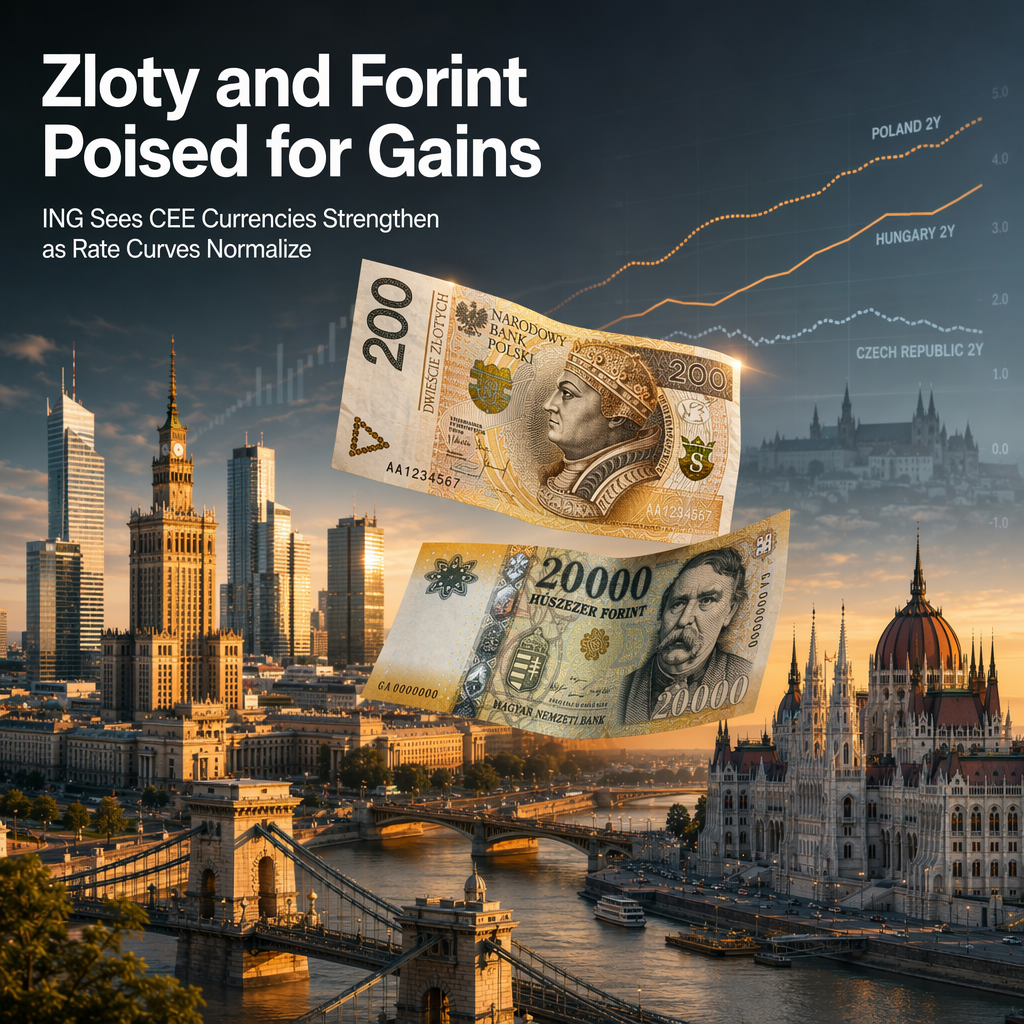
According to ING’s Frantisek Taborsky, Central and Eastern European (CEE) rate curves have repriced sharply, with markets now expecting approximately 60 basis points of tightening in the Czech Republic and 40 basis points in Poland, alongside 50 basis points of easing in Hungary over an 18-month horizon [1]. In the past two sessions, rate curves across the region have shifted by roughly 15-30 basis points [1]. Despite a sharp recovery in rates, this movement has not fully translated into foreign exchange (FX) markets, with rates and FX diverging significantly over the past two weeks [1].
Taborsky notes that there is still material mispricing compared to ING’s forecasts, but market pricing is moving back into a plausible scenario range [1]. He expects the normalization process to continue this week unless geopolitical risks, such as a re-escalation of the US-Iran conflict and rising oil prices, disrupt the trend [1]. ING continues to expect gains in the Polish Zloty (PLN) and Hungarian Forint (HUF), targeting EUR/PLN below 4.300 and EUR/HUF below 358, despite narrower rate differentials [1]. In contrast, the Czech Koruna (CZK) is expected to weaken, with EUR/CZK seen moving above 24.200, as it has closely tracked rates and may be further pressured by anticipated dovish comments from the Czech National Bank this week [1].
The market implications suggest that while the rates rally and reduced rate-hike premium are not supportive for FX in general, the lag in FX versus rates leaves room for selected CEE currencies to strengthen, particularly the PLN and HUF [1].
CONCLUSION
ING analysts see continued potential for gains in the Polish Zloty and Hungarian Forint as CEE rate curves normalize, despite recent divergence between rates and FX. The Czech Koruna, however, is expected to underperform due to anticipated dovish central bank commentary and its close tracking of rates.