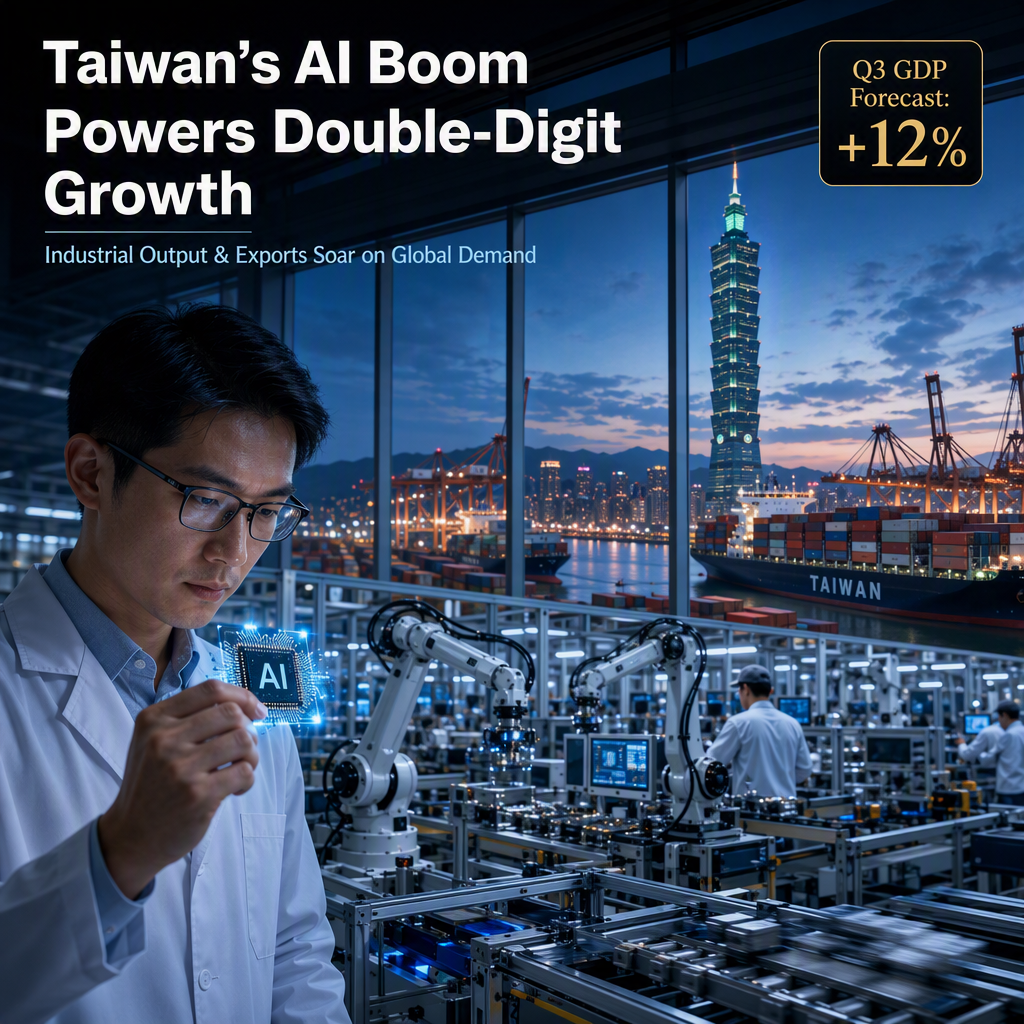
According to Commerzbank analysts Dr. Henry Hao and Charlie Lay, Taiwan's industrial production and exports are experiencing significant growth, primarily driven by robust demand for artificial intelligence (AI) and high-performance computing technologies [1]. In July, industrial production increased by 25.6% year-on-year, surpassing the Bloomberg consensus of 20.7% and improving from 22.6% in June [1]. Manufacturing output also saw a notable rise of 26.9% year-on-year, compared to 24% previously [1].
The technology sector led this surge, with output of computers, electronics, and optical products soaring by 95.6% year-on-year, while electronic components grew by 22.7% [1]. Other sectors such as machinery and basic metals also posted gains of 19.8% and 13.2% respectively, although chemicals and autos remained weak [1]. The Ministry of Economic Affairs projects manufacturing growth to remain robust at 25.5-28.9% year-on-year in August, supported by ongoing AI and high-performance computing demand as well as the traditional electronics peak season [1].
July exports climbed 32.9% year-on-year, and export orders surged 61.9% year-on-year, indicating continued strong external demand at the start of Q3 [1]. These figures, combined with the latest production data, suggest that Q3 GDP growth could remain in the 12.0-12.5% year-on-year range, following a 12.9% expansion in Q2 [1]. The economy expanded by 14.2% in the first half of 2026 [1]. In response to these trends, the government has sharply raised its 2026 growth forecast to 11.05%, reflecting the ongoing boom in AI-related exports and investment [1].
Despite this exceptional growth, inflation remains near 2.1%, which has allowed the Central Bank of the Republic of China (CBC) to maintain its policy rate at 2% [1].
CONCLUSION
Taiwan's economy is experiencing exceptional growth, fueled by surging AI and high-performance computing demand, with double-digit gains in industrial production, exports, and GDP [1]. The government has responded by raising its growth forecast for 2026, while stable inflation allows for steady monetary policy [1]. Market sentiment remains highly positive as Taiwan continues to benefit from the global AI boom.