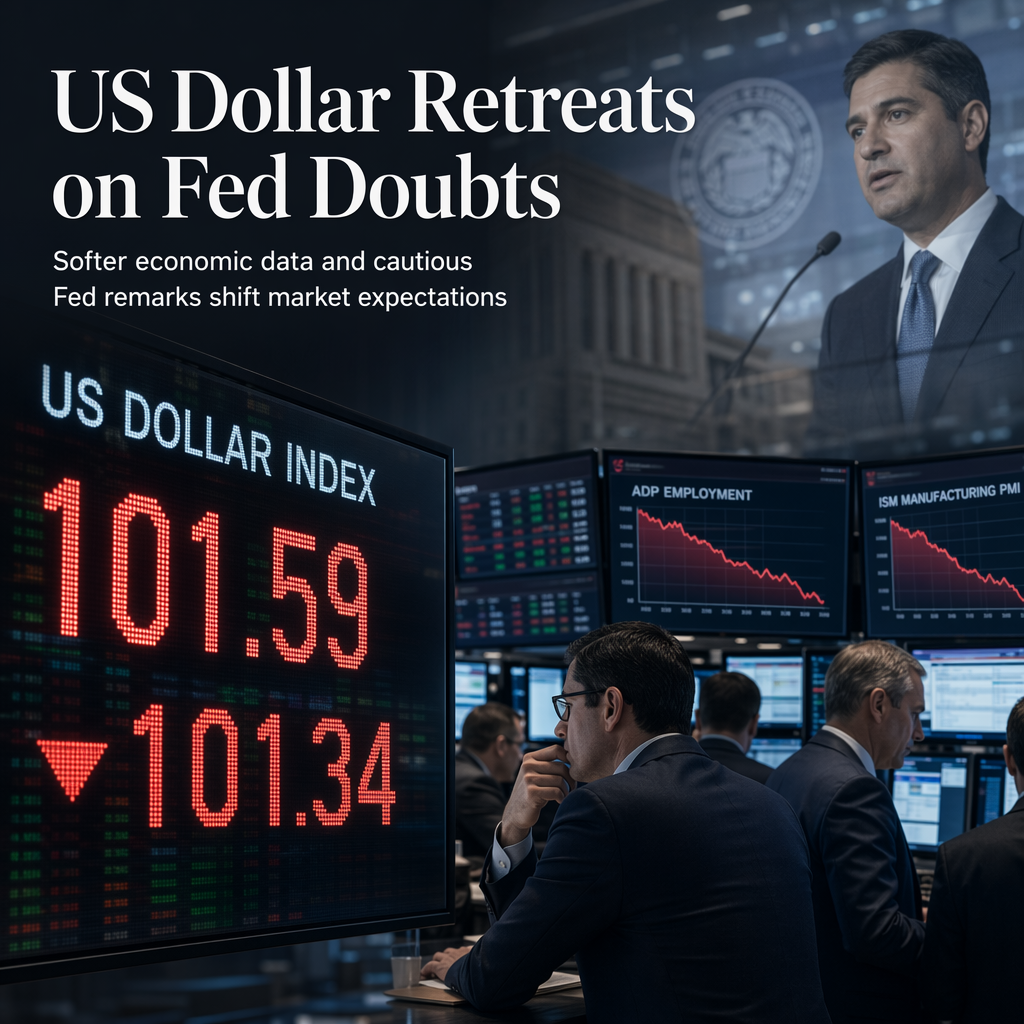
On Wednesday, the US Dollar experienced mixed movements against major currencies following the release of softer-than-expected US economic data and remarks from Federal Reserve Chair Kevin Warsh at the ECB Forum in Sintra. The EUR/USD pair recovered from an intraday low of 1.1361 to trade around 1.1387, though it remained down approximately 0.30% on the day [1]. The US Dollar Index (DXY) retreated from an intraday high of 101.59 to trade near 101.34, reflecting modest selling pressure on the Greenback [1].
The ADP Employment Change report revealed that US private payrolls increased by 98,000 in June, falling short of market expectations of 113,000 and down from 122,000 in May [1][2]. Additionally, the ISM Manufacturing PMI eased to 53.3 in June from 54.0 in May, also missing forecasts [1]. These weaker data points contributed to a cautious market environment and weighed on the US Dollar [1][2].
Federal Reserve Chair Kevin Warsh stated, "We're not going to give forward guidance," and emphasized that "inflation risks have come down" while reaffirming the Fed's commitment to restoring price stability [1]. Despite the softer data, markets are currently pricing in a 67% probability of a rate hike at the Fed's September meeting, according to the CME FedWatch Tool [1]. However, Source 2 reports a roughly 50% chance of a rate hike at the September meeting, indicating some discrepancy in market expectations [2].
Market participants are now focused on Thursday's US Nonfarm Payrolls (NFP) report, which is expected to provide further insight into the labor market and influence the Fed's policy outlook [1][2]. Economists anticipate that 110,000 jobs will be added in June, with the unemployment rate remaining unchanged at 4.3% [2].
In the broader currency market, the New Zealand Dollar declined against the US Dollar, with NZD/USD trading lower at 0.5660, down 0.32% on the day [2]. The Kiwi was pressured by a cautious market environment, weaker Chinese manufacturing data, and a shift in expectations for Reserve Bank of New Zealand policy tightening [2].
CONCLUSION
Softer US economic data and nuanced remarks from Fed Chair Warsh have led to a modest pullback in the US Dollar, with market participants reassessing the likelihood of a September rate hike. Attention now turns to the upcoming US Nonfarm Payrolls report, which is expected to play a pivotal role in shaping future monetary policy expectations.