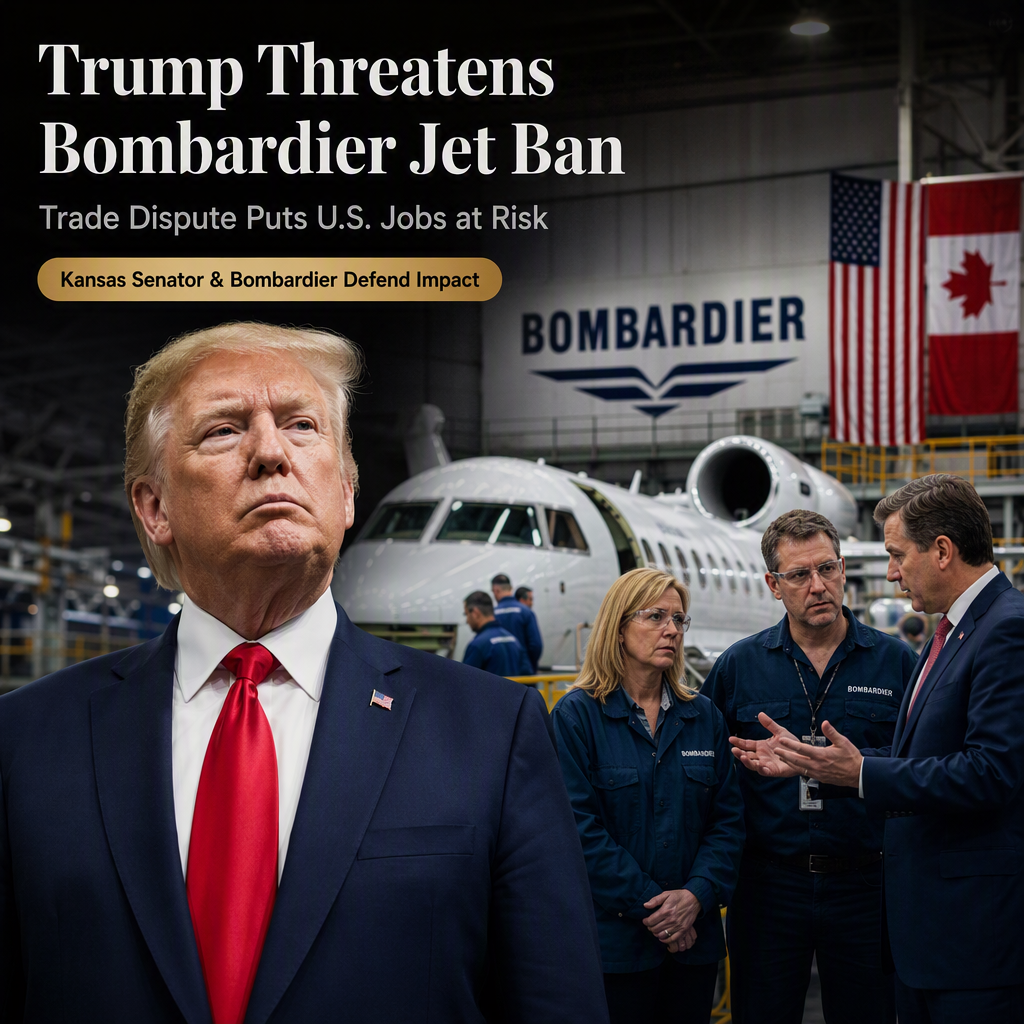
President Donald Trump threatened to block the sale of Bombardier jets in the United States, citing concerns over Canadian trade practices and the quality of Bombardier's products. In a Truth Social post on Monday, Trump declared, "NO MORE SELLING BOMBARDIER IN THE UNITED STATES!" and criticized the company for relying heavily on the U.S. market, stating that over 50% of Bombardier's revenue comes from the United States. He accused Canada of blocking American banks and companies while benefiting from the U.S. market, and demanded that Bombardier build more in the U.S. and stop treating America like a 'piggybank' [1].
Sen. Jerry Moran, R-Kan., responded by emphasizing Bombardier's positive economic impact in Kansas, noting that the company's presence in Wichita supports a local workforce of more than a thousand employees. Moran stated that he had reached out to the Trump administration to highlight Bombardier's contributions to Kansas and the importance of its operations to the local workforce and supply chain. He pledged to continue supporting Bombardier's manufacturing operations in Kansas and to encourage further growth and job creation in the state [1].
Bombardier issued a statement underscoring its extensive U.S. footprint, reporting that its American workers are based in more than 20 states, including Kansas, Texas, Arizona, Florida, Connecticut, Illinois, Delaware, California, Washington D.C., and New Jersey. The company claimed that its aircraft create tens of thousands of U.S. jobs through its direct employment and a supply chain involving approximately 2,800 American companies across 47 states. Bombardier also stated that it spends over $2.5 billion annually with U.S. suppliers and that key components, such as the wings for its business jets and flight control systems, are manufactured in Texas and California, respectively. The company further announced plans to expand its defense activities and service network in the U.S. [1].
The dispute highlights tensions in U.S.-Canada trade relations and raises concerns about potential impacts on Bombardier's U.S. operations, supply chain, and workforce. No specific market reactions or analyst opinions were provided in the article [1].
CONCLUSION
President Trump's threat to block Bombardier jets in the U.S. has prompted strong responses from both a Kansas senator and Bombardier, who emphasized the company's significant economic contributions and U.S. job creation. The situation introduces uncertainty for Bombardier's U.S. operations and supply chain, with potential high market impact if the threat is acted upon.