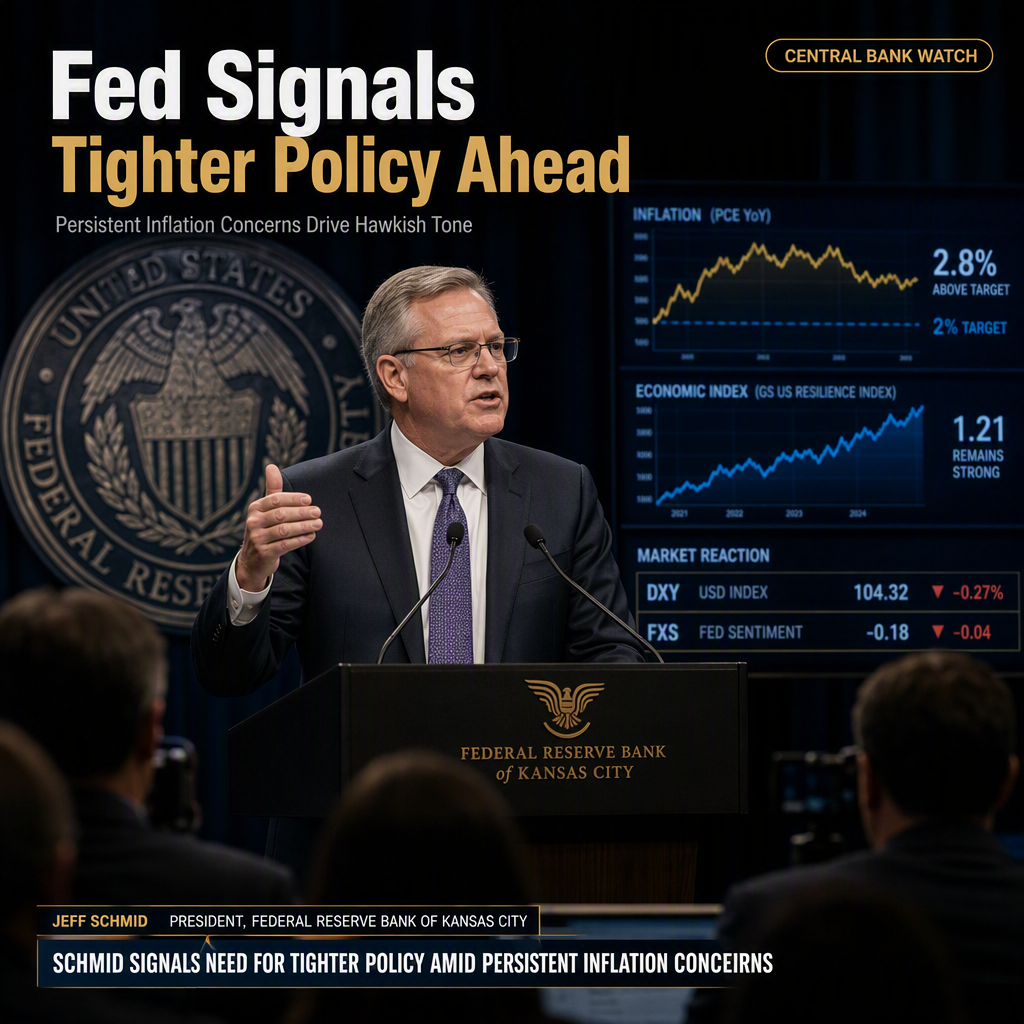
Federal Reserve Bank of Kansas City President Jeff Schmid stated on Wednesday that tighter monetary policy is necessary to bring inflation back to the central bank’s 2% target, emphasizing that current Fed policy is not sufficiently restrictive to address ongoing inflationary pressures [1]. Schmid described inflation as 'too high' and 'worrisome,' and highlighted that recent disinflation trends are too tentative to confirm a sustained easing, cautioning that the central bank should not overlook inflation risks, even if they are driven by supply shocks or factors such as increased AI investment [1].
Schmid noted that the US economy remains resilient, with overall growth performing well and the labor market appearing roughly balanced [1]. He identified the PCE price gauge as the best method for assessing inflation and welcomed recent inflation figures, but reiterated that it is too soon to confirm a trend of easing price pressures [1]. Schmid also warned that the recent easing of energy costs could be temporary, further supporting his call for a firmer policy stance [1].
Market reaction to Schmid’s comments was relatively muted, with the US Dollar Index (DXY) trading 0.02% lower near 99.85 at the time of reporting [1]. The FXS Fed Sentiment Index slipped by 0.96 points to 145.80, indicating a modest pullback in perceived hawkishness compared to the prior reading, though the index remains well above the 100 neutral line, reflecting an overall hawkish policy tone [1]. Schmid’s speech received a 7.3/10 FXS Speechtracker score, slightly above the historical average, reinforcing the message that current policy is not tight enough and that further tightening may be warranted [1].
Schmid’s remarks underscore a firm anti-inflation bias, with a particular focus on the inflationary risks posed by AI-driven investment and the need for vigilance even as some inflation indicators show improvement [1].
CONCLUSION
Fed President Schmid’s comments reinforce expectations for a continued hawkish stance from the central bank, citing persistent inflation and the need for tighter policy. While market reaction was limited, the overall tone remains supportive of a stronger US Dollar and signals that further tightening may be considered if inflation does not ease convincingly.