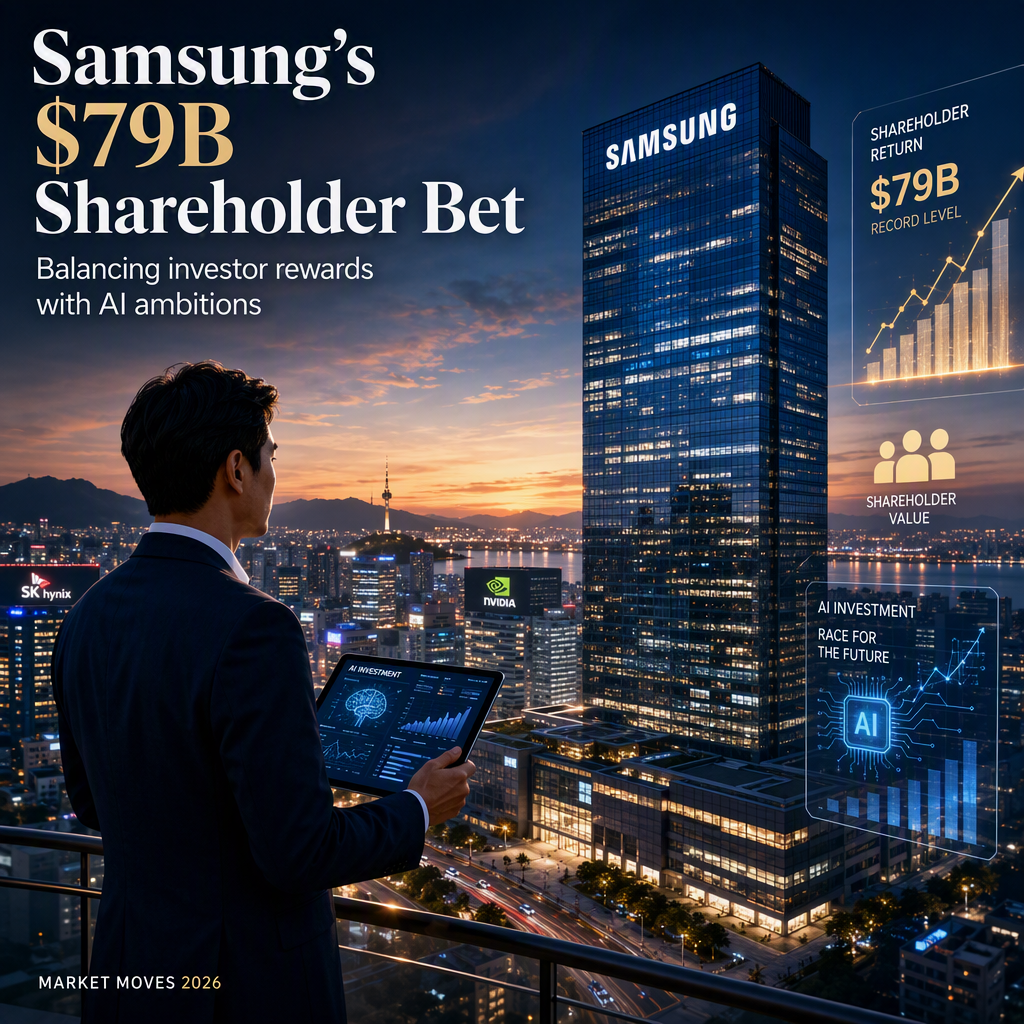
Samsung Electronics has unveiled a record shareholder return program of up to 110 trillion won ($79 billion), reflecting the company's efforts to balance investor rewards with the need for substantial investment in artificial intelligence technology [1]. This announcement follows a period in which Samsung's stock price declined due to concerns about a glut in memory supply, despite the semiconductor division achieving a record operating profit in the second quarter of 2026 [1].
The significant payout is seen as a strategic move to reassure investors amid ongoing market volatility and competitive pressures in the AI sector [1]. The article highlights that Samsung faces a 'tightrope' situation, needing to satisfy shareholders while also allocating resources to maintain its competitive edge in AI [1]. This trend is mirrored by industry peers such as SK Hynix, which has also announced a major buyback plan worth $28.6 billion to support its stock price [1].
Market participants are closely monitoring Samsung's capital allocation strategies, particularly as the company navigates the dual challenges of memory supply concerns and the intensifying demand for AI-related investments [1]. While the record operating profit signals financial strength, the ongoing memory supply glut continues to weigh on market sentiment [1].
No specific price levels or technical indicators are provided, but the focus remains on the implications of the shareholder return program and the company's ability to manage its strategic priorities in a rapidly evolving industry landscape [1].
CONCLUSION
Samsung's record $79 billion shareholder return highlights the company's efforts to address investor concerns amid memory supply challenges and the need for increased AI investment. The market is watching closely to see how Samsung balances these competing demands, with the substantial payout signaling both confidence in its financial position and recognition of ongoing industry pressures.