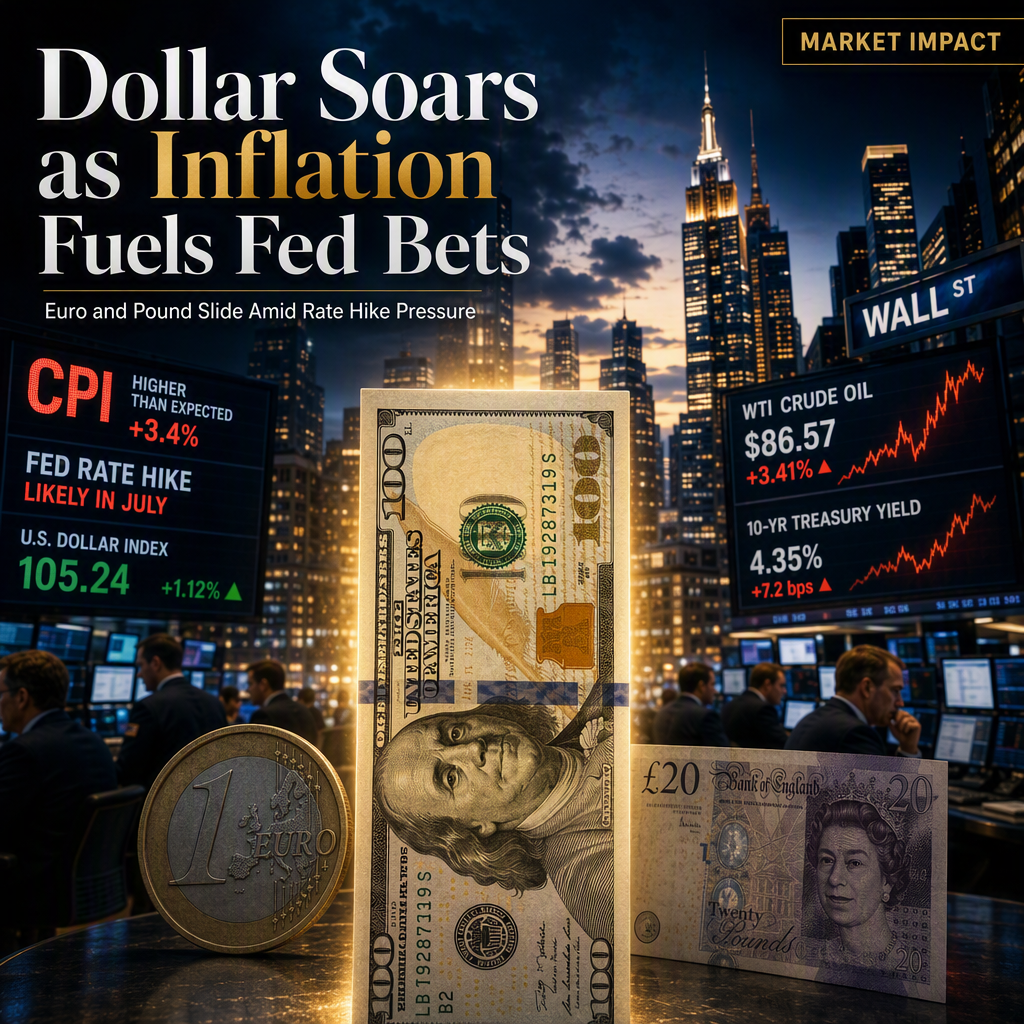
On Tuesday, September 15, the US Dollar (USD) strengthened to a near two-week high around 99.60, driven by hotter-than-expected US Consumer Price Index (CPI) data for August and surging oil prices, which pushed Treasury yields to fresh peaks not seen since 2007 [1]. The Producer Price Index (PPI) also showed strong readings, reinforcing expectations that the Federal Reserve (Fed) will raise rates by 25 basis points at its September meeting, with traders pricing in a more than 92% chance of a hike according to the CME FedWatch tool [1]. Fed funds futures are pricing in a total hike of 51 basis points by year-end, implying two rate hikes across the remaining three FOMC meetings this year, which has contributed to the US Dollar’s recovery as markets adjust to a more extended tightening profile [2].
The US Dollar outperformed major currencies, with the strongest gains against the New Zealand Dollar (+0.36%), Japanese Yen (+0.33%), and British Pound (+0.21%) [1]. The Euro (EUR) fell 0.12% to around 1.1535 against the USD, pressured by expectations of further Fed tightening and despite hawkish signals from European Central Bank (ECB) officials [3]. The ECB raised its key policy rates by 25 basis points on Thursday and warned that more hikes could follow, with traders pricing in a 94% chance of a quarter-point rate hike in December [3]. ECB President Christine Lagarde and Executive Board member Isabel Schnabel highlighted prolonged inflation risks due to the ongoing energy crisis, with Schnabel describing the recent move in energy costs as "quite concerning" [3].
The British Pound (GBP) extended losses against the USD, hovering near five-week lows at 1.3465, following mixed UK employment data [2]. The ILO Unemployment Rate remained steady at 4.9% in the three months to July, while jobless claimants increased by 27.8K, more than three times the expected 8.3K [2][4]. Average Earnings Excluding Bonuses rose 3.5% YoY, as expected, while Including Bonuses grew 3.9%, slower than the previous reading of 4.2% [4]. The GBP also dropped against the Japanese Yen, falling to near 208.60 [4]. The Bank of England (BoE) is widely expected to leave interest rates unchanged at its upcoming meeting, unless UK CPI figures due Wednesday show a much larger-than-expected jump in inflation [2][4]. Scotiabank strategists expect a hawkish hold from the BoE, with a lean toward a 25bps hike at the next meeting in early November [4].
Market participants are also watching the Bank of Japan’s (BoJ) policy outcome on Friday, with Standard Chartered forecasting a 25bps rate hike to 1.25%, but cautioning that officials will likely avoid an overly hawkish message [4]. Meanwhile, the ECB’s hawkish stance is intensifying in response to rising energy prices, with Goldman Sachs, Citi, and Barclays expecting another rate hike in December, and Citi anticipating an additional hike in March 2027 [3].
In China, retail sales rose 0.4% YoY in August, below the 0.8% expected, while industrial production climbed 5.2% YoY, above the market consensus of 4.8% [1].
CONCLUSION
The US Dollar's strength is being driven by hotter US inflation data and rising expectations for Fed rate hikes, putting pressure on the Euro and British Pound. The ECB and BoE are expected to maintain hawkish stances, but the Fed's tightening outlook is dominating currency markets. Overall, the event signals high market impact as traders adjust to shifting global monetary policy expectations.