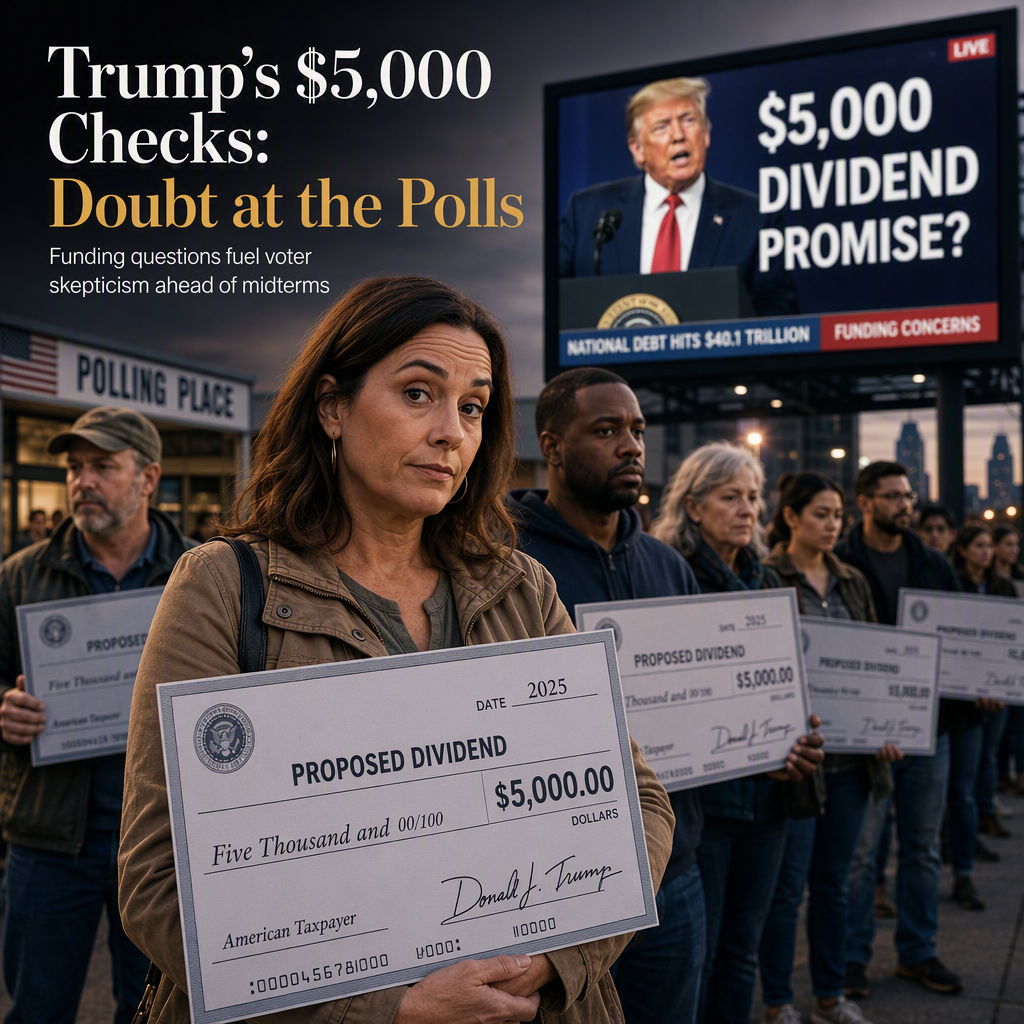
President Donald Trump has proposed sending $5,000 dividend checks to eligible Americans, contingent on Republicans maintaining their majorities in the House and Senate following the upcoming midterm elections [1]. The announcement, made during the Republican National Committee's midterm convention in Dallas last week, has sparked widespread debate regarding its feasibility and likelihood of implementation [1].
Voters interviewed expressed significant skepticism about the proposal, with many dismissing it as unrealistic due to the need for congressional approval and concerns over the nation's $40.1 trillion national debt [1]. One voter described the plan as a 'publicity stunt,' doubting its chances of passing Congress, especially in the context of the midterm elections [1]. Another voter questioned the government's ability to afford the program, suggesting that available funds should be allocated elsewhere [1].
The estimated cost of the proposal is approximately $1.2 trillion, a figure that far exceeds the record customs duties collected under Trump's tariff agenda, which he suggested would be the funding source [1]. This discrepancy has fueled further doubts about the plan's viability [1]. Some voters referenced previous unfulfilled promises, such as earlier stimulus proposals, as reasons for their skepticism [1].
Despite the prevailing doubts, a minority of voters expressed support for the idea, arguing that taxpayer dollars should benefit hardworking American citizens and noting that the proposal appears to be limited to American adults who work [1]. The proposal has become a central talking point in the Republican campaign, with Trump emphasizing that the payments are tied to the GOP retaining control of Congress [1].
CONCLUSION
President Trump's $5,000 dividend check proposal has generated significant skepticism among voters, primarily due to concerns about funding and the feasibility of congressional approval. While a few supporters welcome the idea, the majority view it as unlikely to materialize, especially given the nation's high debt and past unfulfilled promises. The proposal remains a key campaign issue as the midterm elections approach.