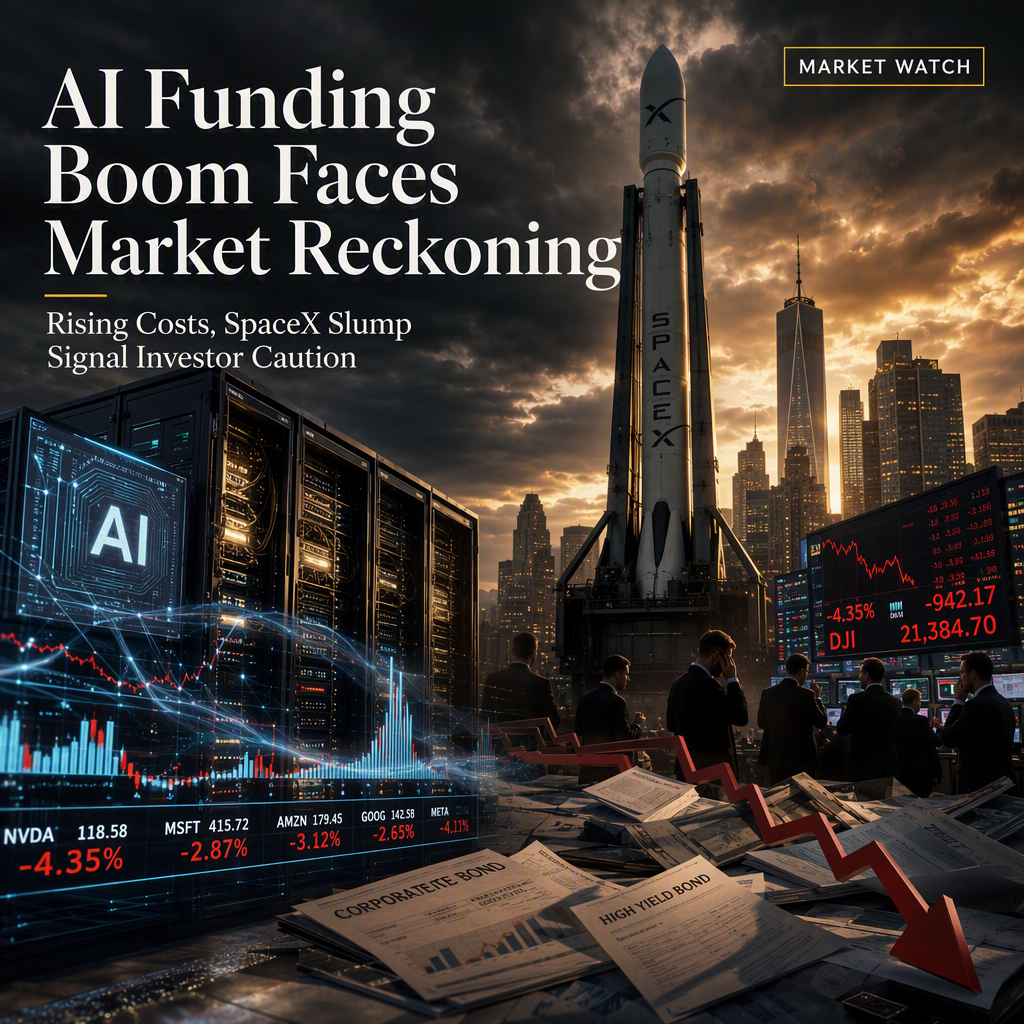
The ongoing race among major U.S. tech companies to secure billions of dollars for artificial intelligence (AI) development is showing signs of strain, as investor confidence wanes and borrowing costs rise [1]. SpaceX, which saw its market capitalization soar to $3 trillion following its initial public offering, has experienced a subsequent decline in share prices, highlighting growing risk awareness among investors [1].
Recent bond sales by tech giants have pushed global corporate bond sales to $3.7 trillion in the first half of the year, much of which is attributed to the AI funding race [1]. However, the pace of investment is slowing as debt burdens increase and post-IPO share price declines, such as those seen with SpaceX, raise concerns about the sustainability of these funding sprees [1].
Market analysts note that the AI rally has generated significant cash flows, with memory makers reporting $90 billion in cash flow from the AI boom [1]. Despite this, rising leverage problems are emerging for both Asian and U.S. companies, and trading sentiment is becoming more cautious. Investors are increasingly scrutinizing the risks associated with large-scale financing and questioning the sustainability of current valuations in the AI sector [1].
There is heightened concern over opaque funding structures and hidden debts, estimated at $1.65 trillion among five major U.S. tech giants, which could pose significant risks if market conditions deteriorate [1]. The combination of soaring investments, higher interest rates, and volatile share prices is prompting a reassessment of risk and reward in the ongoing AI funding spree [1].
CONCLUSION
The AI funding boom is encountering headwinds as higher borrowing costs and increased investor caution impact capital flows. SpaceX's post-IPO share slump and rising debt burdens signal a shift in sentiment, with analysts warning of potential risks from opaque funding structures. The market is now reassessing the sustainability of AI-driven investments amid volatile conditions.