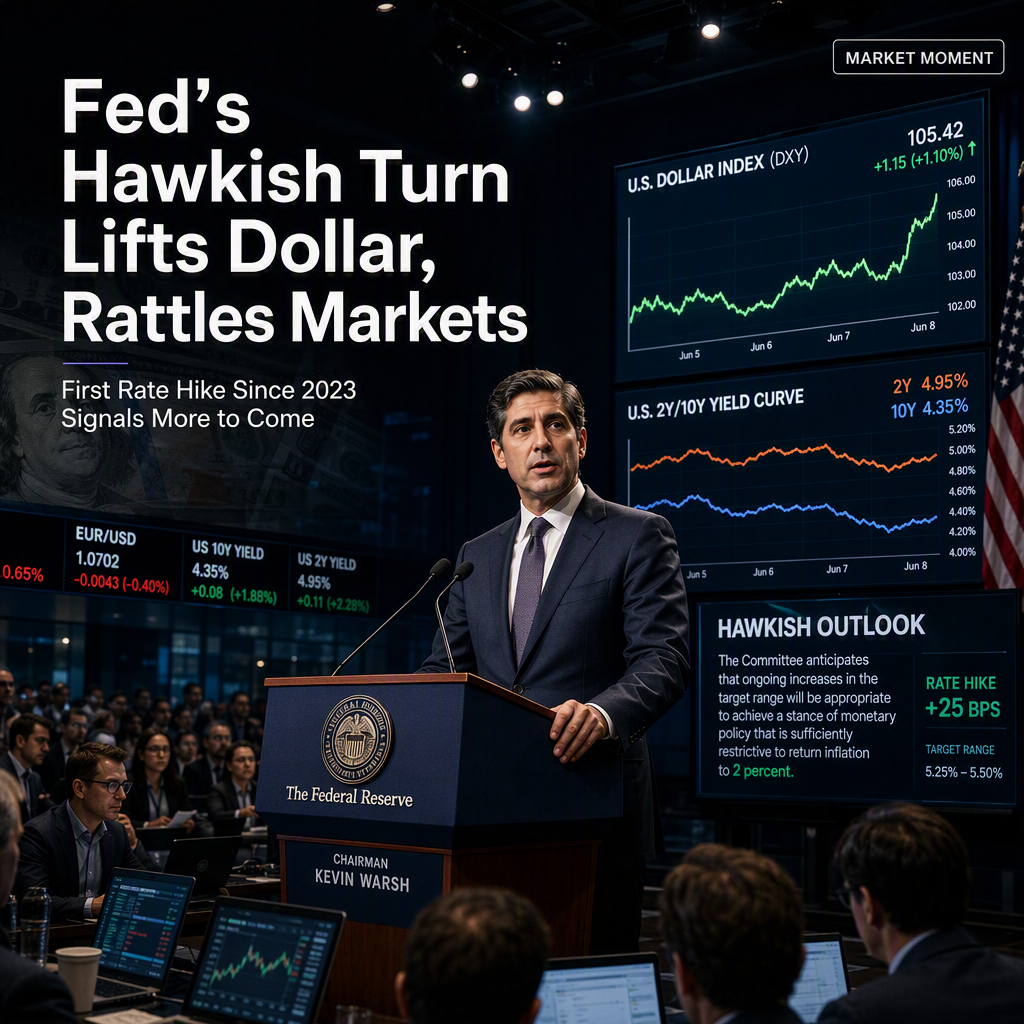
The U.S. Federal Reserve raised its benchmark interest rate by 25 basis points to a target range of 3.75%-4.00% at its September meeting, marking its first rate hike since July 2023 and the first in three years, with unanimous support from the Federal Open Market Committee [1][3][4][6][8]. Fed Chairman Kevin Warsh emphasized during the press conference that inflation has been 'too high ... for too long,' and the updated dot plot showed that 16 of 18 participants foresee at least one more hike before year-end, with four seeing the possibility of two additional hikes [1][3][6][8]. The Fed's risk assessment was notably hawkish, with no participants seeing risks tilted toward weaker GDP growth or labor markets, allowing the committee to focus more clearly on upside inflation risks [1]. Growth projections were revised slightly higher for both this year and next, while inflation expectations remained broadly unchanged [1].
The U.S. Dollar Index (DXY) surged to its highest level since late July following the Fed's decision, supported by rising short-term Treasury yields and strong August retail sales data, which reinforced perceptions of resilient U.S. growth and accommodative monetary policy [1][2][3][6]. However, some profit-taking and a modest pullback in yields led to a slight retreat in the DXY, though it remained above the key 100.00 psychological mark [2][3][6][8]. The EUR/USD pair declined sharply below 1.15, with the bearish tone remaining intact as the hawkish Fed stance provided support to the Greenback [1][6]. According to FXStreet's Fed Sentiment Index, hawkish sentiment jumped by +26.07 points to 151.79, and the FXS Speechtracker score for Warsh's press conference was 7.4/10, above the historical average, underscoring the Fed's firmer stance on inflation [6].
Market participants are now pricing in about a 49.8% chance of another Fed hike in October, according to the CME FedWatch tool, though some analysts, such as those at TD Securities, argue that the USD rally may be short-lived as the median Fed dot plot does not out-hawk existing market pricing [3][6]. Bob Edwards, CIO at Edwards Asset Management, noted that the bond market's biggest moves may be behind us and suggested that if the Fed raises rates again, it would likely be at the December meeting, as the Fed is unlikely to announce changes just before the midterm elections [8].
In the broader context, the Bank of England is expected to diverge from the Fed by holding rates steady despite a recent jump in U.K. inflation to 3.1% in August, while the European Central Bank also raised rates by 25 basis points last week but signaled no pre-commitment to further hikes [6][7]. The Bank of Japan is anticipated to raise its key interest rate at the end of its upcoming meeting [4][7]. Geopolitical tensions, particularly in the Middle East, and rising energy costs continue to influence global inflation and market sentiment [2][3][7].
CONCLUSION
The Fed's first rate hike since 2023, accompanied by a hawkish outlook and signals of further tightening, has strengthened the U.S. Dollar and pushed Treasury yields higher, though some profit-taking has occurred. Markets are now focused on the timing of the next potential hike and the evolving global central bank landscape. The overall market takeaway is one of heightened volatility and continued support for the Dollar amid persistent inflation concerns and central bank divergence.