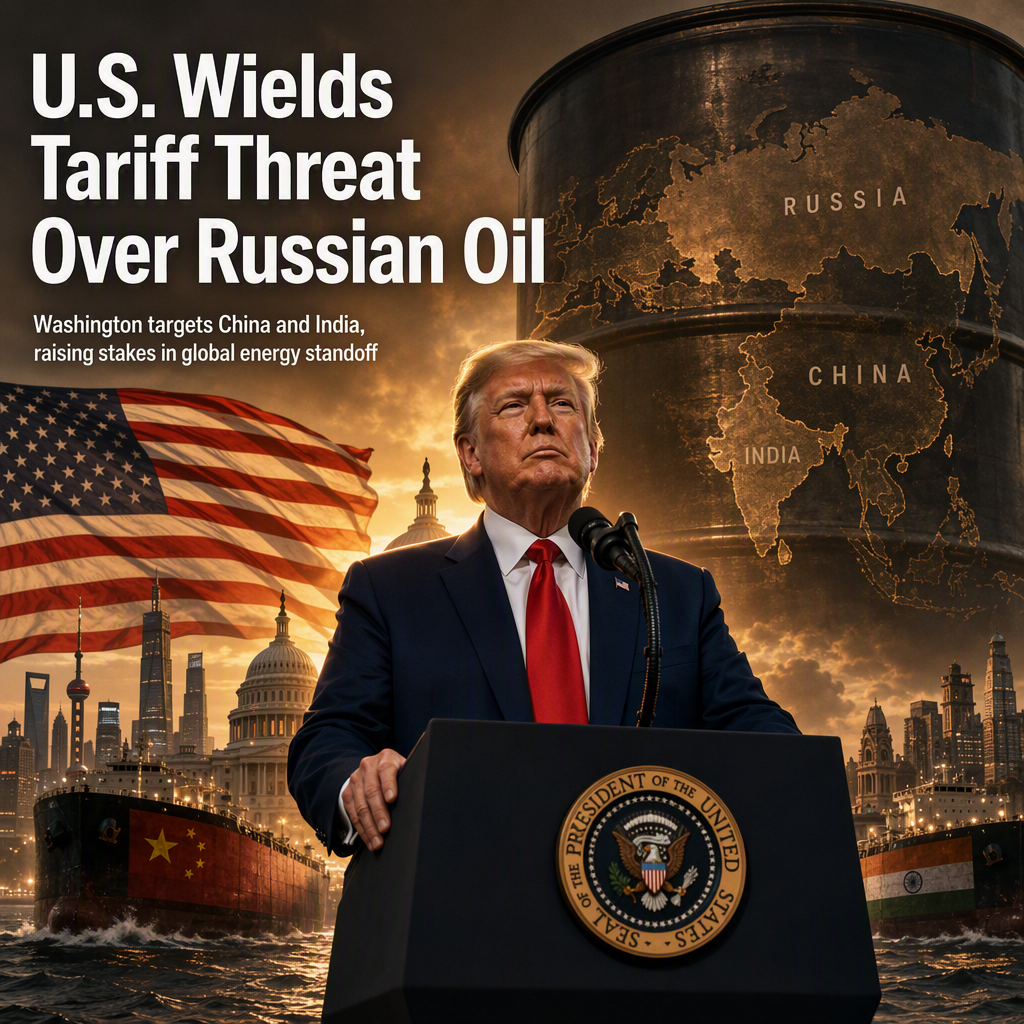
The U.S. House has passed a bill granting President Donald Trump the authority to impose tariffs of up to 100% on countries purchasing oil from Russia, with China and India identified as primary targets due to their significant reliance on discounted Russian crude since the Ukraine war in 2022 and the subsequent Iran war tightened global energy supplies [1]. According to the Center for Research on Energy and Clean Air (CREA), as of the end of August, China accounted for 50% of Russia's crude exports, India 37%, Turkey 5%, and the European Union 5% [1]. Kpler data further indicates that, following the Hormuz crisis, the combined share of Russian oil imports by India and China increased to one-third from one-fifth, underscoring their growing dependence [1].
Deborah Elms, head of trade policy at Hinrich Foundation, stated that all five top purchasers of Russian energy will be 'extremely worried' about the potential implementation of this bill, as it gives the U.S. president power to 'strike hard and quickly at any time for any reason' [1]. Despite the threat, experts suggest that neither China nor India is likely to reduce their purchases of Russian oil in the near term, but the tariffs represent a significant negotiating tool for Washington [1]. Ronak D Desai of the Hoover Institution noted that President Trump is expected to sign the law and hold its tariff authority in reserve as leverage, while nearly a dozen House Republicans privately urged leadership to remove the tariff provisions due to concerns about rising prices ahead of the midterms [1].
India, currently in trade negotiations with the U.S., is seeking a preferential rate compared to competitors, and Chinese President Xi Jinping is scheduled to meet with Trump later this month [1]. Ivan Ryabov of Kpler highlighted the difficulty for China and India to replace 3.5 million barrels per day of Russian seaborne supply, in addition to the 600,000 bpd China imports via pipeline [1].
Market analysts believe Washington is unlikely to escalate tensions with Beijing ahead of the upcoming summit. Martin Chorzempa of the Peterson Institute for International Economics stated that 'China would certainly retaliate' if tariffs are applied, given Beijing's history of responding to U.S. sanctions [1]. Dan Wang of Eurasia Group expects China to defy any restrictions and prioritize energy security, which is 'politically unacceptable' to compromise [1]. Stephen Olson of ISEAS Yusof Ishak Institute added that it is unlikely the U.S. will take any act [1].
CONCLUSION
The U.S. House's approval of tariff authority against Russian oil buyers marks a significant escalation in Washington's leverage over China and India, though immediate action appears unlikely. Market analysts expect both countries to maintain their Russian oil imports, and warn of potential retaliation if tariffs are imposed. The bill's passage introduces uncertainty into global energy markets and U.S. trade relations.