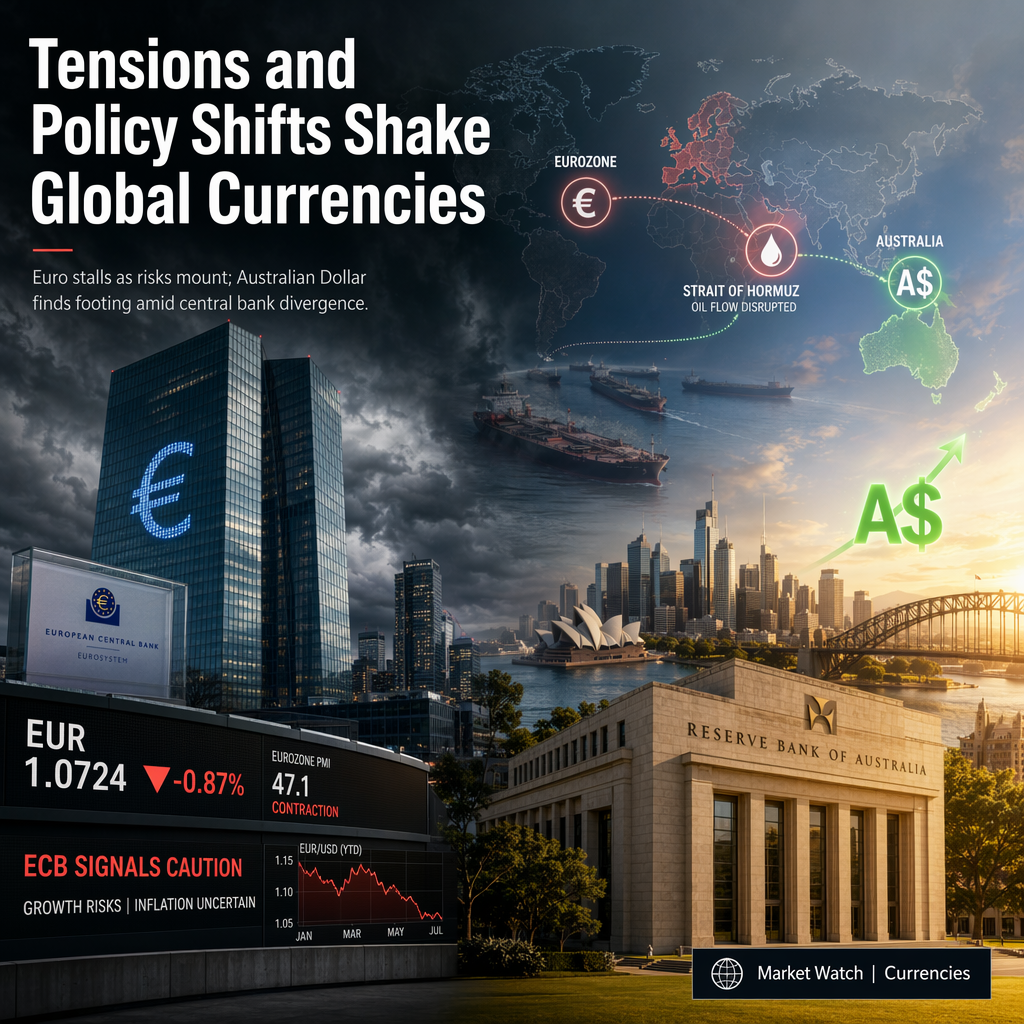
On Friday, the Euro (EUR) reversed most of its earlier gains against the US Dollar (USD), retreating to the 1.1430 area from session highs at 1.1475, leaving the pair nearly flat for the day [1]. This pullback was driven by soft economic data from key Eurozone economies, ongoing geopolitical uncertainty, and elevated oil prices, all of which have dampened Euro rallies [1]. In Germany, June's final Harmonized Index of Consumer Prices (HICP) confirmed a slowdown in inflation to 2.4% year-over-year from 2.7% in May, with monthly inflation contracting by 0.2% [1]. France's Consumer Price Index (CPI) also eased to a 2% annual rate in June from 2.8% in May, with a monthly contraction of 0.3% [1]. Italy's industrial output contracted 0.3% in May, nearly reversing April's 0.4% increase and exceeding the anticipated 0.2% fall; annual factory output growth remained at 1.1%, below the expected 1.3% [1]. These figures suggest moderating price pressures and sluggish economic activity, increasing the likelihood that the European Central Bank (ECB) will keep interest rates unchanged at its upcoming July meeting [1].
Meanwhile, the US Dollar pared some losses as investors remained cautious amid ongoing geopolitical risks. Although US and Iran have halted direct hostilities, the Strait of Hormuz remains effectively closed, with no clear plan for reopening as Washington and Tehran continue to clash over the waterway's status. This situation is keeping oil prices elevated and acting as a headwind for a significant Euro recovery [1].
In contrast, the Australian Dollar (AUD) traded around 0.6950 against the USD, up 0.10% on the day after reaching a more than two-week high, before giving back some gains as investors weighed a weaker USD against lingering supportive factors for the Greenback [2]. The AUD benefited from USD weakness, partly due to expectations of easing Middle East tensions, with US President Donald Trump stating that Iran had reached out for an agreement and White House officials confirming ongoing technical talks on Iran's nuclear program and the Strait of Hormuz [2]. However, geopolitical concerns remain elevated following recent US and Iranian military actions [2].
The Reserve Bank of Australia (RBA) also supported the AUD, with Assistant Governor Sarah Hunter reaffirming the central bank's commitment to bringing inflation back to target and warning that further monetary tightening could be necessary if higher energy prices persist due to Middle East conflicts [2]. On the US side, the Federal Reserve's June meeting minutes indicated that several policymakers expect rates to remain near current levels by year-end, though many see the possibility of higher rates. New York Fed President John Williams stated he does not expect a sustained increase in energy prices despite renewed Middle East hostilities [2].
Currency performance data showed the Australian Dollar was the strongest against the Euro on the day [2]. Investors remain focused on geopolitical developments and monetary policy expectations, which are likely to continue driving major currency pairs in the near term [2].
CONCLUSION
The Euro's rally was curtailed by soft Eurozone data and persistent geopolitical risks, leading to expectations that the ECB will maintain current rates. In contrast, the Australian Dollar found support from both RBA hawkishness and USD weakness, despite ongoing Middle East tensions. Market sentiment remains cautious, with geopolitical developments and central bank signals set to guide currency movements in the near future.