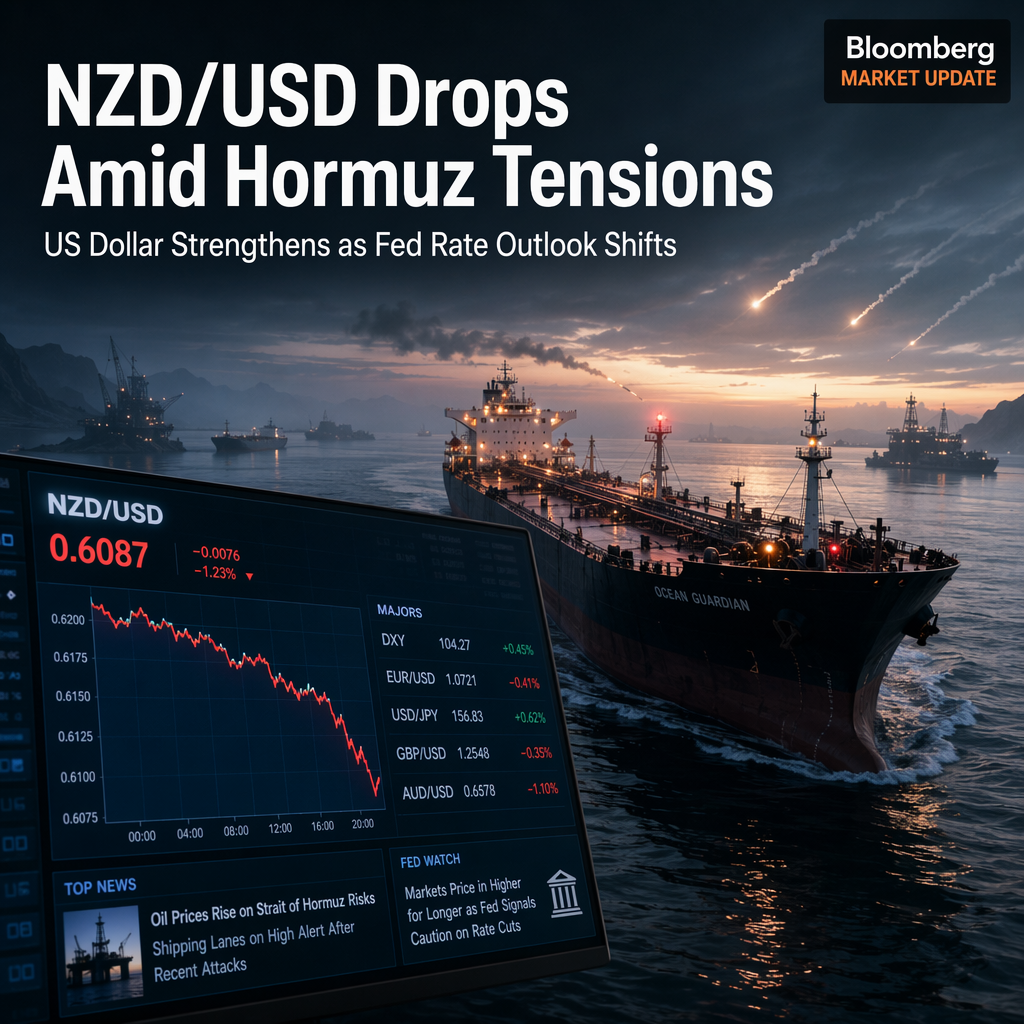
The New Zealand Dollar (NZD) continued its decline against the US Dollar (USD) for the second consecutive day, with NZD/USD trading around 0.5700 during Asian hours on Tuesday. This depreciation is attributed to the US Dollar's resilience, which has been bolstered by renewed geopolitical tensions in the Strait of Hormuz. According to Bloomberg, citing a US official, Iran fired at least two missiles at commercial vessels in the strategic waterway late Monday, resulting in significant damage to two ships but no reported casualties. Additionally, the UK Maritime Trade Operations (UKMTO) confirmed that a southbound tanker was hit by an unknown projectile, causing a fire onboard [1].
Market sentiment has shifted as participants scaled back expectations for Federal Reserve rate hikes in the upcoming months. This adjustment follows a cooling US employment report, which showed fewer jobs added in April, May, and June than anticipated by Wall Street. The recent drop in crude oil prices, attributed to an OPEC+ production boost and a US-Iran peace deal, has also eased inflationary pressures, reducing the urgency for aggressive Fed policy tightening [1].
Despite the sharp decline in oil prices, ING forecasts that the Reserve Bank of New Zealand (RBNZ) will implement a 25-basis-point 'insurance' rate hike to 2.50% on Wednesday. However, ING cautions that this tightening move could be a one-off, offering limited sustained upward momentum for the NZD [1].
No additional analyst opinions or forward-looking statements are provided beyond ING's outlook on the RBNZ's potential rate hike [1].
CONCLUSION
The New Zealand Dollar remains under pressure due to US Dollar strength driven by geopolitical tensions and shifting Fed rate expectations. While a modest RBNZ rate hike is anticipated, analysts suggest it may not provide lasting support for the NZD. Market sentiment remains cautious amid ongoing global uncertainties.