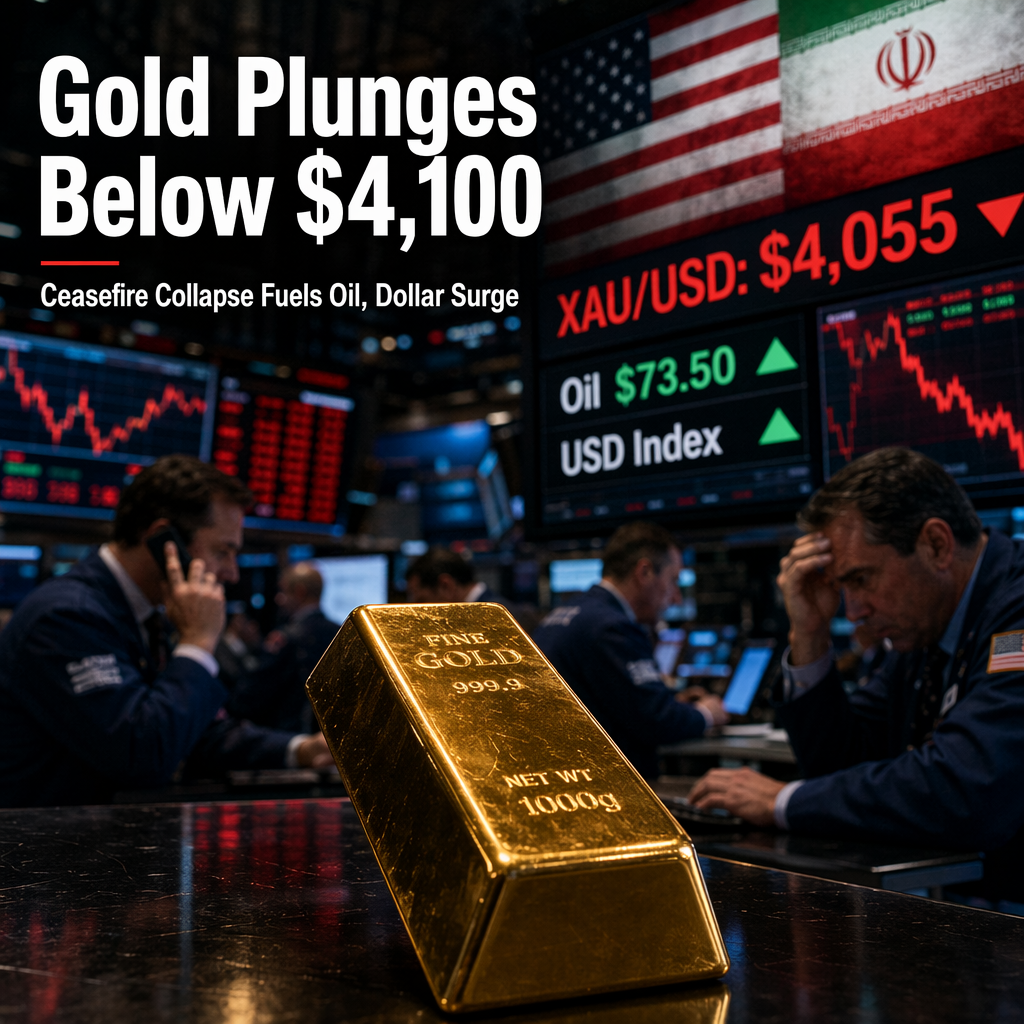
Gold (XAU/USD) experienced a sharp decline on Wednesday, dropping below $4,100 after US President Donald Trump announced that the ceasefire deal with Iran was 'over' and described negotiations with Tehran as 'a waste of time' during remarks at the NATO Summit in Ankara, Turkey [1]. At the time of reporting, XAU/USD was trading around $4,055, erasing most of the gains made in the previous week [1].
The President's comments followed renewed hostilities between the United States and Iran, including attacks on commercial vessels near the Strait of Hormuz, marking the most significant breach of the interim US-Iran agreement since its implementation on June 17 [1]. This escalation boosted the US Dollar and crude oil prices, while diminishing demand for gold [1]. West Texas Intermediate (WTI) crude oil was trading near $73.50 per barrel, up over 7% for the week, fueling inflation concerns [1].
The CME FedWatch Tool indicated that the probability of a Federal Reserve interest rate hike in September rose to 68% from 58% the previous day, as higher oil prices stoked inflation expectations [1]. Elevated US Treasury yields, with the 10-year yield at approximately 4.57%, further pressured gold prices, as investors shifted toward interest-bearing assets [1].
Technical analysis showed XAU/USD maintaining a bearish near-term outlook, trading below the 100-period Simple Moving Average at $4,128, with momentum indicators such as the Relative Strength Index (14) dropping to 38 and the MACD turning negative [1]. Immediate support is seen at $4,000, with a break below this level potentially leading to further declines [1]. Despite the current weakness, structural demand from central banks and institutional investors is cited as a factor that could limit deeper losses in the longer term [1].
Market participants are awaiting the June Federal Open Market Committee (FOMC) meeting minutes for further guidance on the Federal Reserve's policy outlook, as gold's price action remains closely tied to interest rate expectations [1].
CONCLUSION
Gold prices have come under significant pressure following the breakdown of the US-Iran ceasefire and rising expectations of a Federal Reserve rate hike. While the immediate outlook for gold remains bearish amid a stronger dollar and higher yields, ongoing demand from central banks and institutions may provide some support in the longer term.