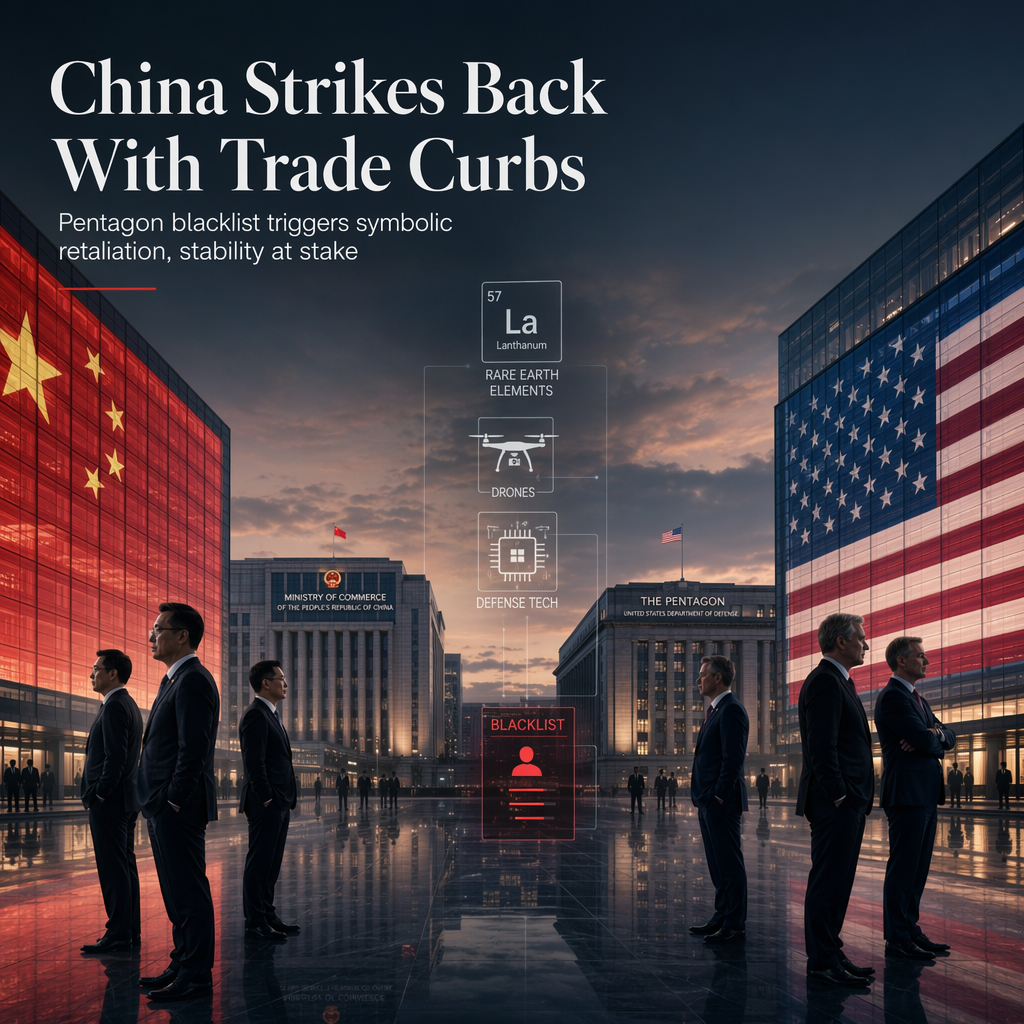
China imposed new trade restrictions on dozens of U.S. companies on June 22, 2026, in response to the U.S. Department of Defense adding more Chinese technology firms to its so-called 1260H military list earlier in the month [1]. The Chinese Ministry of Commerce placed 10 American industrial suppliers, including rare earth miners MP Materials Corp and USA Rare Earth, as well as drone makers Teal Drones and Jaia Robotics, on its export control list, barring exports of any dual-use items originating in China to these companies [1]. Other affected firms include Aveox Inc, Ball Aerospace & Technologies Corp, and Oshkosh Defense [1].
Additionally, the Chinese Finance Ministry excluded 46 U.S. companies, mostly defense contractors, from participating in government procurement projects, with exemptions for foreign-funded, locally registered entities associated with the excluded firms [1]. These actions follow the Pentagon's recent update to its 1260H list, which added Chinese companies such as Alibaba Group, Baidu, and BYD, accusing them of aiding Beijing's military [1]. The 1260H designation does not impose immediate sanctions but prevents the U.S. Department of Defense from awarding direct contracts to listed companies starting June 30, 2026, with indirect procurement restrictions set for 2027 [1].
Analysts cited in the article suggest that both the U.S. and Chinese measures are largely symbolic, with Han Shen Lin of The Asia Group noting that most targeted U.S. companies have little or no meaningful business exposure in China [1]. Dan Wang of Eurasia Group described China's response as a 'model example' of mild escalation intended to keep the broader U.S.-China relationship stable, especially after last month's Trump-Xi summit, which reset relations on a more positive footing [1].
Chinese authorities have stated they will take all necessary measures to protect the legitimate rights and benefits of Chinese companies and have criticized the U.S. for creating discriminatory lists under the pretext of national security [1]. Several designated Chinese firms have disputed their inclusion on the U.S. list and pledged legal action to seek removal, referencing a previous successful court challenge by Xiaomi [1].
CONCLUSION
China's latest trade curbs on U.S. firms are a direct response to the Pentagon's expanded military blacklist but are seen by analysts as largely symbolic with limited immediate commercial impact. Both sides appear to be signaling resolve while aiming to avoid major escalation, maintaining a cautious stability in U.S.-China relations.