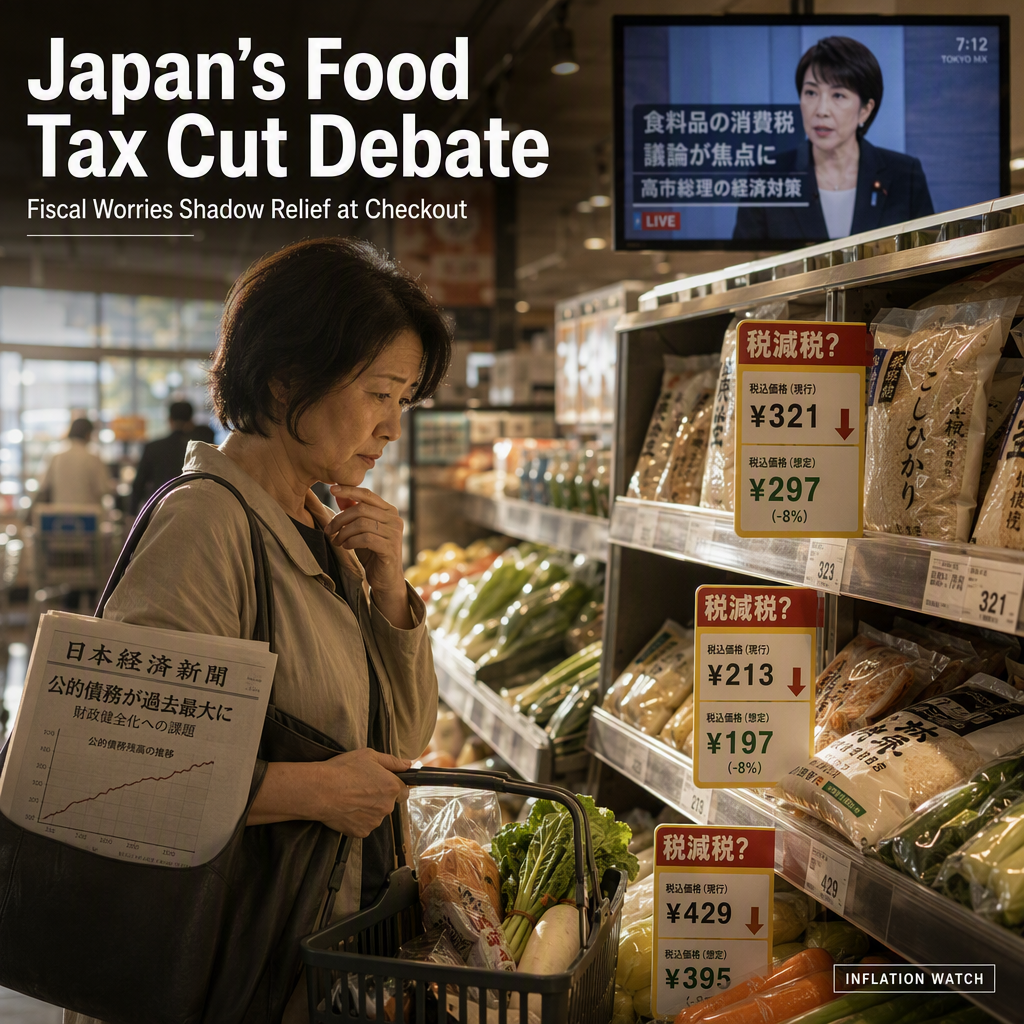
Japanese Prime Minister Sanae Takaichi's long-anticipated proposal to cut the consumption tax on food aims to fulfill a campaign promise for her Liberal Democratic Party and provide relief to households facing rising prices [1]. However, many economists argue that this measure is an inadequate response to inflation and could significantly weaken Japan's fiscal position [1]. The planned tax cut is expected to create a funding gap of around $30 billion, exacerbating concerns about Japan's already high public debt levels, which are among the highest in the developed world [1].
Market participants are wary that the government may increasingly rely on inflation and the Bank of Japan's accommodative monetary policy to manage its debt burden, rather than implementing sustainable fiscal reforms [1]. This reliance could undermine investor confidence in Japan's fiscal stability and potentially drive up yields on government bonds if risk premiums rise [1]. The article draws a parallel to the UK's 'Truss shock,' where unfunded tax cuts led to market turmoil and a sharp sell-off in government bonds, warning that Japan could face similar risks if credible plans to offset the revenue loss are not presented [1].
A Tokyo-based economist is quoted as saying, 'Reducing the consumption tax on food is popular, but it is not a sustainable solution to the cost-of-living crisis. Without credible plans to offset the revenue loss, the risk is that Japan will end up relying on inflation to erode the real burden of its debt' [1]. The debate also underscores a growing divergence between Japan and the United States in fiscal policy approaches, with the US signaling a return to fiscal discipline while Japan continues with proposed tax cuts and stimulus measures [1].
CONCLUSION
Japan's proposed food tax cut is raising significant concerns among economists and market participants about fiscal sustainability and the risk of increased reliance on inflation. Without clear plans to address the resulting budget shortfall, the measure could undermine confidence in Japan's fiscal position and lead to higher government bond yields.