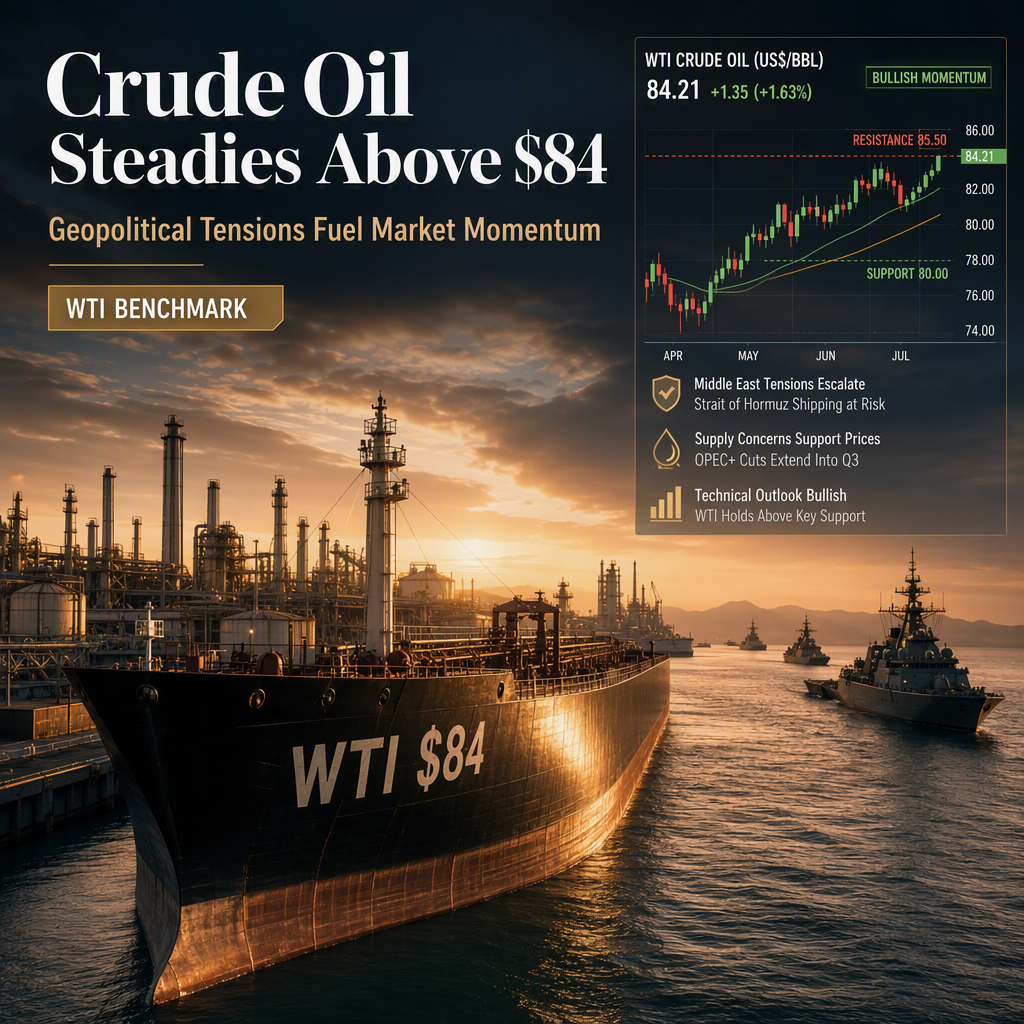
West Texas Intermediate (WTI), the benchmark for US crude oil, entered a bullish consolidation phase after reaching an over two-week high during the Asian session on Tuesday, currently trading around $84.20 [1]. The ongoing US-Iran standoff over the Strait of Hormuz has contributed to a geopolitical risk premium, supporting higher oil prices [1].
From a technical perspective, WTI maintains a near-term bullish bias, holding above the 38.2% Fibonacci retracement level of the July-August decline. Momentum indicators remain constructive, with the Relative Strength Index (RSI) at 56 and the Moving Average Convergence Divergence (MACD) above zero and trending higher, suggesting further near-term appreciation is possible [1].
However, bullish momentum faces a key structural barrier at the $86.65-$86.70 range, which includes the 100-day Simple Moving Average (SMA) and a downward-sloping trend line. The 50.0% Fibonacci retracement level at $87.23 reinforces this resistance, and a break above these levels could pave the way for an extension toward the 61.8% Fibonacci retracement at $91.93 [1]. On the downside, initial support is seen at $82.53 (38.2% Fibo), followed by $76.72 (23.6% Fibo), with further selling potentially exposing the monthly swing low in the mid-$73.00s and eventually sub-$70.00 levels [1].
The article notes that uncertainties and geopolitical risks continue to influence the market, but does not provide specific forward-looking statements or analyst opinions beyond technical analysis [1].
CONCLUSION
WTI crude oil prices remain supported above $84, driven by geopolitical tensions and positive technical momentum. While resistance levels could limit further gains, a break above key barriers may lead to additional upside. The market impact is medium, with traders closely watching technical and geopolitical developments for future direction.