
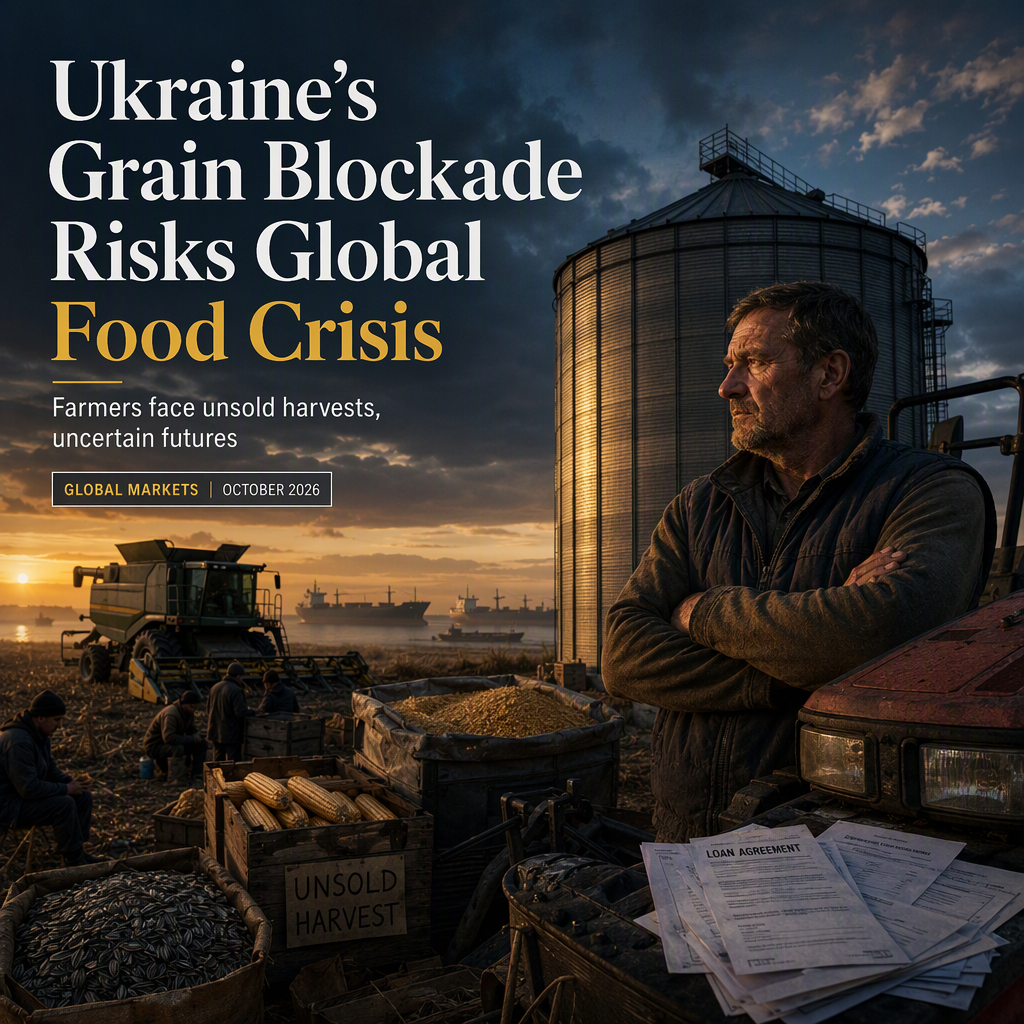
Ukraine’s 2026 harvest has been strong, with farmers like Oleksandr Chumak reporting good yields in crops such as corn, soybeans, and sunflower. However, an ongoing export blockade has left millions of tons of Ukrainian and Russian produce trapped in storage, unable to reach markets in Europe, the Middle East, Asia, and Africa [1]. The blockade, intensified by Russian drone and missile attacks on Black Sea targets and retaliatory strikes from Kyiv, has made it impossible to insure commercial shipping, effectively halting exports from both countries [1].
This disruption is severely impacting Ukrainian farmers, who are scaling back on corn and barley production and shifting toward less logistically exposed oilseeds and niche crops [1]. According to Andrii Dykun, chairman of the Ukrainian Agri Council, around 80% of grain cannot currently be sold at a profit, leaving farmers without the cash flow needed to pay taxes, rent, or invest in future crops [1]. Dykun stated, “The only crops we are able to sell are rapeseeds and sunflower seeds. But still, the volume is not enough... So why should we plant if today we have no profits at all?” [1].
The global market faces a dual risk: the current blockade is supporting world crop prices, but a ceasefire or reopening of the Black Sea route could quickly release large, cheap stockpiles, potentially driving prices lower [1]. Despite Turkey’s efforts to broker a deal, fatal attacks in the Black Sea continue into October 2026, making a ceasefire unlikely in the near term [1].
Financially, PrivatBank, Ukraine’s largest lender, has more than doubled its working capital loans to agribusinesses, disbursing 1.53 billion hryvnia ($34.2 million) between June and August 2026 compared to 718 million hryvnia in the same period last year. Small and medium-sized producers account for 70% of the bank’s agricultural loan book [1]. However, these funds remain tied up in unsold grain inventories, leaving farms struggling to cover operating expenses and secure financing for upcoming sowing campaigns [1].
CONCLUSION
Ukraine’s grain export blockade is creating severe financial strain for farmers and threatens future crop production. While current supply disruptions are supporting global crop prices, any resolution could rapidly shift the market. The ongoing conflict and export uncertainty present significant risks to both Ukrainian agriculture and global food security.