
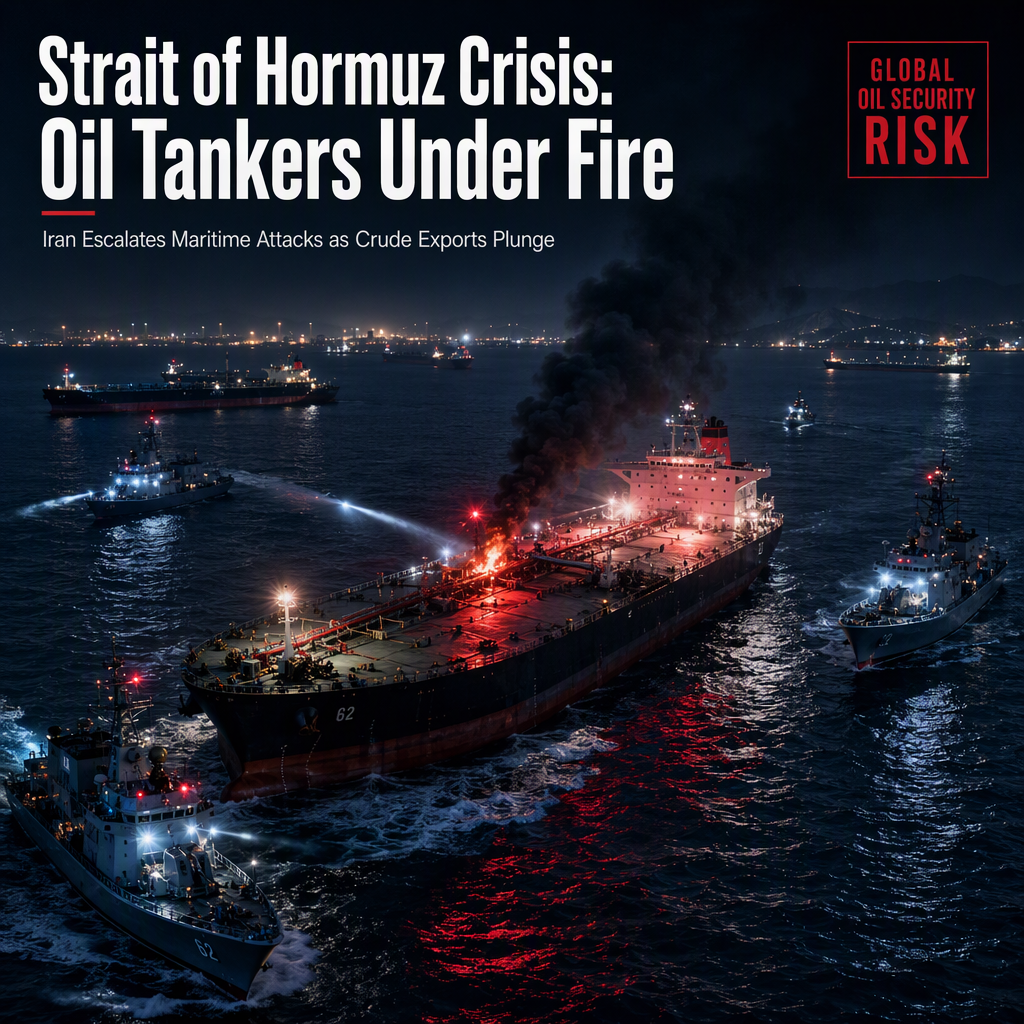
Iran has significantly increased its attacks on oil tankers transiting the Strait of Hormuz, with eleven tankers targeted during the week ending October 4, marking the highest number of strikes since the war began in late February, according to International Maritime Organization (IMO) data [1]. An additional five tankers have been attacked this week, and twelve Indian sailors were injured on Monday when a projectile struck the UAE-owned tanker 'On Peace' [1]. The Joint Maritime Information Center, a coalition of U.S. allied militaries, warned that these actions demonstrate Iran's intent to assert its presence and maintain pressure on vessels in key transit lanes [1]. A senior Iranian Revolutionary Guard official stated Iran's intention to block all 'illicit routes' through Hormuz [1].
The surge in attacks coincides with a rebound in Middle Eastern crude oil exports to prewar levels in September, largely due to U.S. military escorts along Oman's coast [1]. Despite this, maritime risk remains extremely high, with at least nine sailors killed in ship attacks since July [1]. Richard Meade, editor in chief of Lloyd's List, emphasized that the current situation is 'not a sustainable new normal' [1]. U.S. Central Command reported that 20 million barrels of crude had transited the strait, refuting Iranian claims of a closed waterway [1].
However, crude flows have recently declined as attacks intensified. Exports through Hormuz dropped to 8.5 million barrels per day (bpd) for the week ended Wednesday, about 40% below normal prewar levels, while Middle East shipments overall stood at 15.3 million bpd, 10% below prewar levels, according to Kpler data [1]. Iran has not loaded any crude oil for export since late August due to the U.S. naval blockade [1]. The Iranian Revolutionary Guard has also warned that attacks may extend deeper into the Persian Gulf, targeting ships throughout the region that violate Iran's transit restrictions [1].
CONCLUSION
Iran's escalation of attacks on oil tankers in the Strait of Hormuz has led to a significant reduction in crude exports, heightening maritime risk and instability in the region. Despite U.S. military escorts, the situation remains volatile, with industry experts warning that current conditions are unsustainable. The ongoing conflict and threats from Iran continue to pose a high-impact risk to global oil supply and shipping security.