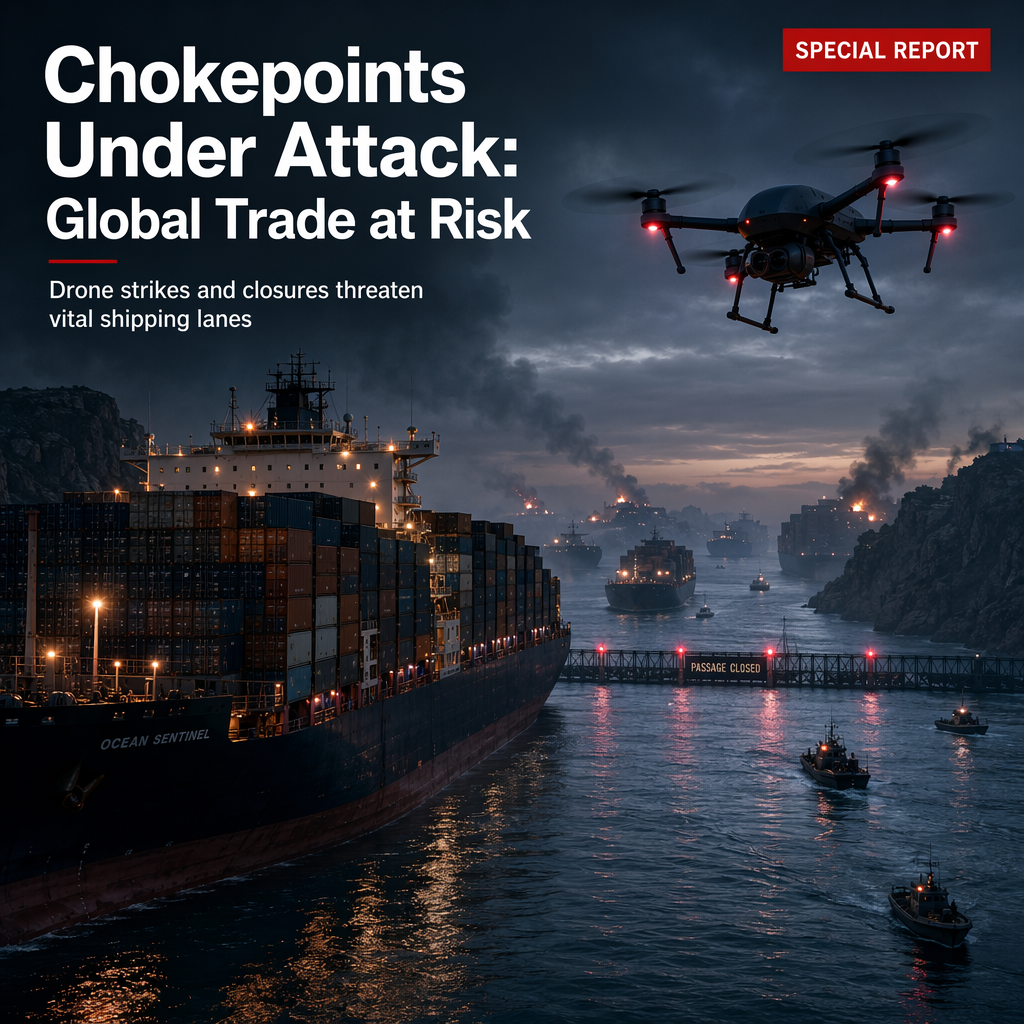
Attacks and threats around key maritime chokepoints, including the Strait of Hormuz, Red Sea, Black Sea, and Sea of Azov, are causing significant disruptions to commercial shipping routes, according to CNBC World [1]. These disruptions are particularly concerning given that roughly 80% of global merchandise trade by volume is transported by sea, meaning that any interruption can have far-reaching effects on energy, food, and consumer goods prices [1]. Shipping companies are responding by considering rerouting vessels, increasing insurance costs, building inventory buffers, and evaluating risks around other critical routes such as the Panama Canal [1].
The article highlights that the Strait of Hormuz is currently rattling global trade, but it is only one example of vital maritime corridors becoming frontlines in a new era of warfare characterized by drones and missiles targeting economic lifelines [1]. David Roche, president and global strategist at Quantum Strategy, notes that the Sea of Azov is witnessing the first maritime offensive conducted almost entirely with drones, supplemented by missiles, which allows smaller military forces to threaten ships, ports, and infrastructure at a lower cost [1]. Quantum estimates that about 25% of Russia's grain exports and 25% to 30% of its Black Sea oil exports could be disrupted, with Russia accounting for more than a fifth of internationally traded wheat, potentially impacting global food prices [1].
Yevgeniya Gaber, a senior fellow at the Atlantic Council, reports that Russia's recent suspension of shipping through the Kerch Strait has effectively shut down a vital maritime corridor, which had become an important alternative to land routes connecting Russia with occupied Crimea [1]. Gaber emphasizes the economic significance of the Sea of Azov, which is used to transport sanctioned crude oil, petroleum products, grain, coal, and steel [1]. She also states that Ukraine's efforts to exploit Russia's maritime and economic vulnerabilities have resulted in "one of the most significant blows to military and commercial fleets" since World War II, with Ukraine claiming to have degraded roughly one-third of Russia's Black Sea fleet since 2022 [1].
The article also raises concerns about the Panama Canal potentially becoming the next flashpoint for maritime disruption, further underscoring the vulnerability of global supply chains to emerging risks [1].
CONCLUSION
Disruptions at key maritime chokepoints are significantly impacting global shipping, raising costs and threatening supply chains for energy, food, and consumer goods. The use of drones and missiles has escalated risks, with major corridors like the Sea of Azov and Black Sea facing closures and attacks. Market participants should expect continued volatility and elevated costs as shipping companies adapt to these evolving threats.