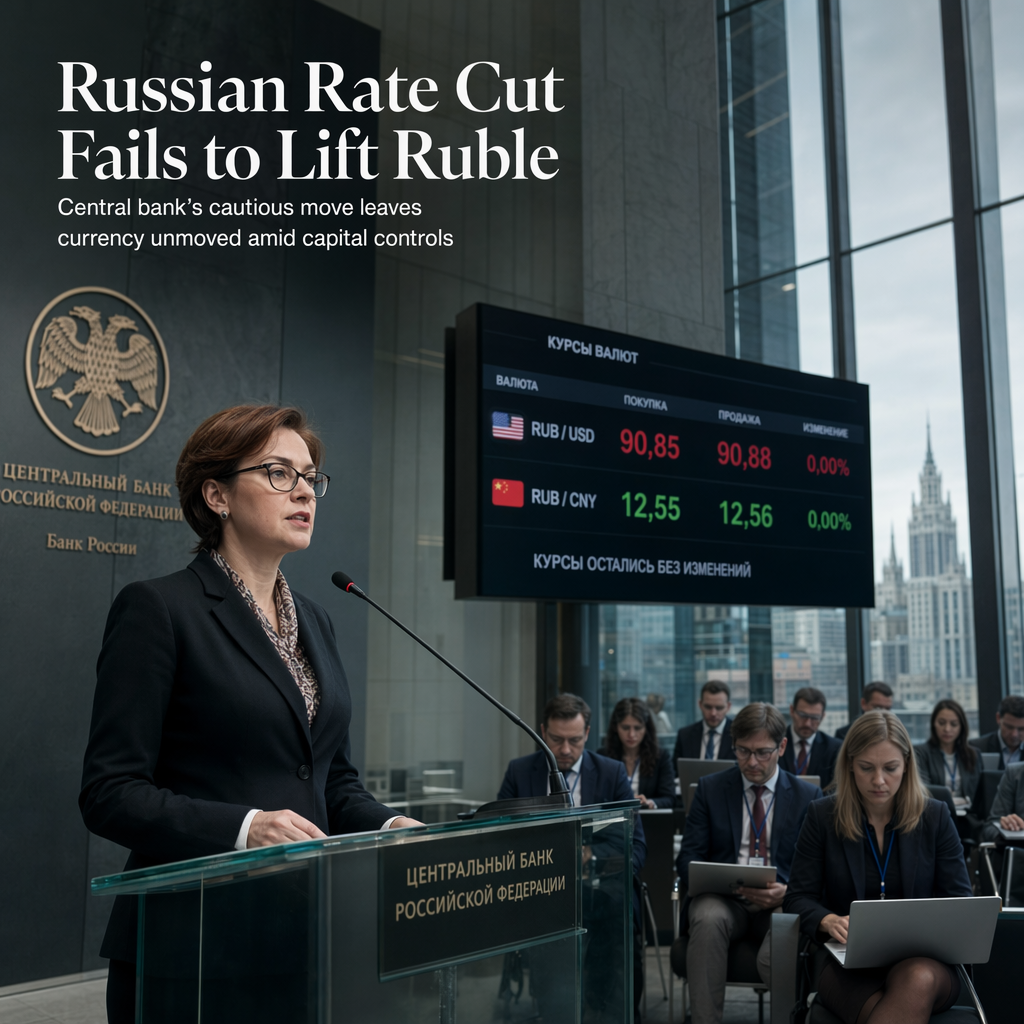
The Russian Central Bank surprised markets by reducing its key interest rate by only 25 basis points to 14.25%, rather than the 50 basis points that had been widely anticipated. This move was interpreted as a hawkish signal, with the central bank indicating that any further rate cuts would be considered at future meetings rather than being imminent [1].
Despite the central bank's cautious approach, the Russian Ruble (RUB) showed little reaction. According to Commerzbank’s Michael Pfister, the hawkish stance failed to support the currency due to ongoing capital controls and the fact that the ruble is no longer freely tradable. Instead, the RUB is quoted indirectly through the Chinese Yuan (CNY) and US Dollar (USD) exchange rates [1].
Pfister notes that, under current conditions, even a halt to further rate cuts would not benefit the ruble. The lack of real capital inflows means market participants cannot take advantage of higher interest rates, and the ruble is unable to appreciate as a result [1]. The analyst further emphasizes that the ruble only appreciates in response to prospects of an imminent end to the war or a significant energy price shock, rather than monetary policy changes [1].
No immediate market rally or significant appreciation of the ruble was observed following the central bank's decision, highlighting the limited impact of monetary policy on the currency under current geopolitical and economic constraints [1].
CONCLUSION
The Russian Central Bank's smaller-than-expected rate cut signaled a hawkish stance but failed to boost the ruble, which remains constrained by capital controls and indirect pricing mechanisms. Analysts suggest that monetary policy alone is unlikely to drive appreciation in the ruble, with geopolitical developments and energy prices remaining the key factors for the currency's outlook.