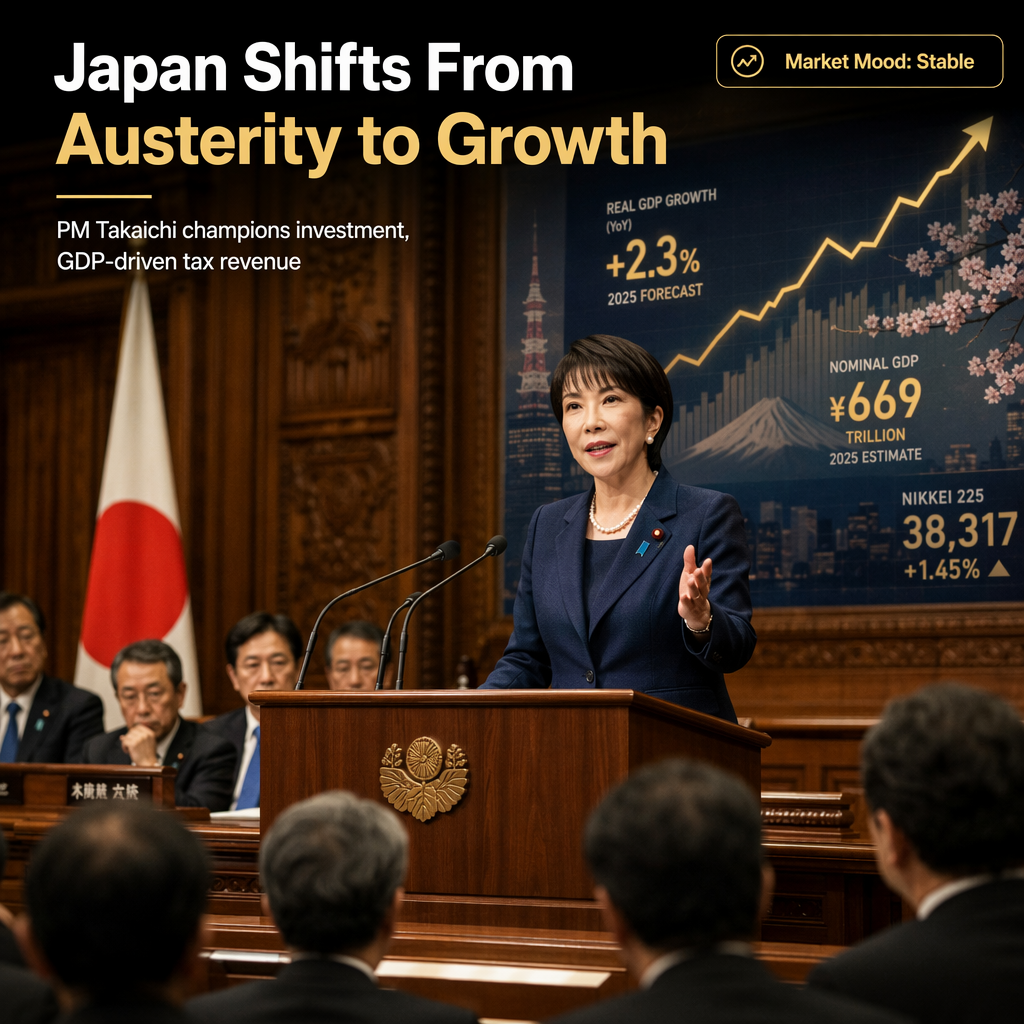
Japan Prime Minister Sanae Takaichi announced during the European trading session on Monday that the country must exit from excessively tight fiscal policy to stimulate economic growth and boost domestic investment. Takaichi emphasized that while Japan will move away from years of excessive austerity, the government will not engage in reckless fiscal spending. Instead, any increase in government expenditure will be supported by expanding GDP-driven tax revenue, rather than unsustainable borrowing or spending [1].
Takaichi highlighted that Japan's inflation rate stands at 1.7%, the lowest among G7 countries, but noted positive developments in the wage outlook and signs that the economy is beginning to gain momentum. She stressed the importance of not postponing investment, warning that delaying such measures could result in lost growth opportunities for Japan. The Prime Minister also mentioned plans to submit a bill to lower the 8% sales tax on food, contingent on reaching an agreement among lawmakers [1].
Despite these policy signals, there was no major impact on the Japanese Yen (JPY) following Takaichi's remarks. At the time of reporting, the USD/JPY pair was trading 0.15% lower, near 163.60. Takaichi also addressed the ongoing debate about deflation in Japan, stating that while the country is no longer experiencing sustained price declines, the government has not yet met the conditions to officially declare an end to deflation, as there remains a risk of returning to such an environment [1].
Other points raised by Takaichi included the gradual impact of price relief measures, the importance of setting clear fiscal targets, and the ruling Liberal Democratic Party's pledge to cut the number of lawmakers. She also noted that the government is closely monitoring the situation in the Middle East and will not be influenced by fluctuations in opinion polls [1].
CONCLUSION
Prime Minister Takaichi's comments signal a cautious but clear shift away from fiscal austerity in Japan, with a focus on growth-driven tax revenue and targeted investment. The market reaction was muted, with the Japanese Yen showing little movement, indicating limited immediate impact from the announcement.