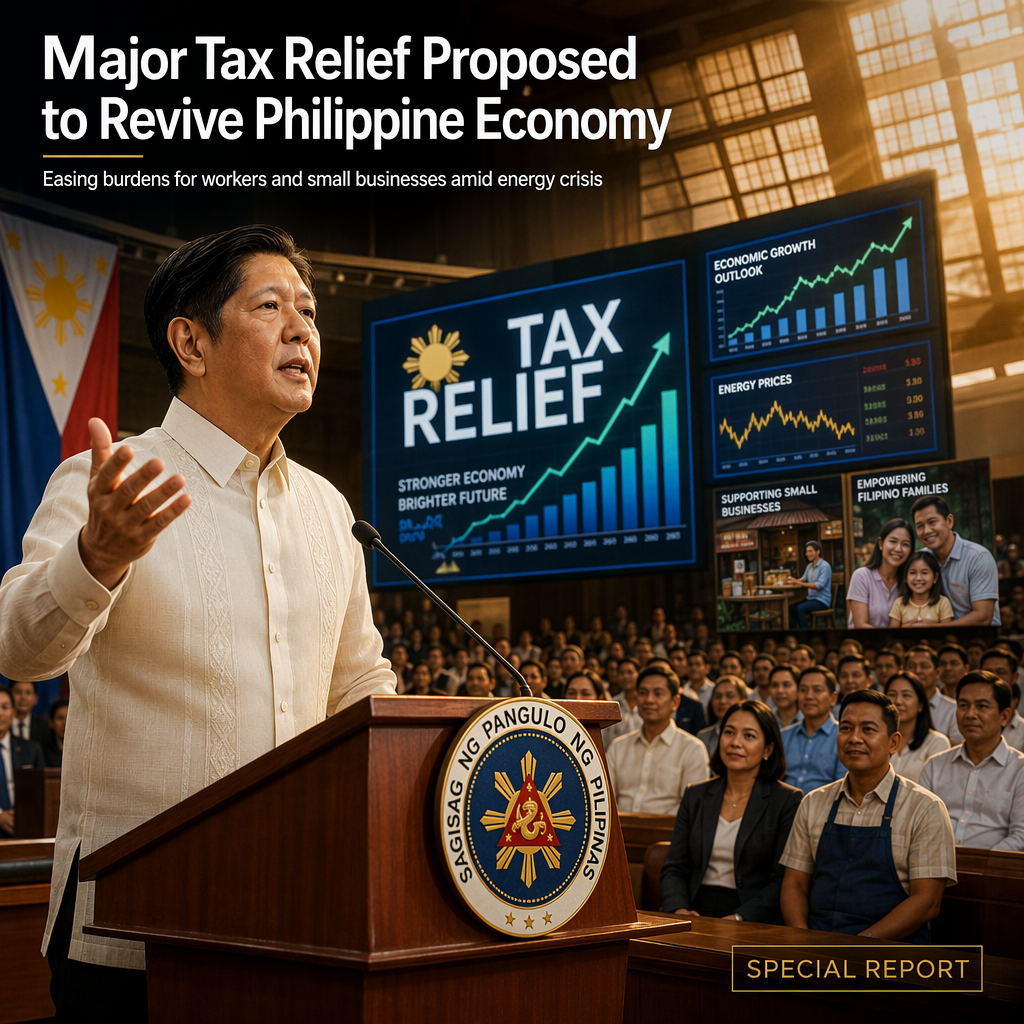
Philippine President Ferdinand Marcos Jr. has announced a proposal to raise the income tax threshold by 40% and eliminate certain financial burdens on small businesses, aiming to stimulate economic growth in the face of challenges posed by the ongoing global energy crisis [1]. In his fifth state of the nation address at the House of Representatives in Quezon City, Marcos emphasized the need to ease the tax burden on both individuals and entrepreneurs, stating, "We must ease the tax burden on our people and our entrepreneurs so that they have more resources to invest, spend, and grow our economy" [1].
The proposed tax reforms are intended to provide relief to lower- and middle-income earners, as well as small businesses that have been particularly affected by higher energy costs and sluggish demand [1]. The administration highlighted that these measures are designed to boost domestic consumption and investment, which are seen as key drivers of economic recovery, especially as the Philippines' growth has lagged behind regional peers [1]. The Asian Development Bank recently lowered its growth forecast for the Philippines, attributing the downgrade to the energy shock [1].
Financial analysts cited in the article noted the potential for the tax changes to positively impact consumer spending and the viability of small businesses [1]. However, they also cautioned that the government would need to ensure adequate fiscal space to maintain infrastructure and social spending if tax revenues decline as a result of the reforms [1].
No specific figures were provided regarding the new income tax threshold or the number of beneficiaries, and the administration is expected to submit detailed legislative proposals to Congress in the coming weeks [1].
CONCLUSION
President Marcos's proposed tax reforms signal a proactive approach to reviving the Philippine economy amid external pressures from the global energy crisis. While analysts see potential for increased consumer spending and small business support, concerns remain about maintaining fiscal stability if tax revenues decrease.