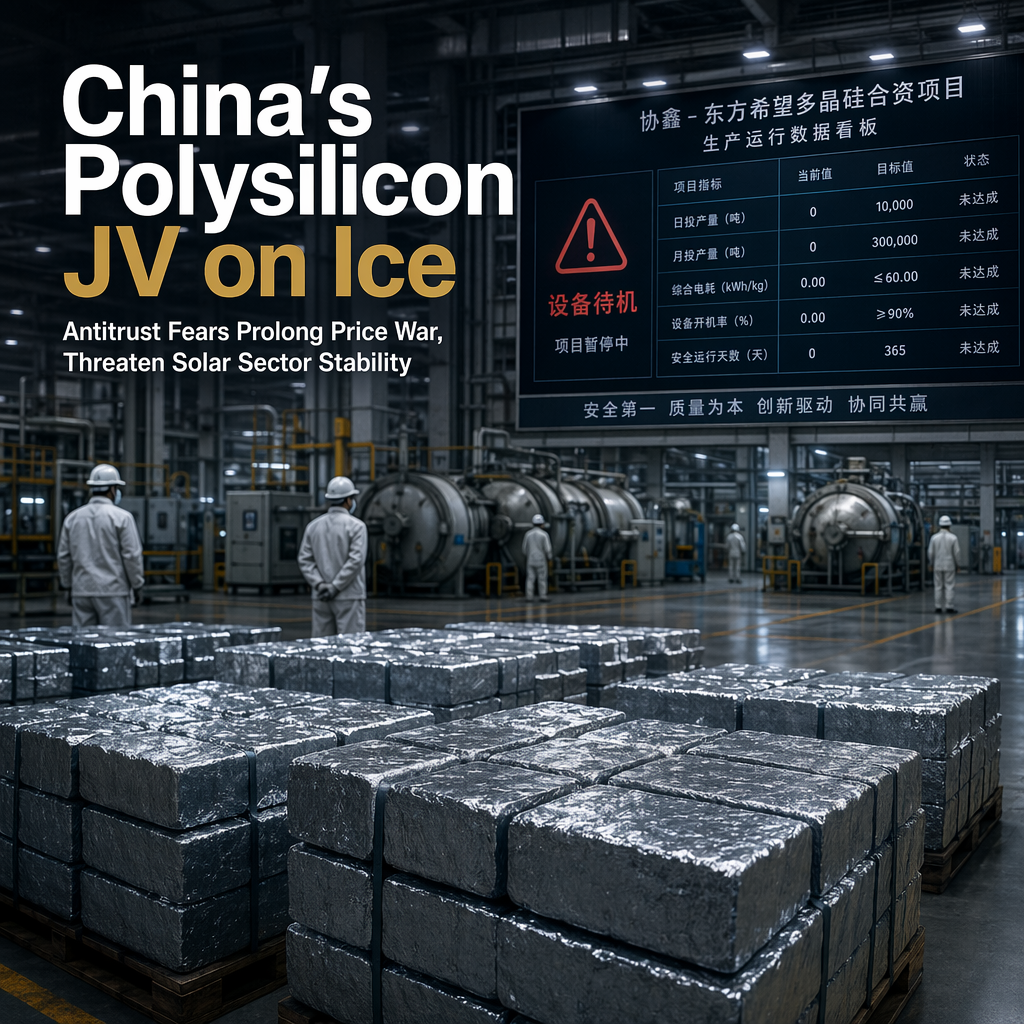
A major joint venture (JV) in China aimed at consolidating production capacity for polysilicon, a critical material for solar panels, has remained inactive for several months following concerns raised by Chinese antitrust authorities about potential anticompetitive practices [1]. The JV was designed to bring together several leading Chinese polysilicon manufacturers to address the ongoing oversupply and stabilize falling prices in the market [1]. However, regulatory apprehension that the consolidation could lead to price manipulation or the creation of a monopoly has stalled progress, with no forward movement reported since the initial launch [1].
Chinese suppliers currently control 95% of global polysilicon production capacity, underscoring the strategic importance of the sector [1]. The ongoing supply glut and price war have already resulted in significant losses for many Chinese solar panel companies, and the JV was viewed as a potential solution to rationalize capacity and coordinate supply to stem further price declines [1]. Market analysts warn that the continued lack of action could extend the financial difficulties facing the industry, particularly for smaller producers who may be forced out of the market [1].
Polysilicon prices remain under pressure, with technical analysis indicating no immediate support levels and the possibility of prices reaching new lows if the oversupply persists [1]. Market participants are closely monitoring for any signals from regulators or companies regarding the resumption of JV discussions or alternative strategies to address the supply-demand imbalance [1].
An industry source emphasized that authorities are particularly cautious about any moves that could be seen as price fixing or monopolistic behavior, especially given the strategic significance of the solar energy sector in China [1].
CONCLUSION
The stalled progress of China's polysilicon JV, due to antitrust concerns, is exacerbating the ongoing price war and financial strain in the solar panel industry. Without regulatory approval or alternative measures, oversupply and depressed prices are likely to persist, increasing risks for smaller producers and prolonging market uncertainty.