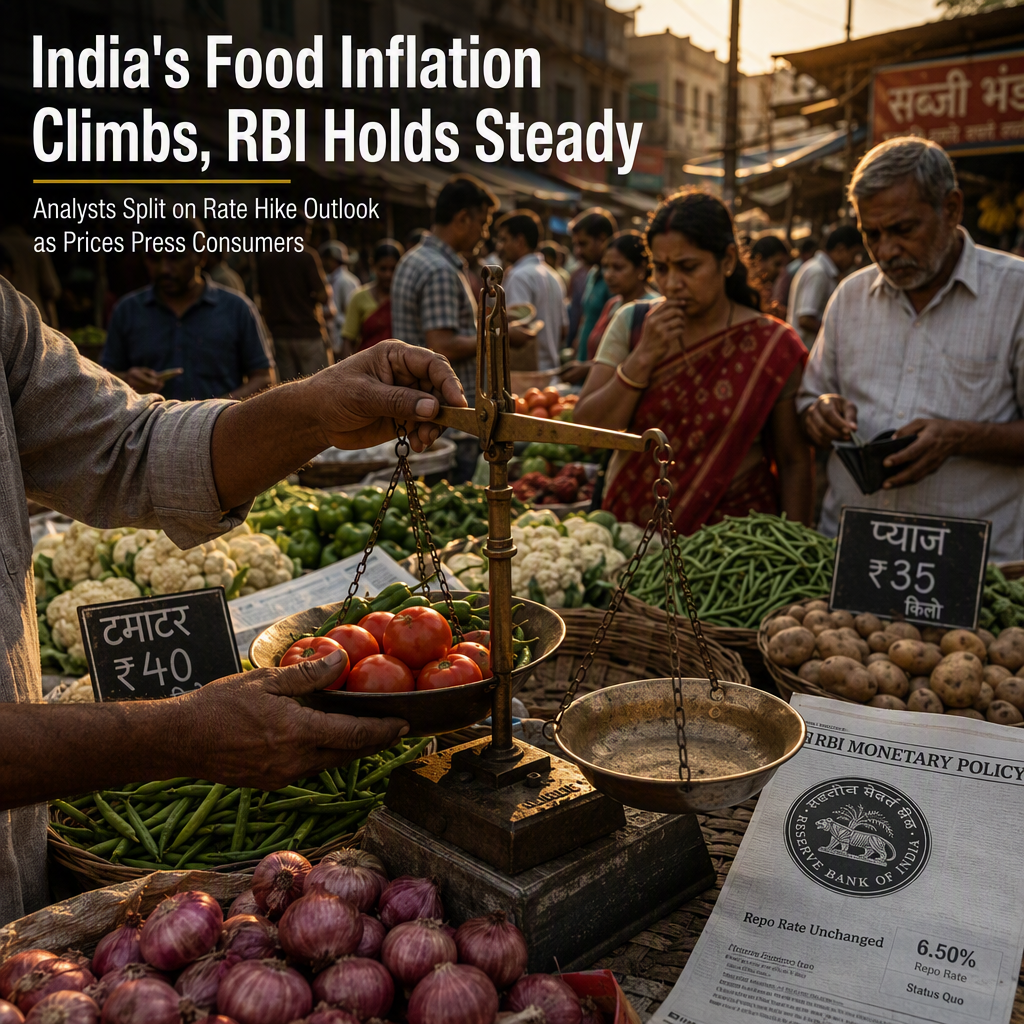
India's Consumer Price Index (CPI) inflation increased to 4.45% year-on-year in July from 4.38% in June, driven primarily by a surge in food inflation, which rose to 5.52% year-on-year from 5.32% in June [1]. This marks the second consecutive month that headline inflation has exceeded the Reserve Bank of India's (RBI) 4.0% midpoint target, though it remains within the central bank's 2–6% tolerance band [1].
The RBI decided to keep its key repo rate unchanged at 5.25%. Analysts from MUFG and DBS Group Research both agree that the latest inflation data supports the RBI's decision to hold rates steady, but they differ on the likely duration of this pause [1]. MUFG highlights the risk of inflation broadening due to strong domestic demand and accelerating credit growth, projecting a 50-basis-point rate hike cycle beginning in December 2026 [1]. In contrast, DBS Group Research points to benign core inflation and the absence of generalized price shocks, suggesting an extended pause with no immediate need for tightening [1].
Market conditions remain stable, with 10-year government bond yields holding in the 6.75–6.85% range and domestic fuel pump prices unchanged, which DBS sees as providing a buffer for onshore markets [1]. MUFG, however, warns of risks from potential weather shocks and continued credit growth that could eventually push inflation higher [1].
According to Michael Wan at MUFG, the July CPI print reinforces the view that domestic inflation is building slowly, with food inflation leaving consumer prices vulnerable to supply shocks [1]. Radhika Rao at DBS Group Research maintains that the current inflation environment gives the RBI's Monetary Policy Committee ample room to continue its rate pause [1].
CONCLUSION
India's July inflation data, led by rising food prices, supports the RBI's decision to hold rates at 5.25%. While MUFG sees potential for future rate hikes starting in December 2026, DBS expects an extended pause, citing stable core inflation and market conditions. The market impact is medium, with analysts divided on the timing of any future tightening.