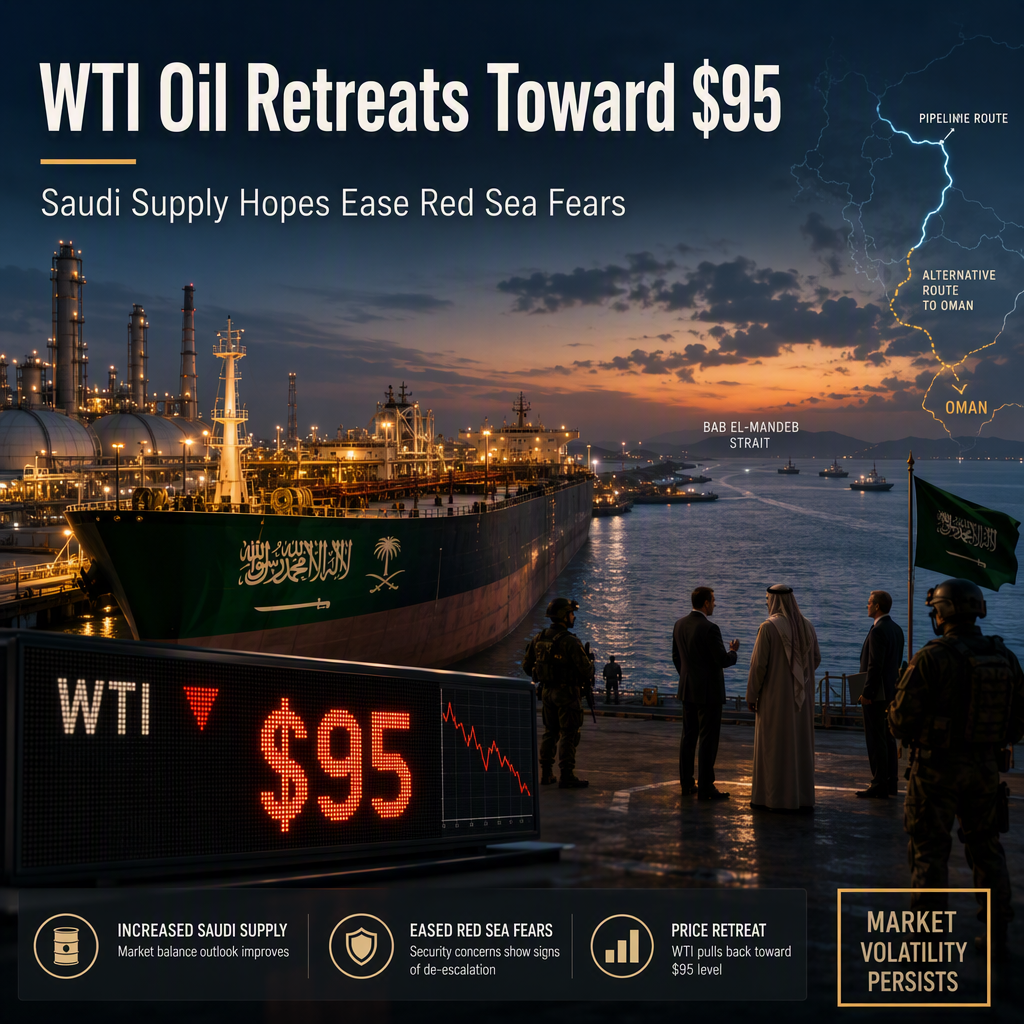
West Texas Intermediate (WTI) Oil prices have eased to levels near $95, marking the first weekly decline in the past three weeks after reaching a four-month high of $102.07 last Tuesday [1]. This pullback is attributed to hopes that Saudi Arabia will increase its crude supply, as well as diplomatic efforts by China, which has reportedly asked Iran to rein in Yemen's Houthis following the Iran-backed militias' seizure of critical coastal areas in the Red Sea and threats to block the Bab el-Mandeb waterway [1].
Concerns over supply disruptions had escalated last week after a drone attack damaged the West-East pipeline, which transports oil to the Red Sea port of Yanbu and is used to bypass the Strait of Hormuz blockade. However, news that Saudi Arabia has found an alternative route through Oman to supply crude to Asian countries has helped ease these fears [1]. Despite these developments, uncertainty in the Middle East continues to support crude prices, with ongoing reciprocal attacks between Saudi Arabia and the Houthis and the US-Iran conflict entering a 'grey area' [1].
The Strait of Hormuz remains practically closed, and the UK Maritime Trade Operations (UKMTO) reported an attack on a vessel 16 nautical miles northeast of Oman’s Khasab, further highlighting the persistent risks to oil supply routes in the region [1]. The Chinese foreign ministry emphasized that China does not want regional tensions to spill over into Yemen and the Red Sea, but the situation remains tense [1].
Overall, while hopes for increased Saudi supply and diplomatic interventions have provided some relief to oil prices, ongoing geopolitical risks in the Middle East continue to limit price declines and maintain market volatility [1].
CONCLUSION
WTI Oil prices have retreated from recent highs on expectations of increased Saudi supply and diplomatic efforts to ease Red Sea tensions. However, persistent geopolitical risks in the Middle East are keeping the market cautious, limiting further declines in crude prices.