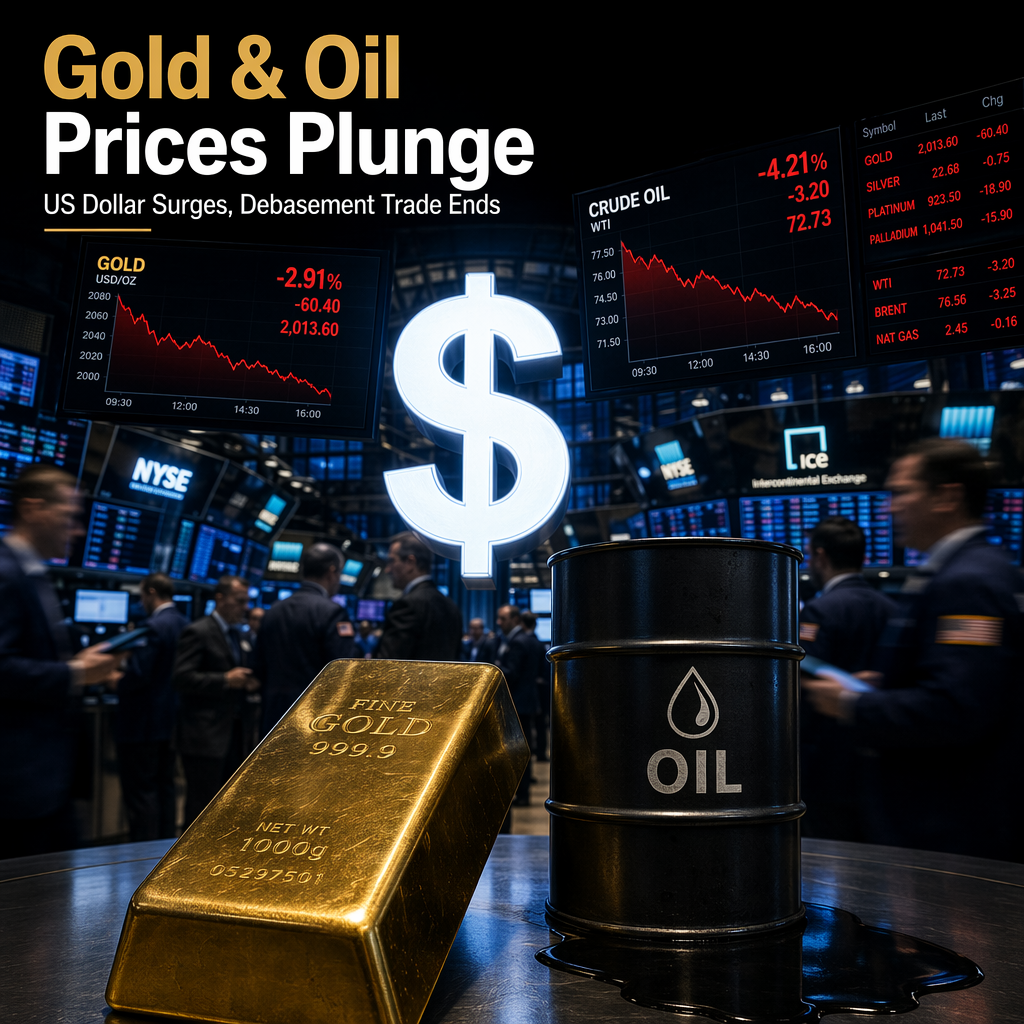
A sharp reversal in gold prices has occurred, with Societe Generale reporting a 20% year-to-date decline and an 11.7% drop in June alone, effectively ending the 'dollar debasement' trade narrative that had previously supported gold prices [1]. Silver has also fallen by 25% over the same period [1]. The collapse in gold and oil prices, with Brent crude on track for its lowest weekly close since February 27, has been a defining theme for June, alongside a resurgence in the US dollar and a flattening of US bond curves [1]. Gold prices fell below $4,000/oz, and Brent crude returned to pre-war levels, further highlighting the strength of the dollar [1][3].
The US Dollar Index (DXY) experienced its first post-FOMC decline, easing by 0.2% to 101.43, as markets reassessed the Federal Reserve's policy stance in light of recent inflation data [2]. Headline and core US inflation for May matched expectations at 4.1% and 3.4% year-over-year, respectively, both remaining well above the Fed's 2% target [2]. Futures markets have reduced the probability of a September Fed rate hike to 47.5%, falling below 50% for the first time since the hawkish June 17 FOMC meeting [2]. Despite this, Fed officials, including Chicago Fed President Austan Goolsbee, emphasized that core inflation remains too high and that restrictive policy is likely to persist [2].
Societe Generale also noted that the broad strength of the US dollar overshadowed the declines in gold and Brent prices [3]. In India, the rupee traded flat but outperformed regional peers due to debt portfolio inflows, while domestic bonds rallied as the Reserve Bank of India pushed back on tighter policy speculation [3]. The composite PMI in India eased to 57.4 in June from 59.3 in May, indicating softer economic momentum [3].
Looking ahead, markets are expected to remain cautious, with attention focused on upcoming US economic data, including the ISM manufacturing prices paid index and nonfarm payrolls, as well as the European Central Bank's Sintra forum [2]. Central banks are not expected to use lower oil prices as a reason to cut rates, but rather as a buffer to maintain restrictive policies for longer [2]. If major central banks adopt more convergent monetary stances, major currencies could begin to consolidate after the recent surge in the US dollar [2].
CONCLUSION
The sharp declines in gold and oil prices, coupled with a resurgent US dollar and persistent inflation, have marked a significant shift in market dynamics. While the probability of further Fed rate hikes has diminished, central banks are expected to keep policies restrictive, and the dollar's strength continues to overshadow other asset moves. Investors remain focused on upcoming economic data and central bank signals for further direction.