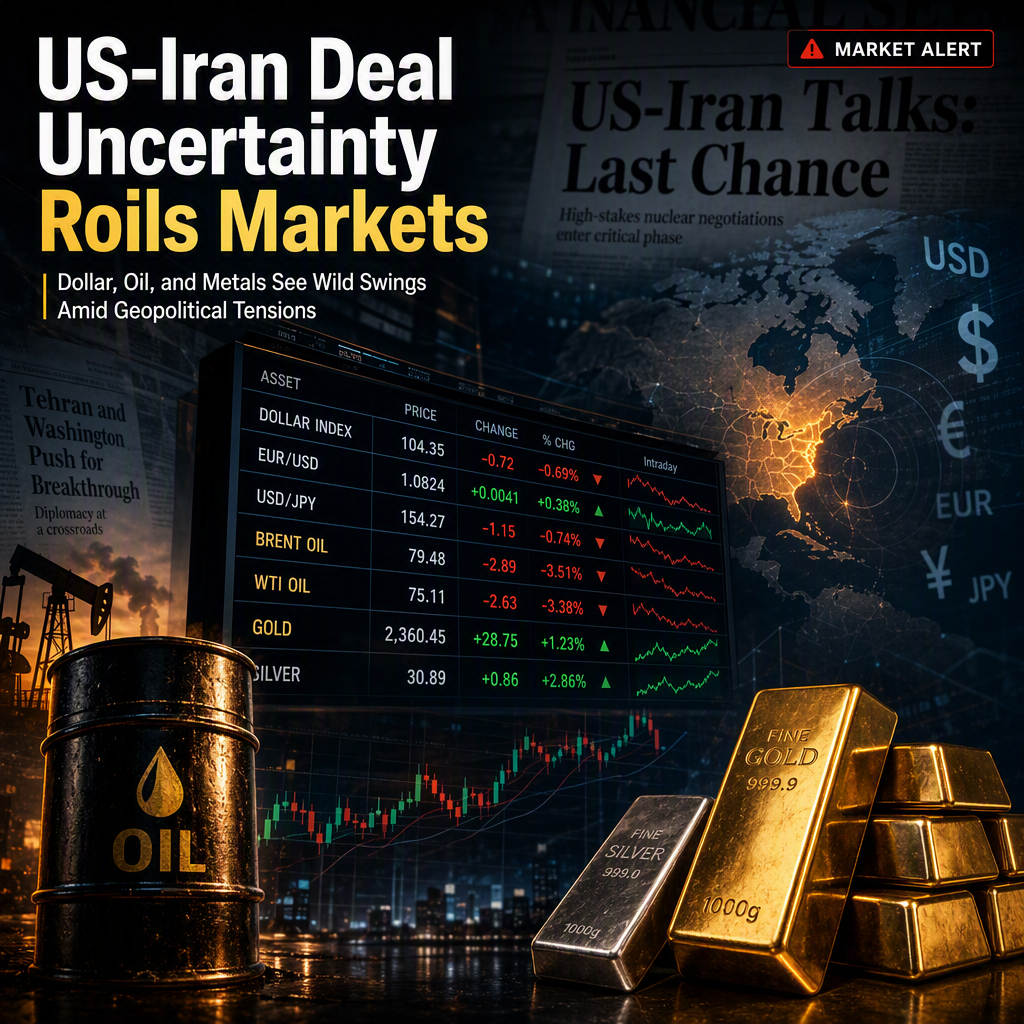
Markets experienced heightened volatility following US President Donald Trump's announcement that talks with Iran are underway, describing it as Tehran's 'last chance' to secure a deal to end the five-month conflict in the Middle East. However, Iranian officials denied any negotiations with the US, stating their discussions are limited to Oman regarding the Strait of Hormuz [2][3][4][6][5]. This uncertainty has led to sharp movements in several asset classes.
The US Dollar stabilized after moderate recovery gains, supported by fading optimism for a diplomatic resolution in the Middle East. The Dollar was the strongest against the New Zealand Dollar this week, up 0.60%, and posted gains against other majors such as EUR (+0.37%), GBP (+0.48%), JPY (+0.33%), CAD (+0.35%), AUD (+0.37%), and CHF (+0.45%) [2]. Analysts at Commerzbank warn that Fed Chair Warsh's cautious, verbally hawkish stance may leave the Dollar exposed to data-driven volatility, especially as unresolved Middle East conflict continues to impact inflation. They doubt this approach will support the Dollar over the medium term, highlighting risks to Fed credibility [1]. Upcoming US employment data is seen as a key driver for further Dollar movement, with markets pricing in a 64.7% chance of a September rate hike, down from 77% before the July Fed meeting [6].
Oil prices, including ICE Brent, fell sharply—over 7%—on optimism that a US-Iran deal may be imminent, after Trump called off planned strikes against Iran. ING strategists caution that the scale of the sell-off may be overdone given ongoing uncertainty and renewed security risks in the Strait of Hormuz and Black Sea. Iranian denials of talks and continued risks for oil tankers have kept sea traffic through key straits at very low levels [4][5]. Crude oil rebounded early Tuesday, with WTI trading near $79.50, up about 1% on the day [2].
Precious metals also reacted, with Silver (XAG/USD) accelerating its recovery to session highs above $59.00, buoyed by cautious hopes for peace in Iran. Technical indicators suggest a mildly bullish bias, but the rally may be capped by a stronger US Dollar [5].
Currency markets reflected these developments: the Australian Dollar edged higher above 0.7000 on US-Iran breakthrough hopes, but Rabobank analysts see limited upside potential for AUD/USD in the coming months, forecasting sideways trading around 0.69-0.70 [3]. The Canadian Dollar declined as USD/CAD approached 1.4050, with gains capped despite a softer USD undertone. Analysts note that renewed tensions could boost crude prices and support the CAD, given Canada’s status as a major oil exporter [6]. The British Pound traded lower against the Dollar, pressured by a dovish tone from BoE Governor Bailey despite a hawkish voting split, and by a stronger Dollar ahead of key US economic releases [7].
In a related development, reports indicate the US sold euros to fund its yen intervention, thereby weakening the Dollar against the euro. The euro strengthened to a high of 1.1558 against the Dollar, its strongest level in almost two months [8].
Earnings reports also contributed to market sentiment: Amazon topped $3 trillion in market cap after better-than-expected results, HSBC reported a second-quarter earnings beat with pre-tax profit of $10.1 billion, and Saudi Aramco exceeded expectations following disruptions in the Strait of Hormuz [8].
CONCLUSION
Uncertainty surrounding US-Iran negotiations and Middle East tensions has triggered sharp volatility across currency, oil, and precious metals markets. While the US Dollar remains supported by upcoming economic data and cautious Fed policy, oil and precious metals are reacting to shifting geopolitical risk premiums. Forward-looking analyst opinions suggest continued volatility, with market direction hinging on both diplomatic developments and key US data releases.