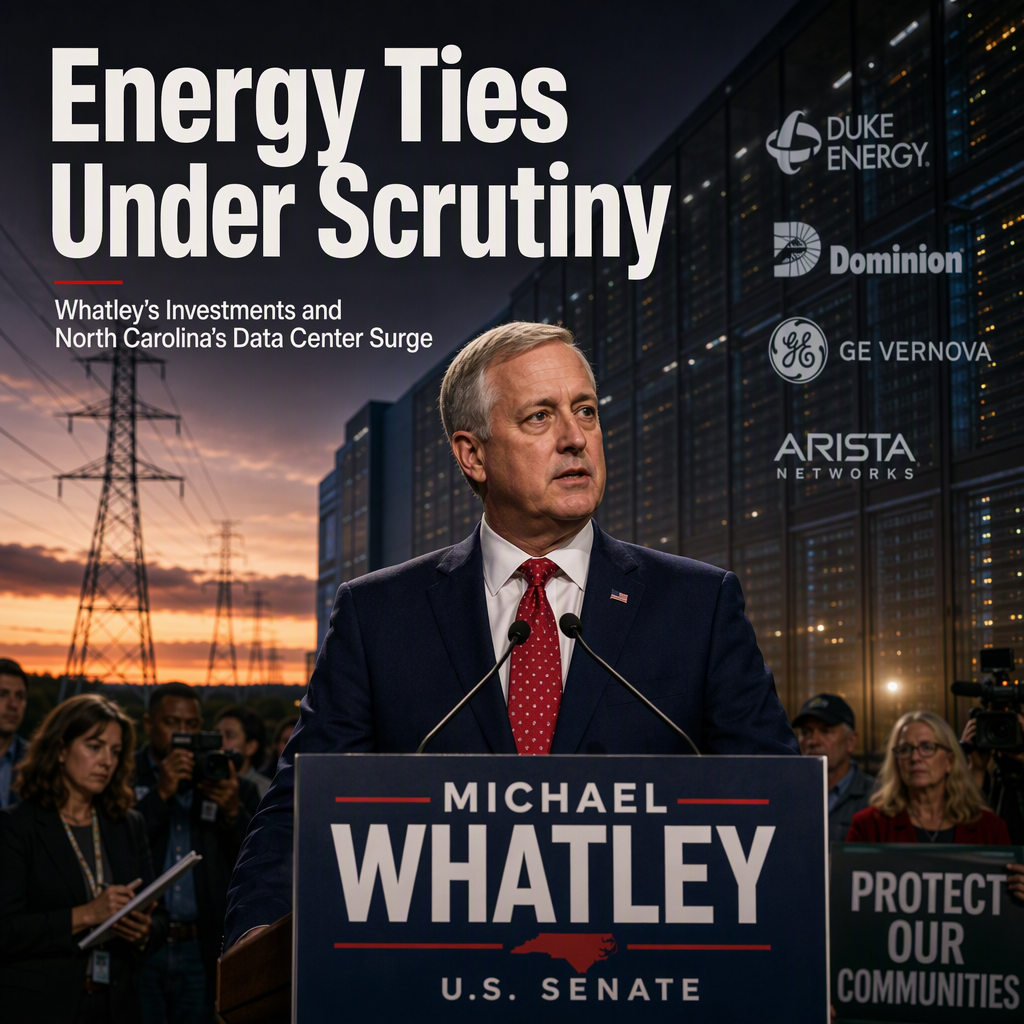
Michael Whatley, the Republican nominee for U.S. Senate in North Carolina and former chair of the Republican National Committee, has reported holding between $246,000 and $690,000 in energy investments with companies connected to the state's data center expansion, according to his federal financial disclosure [1]. The majority of these holdings are with four companies: Duke Energy ($149,000–$410,000), Arista Networks ($1,000–$15,000), Dominion Energy ($80,000–$200,000), and GE Vernova ($16,000–$65,000) [1]. While not all of these companies directly build data centers, they provide essential services or products, such as utility power and on-site gas turbines, to data center operators like Amazon and Microsoft [1].
In addition to his investment holdings, Whatley reported receiving $361,000 from CAPCVentures LLC, a Washington, D.C. consulting firm, in 2025. CAPCVentures lists GE Vernova, Centrus Energy, and the Renewable Fuels Association as clients, with earlier reports indicating Whatley earned approximately $755,000 from the firm between 2022 and 2025 [1]. These financial ties have raised questions about potential conflicts of interest, given Whatley's public support for data center growth in North Carolina—a topic that has generated national debate over zoning, energy consumption, and local economic impact [1].
When questioned about these potential conflicts, Whatley's campaign stated that he supports the Stop Insider Trading Act and advocates for reforms requiring elected officials to place their assets in qualified blind trusts, ensuring no control over investment decisions [1]. The campaign also emphasized Whatley's position that local communities should have the authority to decide on data center projects, with no costs shifted to residential ratepayers and no special subsidies or deals for Big Tech companies [1].
The news has drawn attention to the intersection of political influence, energy investment, and the rapid expansion of data centers in North Carolina. While the articles do not mention specific market reactions, the involvement of major energy and technology infrastructure companies suggests ongoing scrutiny and potential implications for regulatory and investment environments in the state [1].
CONCLUSION
Michael Whatley's financial ties to energy companies involved in North Carolina's data center boom have raised questions about potential conflicts of interest. His campaign has responded by supporting insider trading reforms and emphasizing local control over data center development. The situation highlights the complex relationship between political leadership, investment holdings, and the state's evolving technology infrastructure landscape.