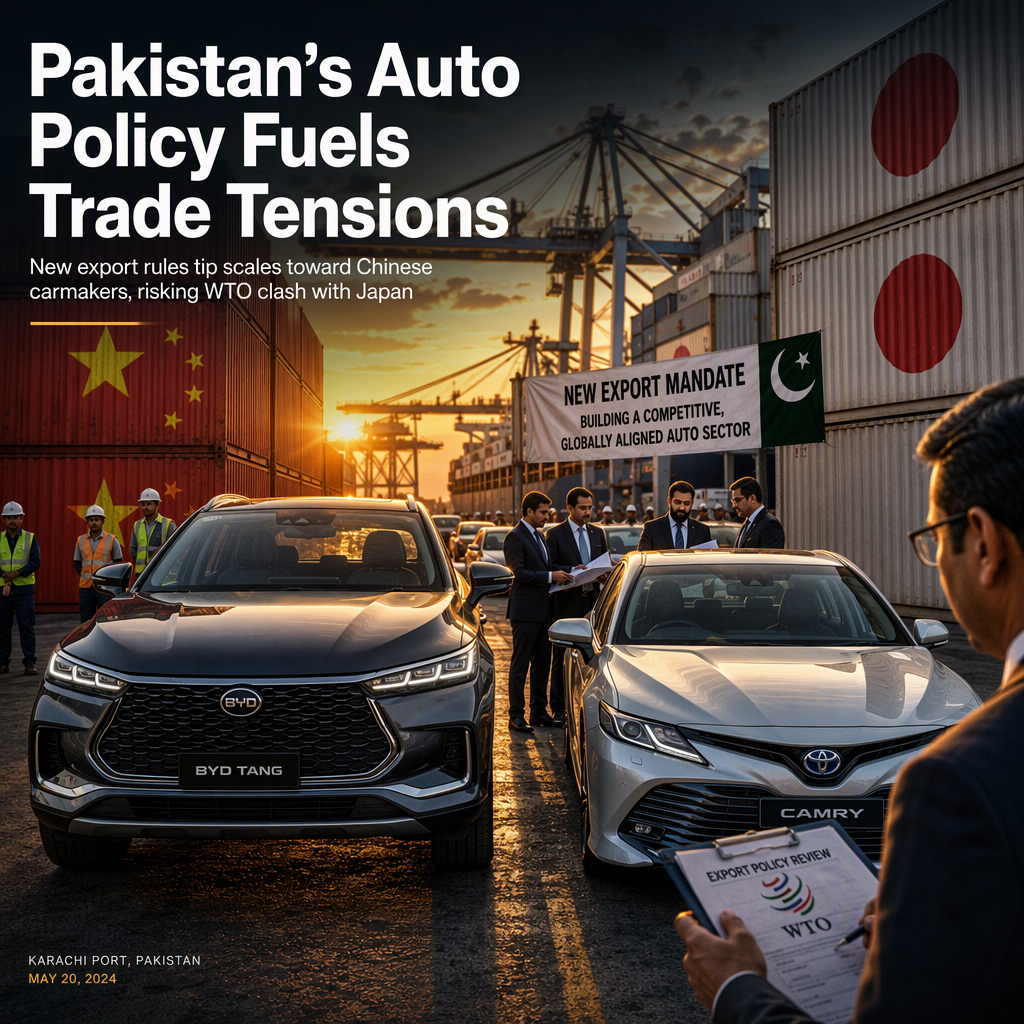
Pakistan's updated auto policy is set to reignite tensions with Japan at the World Trade Organization, as it maintains rules previously challenged by Tokyo. The policy mandates that carmakers manufacturing in Pakistan must export 12% of all vehicles by value, and ties manufacturers' export performance to licensing and concessions on imported vehicle parts [1].
Experts cited in the article suggest that these strict export targets are likely to benefit Chinese automakers, who are expected to adapt more quickly to the new requirements compared to Japanese companies [1]. The export requirement and its linkage to licensing and imported parts concessions have been a longstanding point of contention between Pakistan and Japan, with Japan having already raised the issue at the WTO. The continuation of these measures is likely to reignite the dispute [1].
Industry observers note that the policy could alter the competitive landscape in Pakistan's automotive market, potentially favoring Chinese entrants at the expense of established Japanese players [1]. No specific market reactions, analyst opinions, or forward-looking statements beyond these observations are provided in the article.
CONCLUSION
Pakistan's auto policy is poised to escalate trade tensions with Japan while potentially giving Chinese automakers a competitive edge in the local market. The policy's export requirements and their connection to licensing remain a contentious issue, with possible implications for the automotive sector's competitive dynamics.