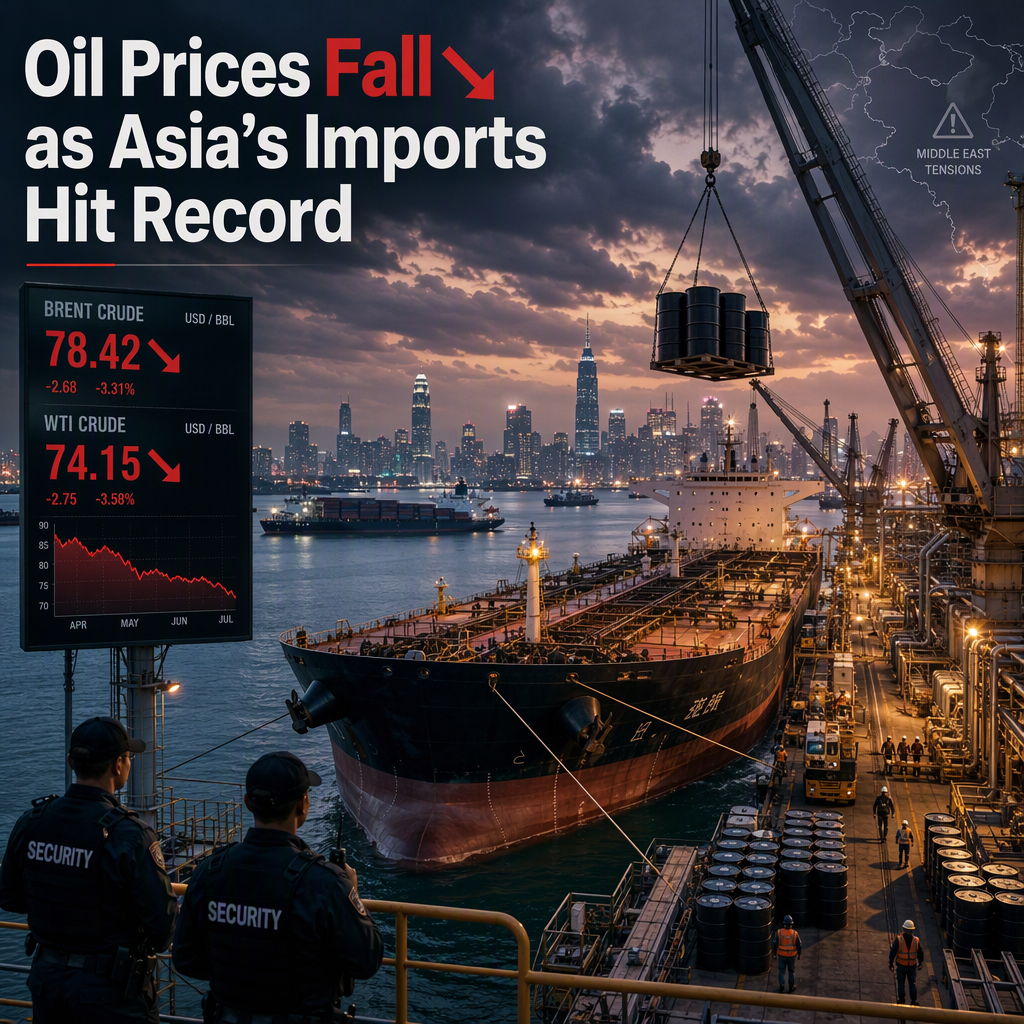
Oil prices fell on Thursday following a report that Asia is set to import 23.96 million barrels per day (bpd) of crude oil in September, an increase from 23.38 million bpd in August and the highest level since February, according to data from Kpler cited by Reuters [1]. This surge in imports marks the largest volume since the start of the US-Iran war [1]. Brent crude futures for November delivery declined by 0.52% to $102.54 a barrel, while U.S. West Texas Intermediate (WTI) futures for November dropped 0.34% to $91.85 per barrel [1].
The market is closely monitoring ongoing tensions in the Middle East, particularly between the U.S. and Iran. Iranian President Masoud Pezeshkian, speaking at the United Nations General Assembly, accused the U.S. and Israel of contributing to global instability and stated, 'The United States president described us as terrorists. We have been the victims of terrorism,' further asserting that Iran will continue to resist 'until our last breath' [1].
Naeem Aslam, chief investment officer at Zaye Capital Markets, noted that while the decline in oil prices may provide some relief to equities in the U.S. and Europe, several risks remain. These include the potential for further monetary tightening, renewed escalation in the Middle East, and ongoing U.S.-China discussions regarding trade, artificial intelligence, and strategic supply chains [1].
CONCLUSION
Oil prices declined as Asia's crude imports reached their highest level since the start of the Iran war, amid ongoing geopolitical tensions and market uncertainty. While lower oil prices may temporarily support equities, analysts caution that risks from the Middle East and global economic policy could quickly reverse this trend.