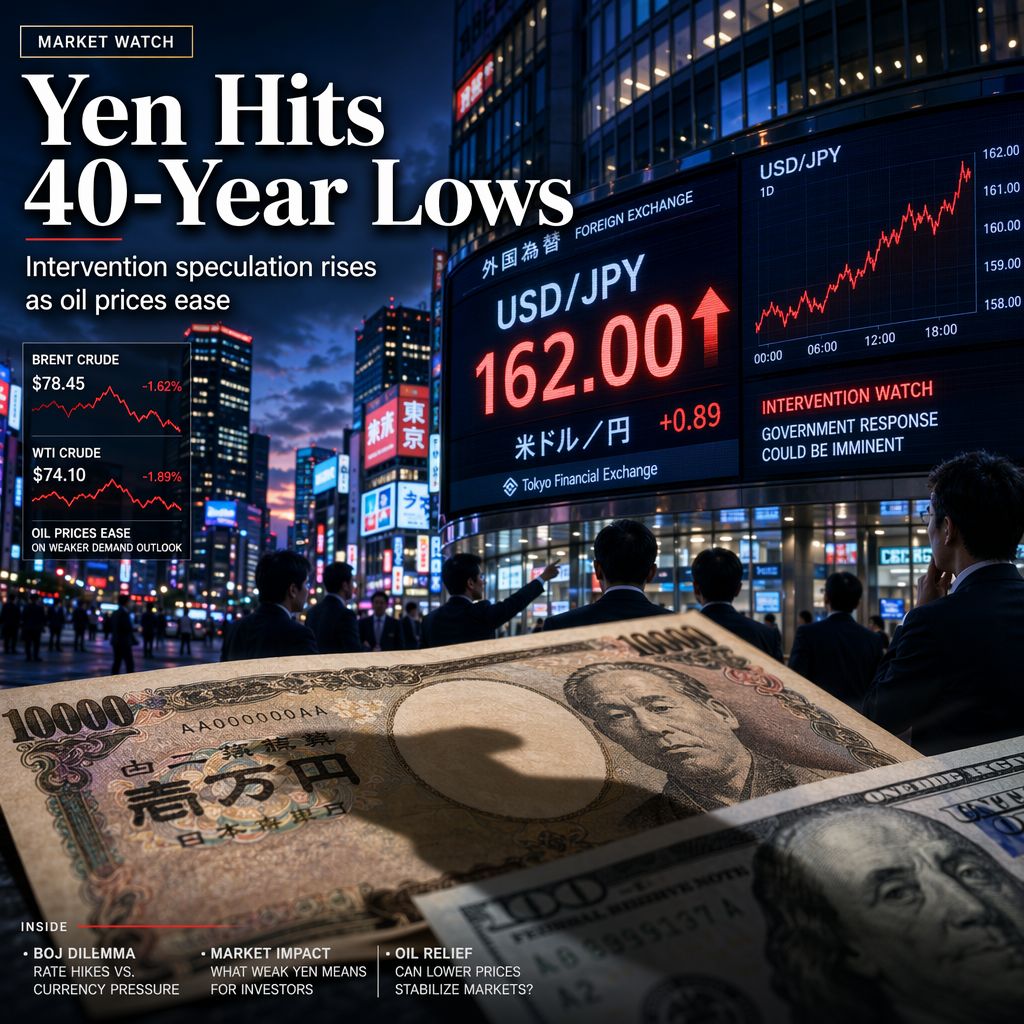
The Japanese Yen (JPY) is trading near its weakest levels since 1986 against the US Dollar (USD), with the USD/JPY pair approaching the 2024 peak around 162.00 and closing in on multi-decade highs [1][2]. Societe Generale highlights that the pair has resumed its uptrend after holding a multi-month ascending trendline near 157.40 and breaking out of consolidation, with resistance at the 2024 high near 162.00. If this level is breached, Societe Generale sees potential targets at 163.70-164.20 and 165.70, provided the 159.65-159.10 support zone holds [1].
Deutsche Bank notes that intervention chatter is intensifying as the Yen approaches levels last seen in 1986, with thin holiday liquidity potentially providing Japanese authorities an opportunity to surprise the market. The risk of official intervention is seen as a wild card that could trigger sharp reversals, even though the broader trend still favors USD strength [1].
Brown Brothers Harriman (BBH) offers a slightly different perspective, arguing that the recent slump in crude oil prices should relieve some pressure on the Yen and could help nudge USD/JPY lower toward 155.00. BBH also points out that Japan's May inflation remained contained at 1.5% year-over-year, supported by government energy subsidies, and that the Bank of Japan (BoJ) is not seen as behind the curve in its tightening cycle. The swaps curve is pricing in nearly 50 basis points of hikes to 1.50% over the next twelve months, which BBH considers broadly appropriate [2].
According to [1], the market is closely watching for possible intervention by Japanese authorities, especially given the proximity to historical lows and the potential for sharp moves in thin liquidity. However, [2] suggests that lower oil prices and contained inflation may ease some of the downward pressure on the Yen, potentially limiting the need for immediate policy action.
CONCLUSION
The Japanese Yen remains under significant pressure near 40-year lows, with intervention speculation intensifying as USD/JPY approaches key resistance levels. While some analysts see scope for further Yen weakness, others highlight that lower oil prices and subdued inflation could provide relief. The market impact is high, with traders closely monitoring both official intervention risks and macroeconomic developments.