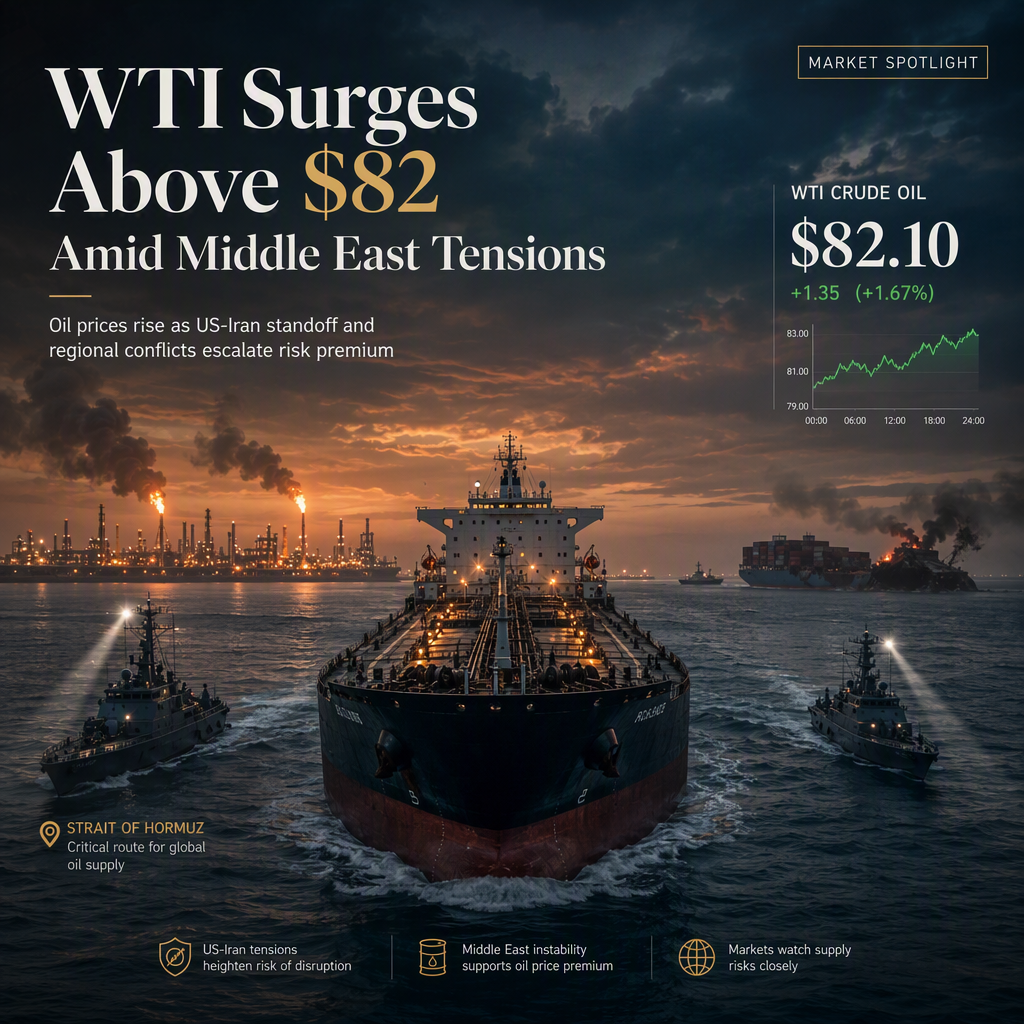
West Texas Intermediate (WTI) crude oil advanced on Monday, trading around $82.10 per barrel, marking a 0.70% increase for the day. This upward movement is attributed to the ongoing deadlock between the United States and Iran, which has heightened concerns about oil flows through the critical Strait of Hormuz. Iranian Foreign Minister Abbas Araghchi stated that no negotiations are currently taking place between the two countries, emphasizing that the US must accept Iran's conditions for shipping to resume through the waterway. Tensions escalated further over the weekend, with Iranian Deputy Foreign Minister Kazem Gharibabadi urging US President Donald Trump to 'accept the reality of defeat' after Trump suggested he would soon declare the Strait of Hormuz a 'territory of the United States' [1].
The oil market is also closely monitoring the situation in Lebanon, where renewed fighting between Israel and Iran-backed Hezbollah has raised concerns about the stability of energy supplies in the Middle East. A further deterioration in this conflict could sustain or increase the geopolitical risk premium in WTI prices. Additionally, supply risks extend beyond the Middle East, as Russia faces fuel shortages following Ukraine's resumption of near-daily attacks on Russian oil refineries, introducing further uncertainty over global energy product availability [1].
Market participants are awaiting the American Petroleum Institute (API) weekly crude oil inventory report, scheduled for Tuesday, for further direction. Rabobank’s Bas van Geffen highlighted that the Middle East ceasefire is set to expire, with little of the truce remaining. Over the weekend, Israel launched new strikes in Lebanon, a bulk carrier attempting to exit the Strait of Hormuz was hit by a projectile, and Yemen’s main port suspended operations after Houthi missile attacks. Rabobank warns that additional US sanctions on Iran could have domestic repercussions, especially if Washington targets Chinese banks financing Iranian oil trade, which could worsen US-China relations ahead of a scheduled Trump-Xi meeting [1].
On the energy front, Rabobank notes that the US has attempted to mitigate the impact of these geopolitical tensions by releasing oil from the Strategic Petroleum Reserve, but this has not prevented prices from rising. The oil market remains in backwardation, reflecting ongoing supply concerns and a persistent risk premium [1].
CONCLUSION
WTI crude oil prices have climbed above $82 per barrel, driven by escalating geopolitical tensions in the Middle East and supply disruptions in Russia. The market is maintaining a significant risk premium as uncertainty persists over the Strait of Hormuz and broader regional stability. Traders are closely watching upcoming inventory data and potential policy moves, with the outlook remaining sensitive to further developments.