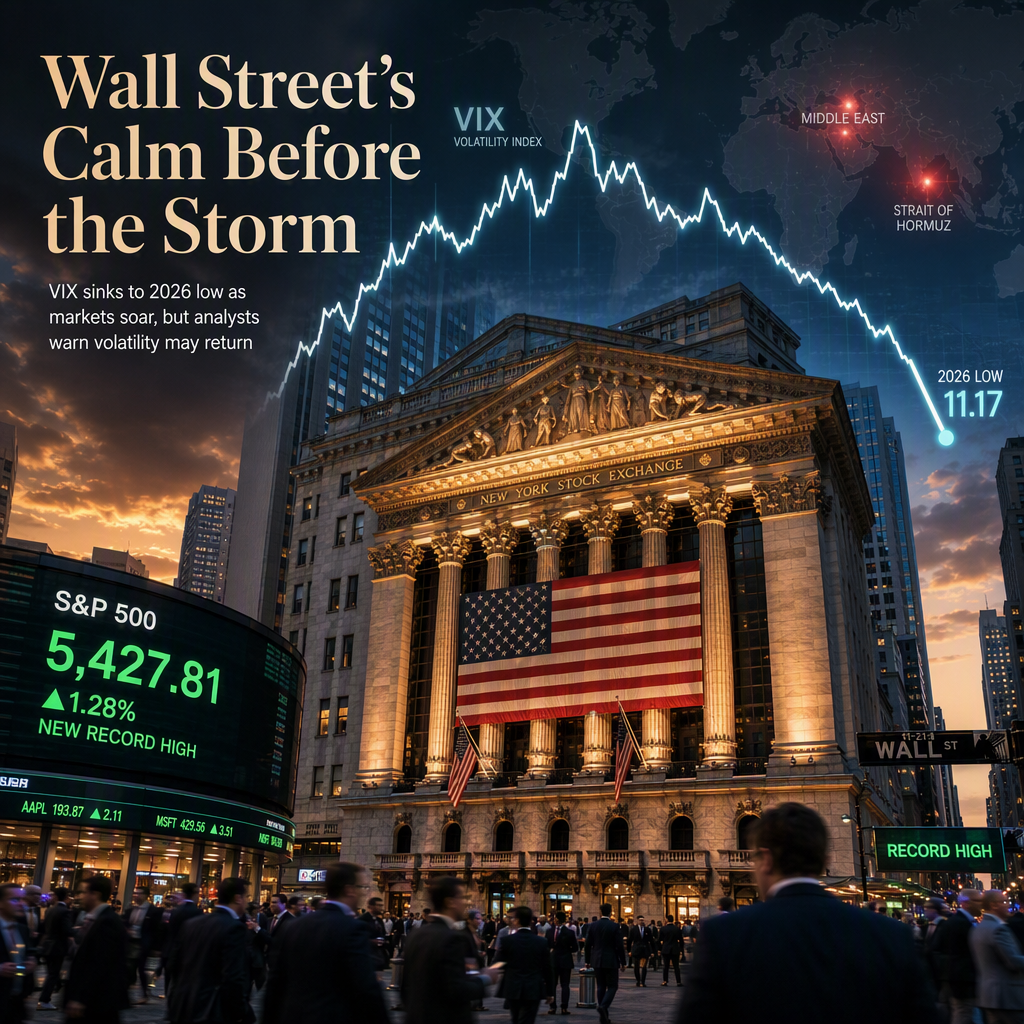
The Chicago Board Options Exchange's Volatility Index (VIX), widely regarded as Wall Street's 'fear gauge,' has fallen to 14.2, its lowest level so far in 2026, as U.S. stock markets approach record highs with the S&P 500 up approximately 16% year-to-date [1]. This decline in the VIX reflects a period of relative market calm, despite ongoing geopolitical tensions such as the Middle East conflict and the Strait of Hormuz impasse, as well as emerging signs of U.S. consumer strain [1].
Strategists caution that this tranquility may be short-lived. Jonathan Krinsky, managing director and chief market technician at BTIG, highlighted that the current environment of low volatility and record equity valuations coincides with the historically turbulent mid-August to mid-October period, especially during mid-term election years [1]. Krinsky noted that since 1990, every mid-term election year has seen the equal-weight S&P 500 experience a pull-back of at least 7% from its August 18 average peak through mid-October [1]. He also pointed out that 2026 has been an anomaly, with no 80% downside volume day since last October, compared to an average of 21 such days per year, and never fewer than five in any year since 1990 [1].
Despite recent dovish inflation-related data, including jobs, CPI, and PPI reports, long-end Treasury yields remain near cycle highs, adding to the risk backdrop [1]. Krinsky advised that this is an attractive time for investors to pare down risk or consider hedging broad-based equity exposure as markets enter a historically difficult calendar period [1].
Global quant trading firm Susquehanna described the recent volatility reset as 'substantial,' noting that two-month implied volatility has edged back toward pre-Iran-war levels at 13.5%, even as cross-asset and geopolitical risks persist [1]. Axel Rudolph, chief technical analyst at IG, also commented on the VIX's slide [1].
CONCLUSION
While the VIX's drop to 2026 lows signals investor complacency amid record market highs, analysts warn that historical patterns and unresolved geopolitical risks suggest volatility could return in the coming months. Investors are urged to consider risk management strategies as markets enter a seasonally challenging period.