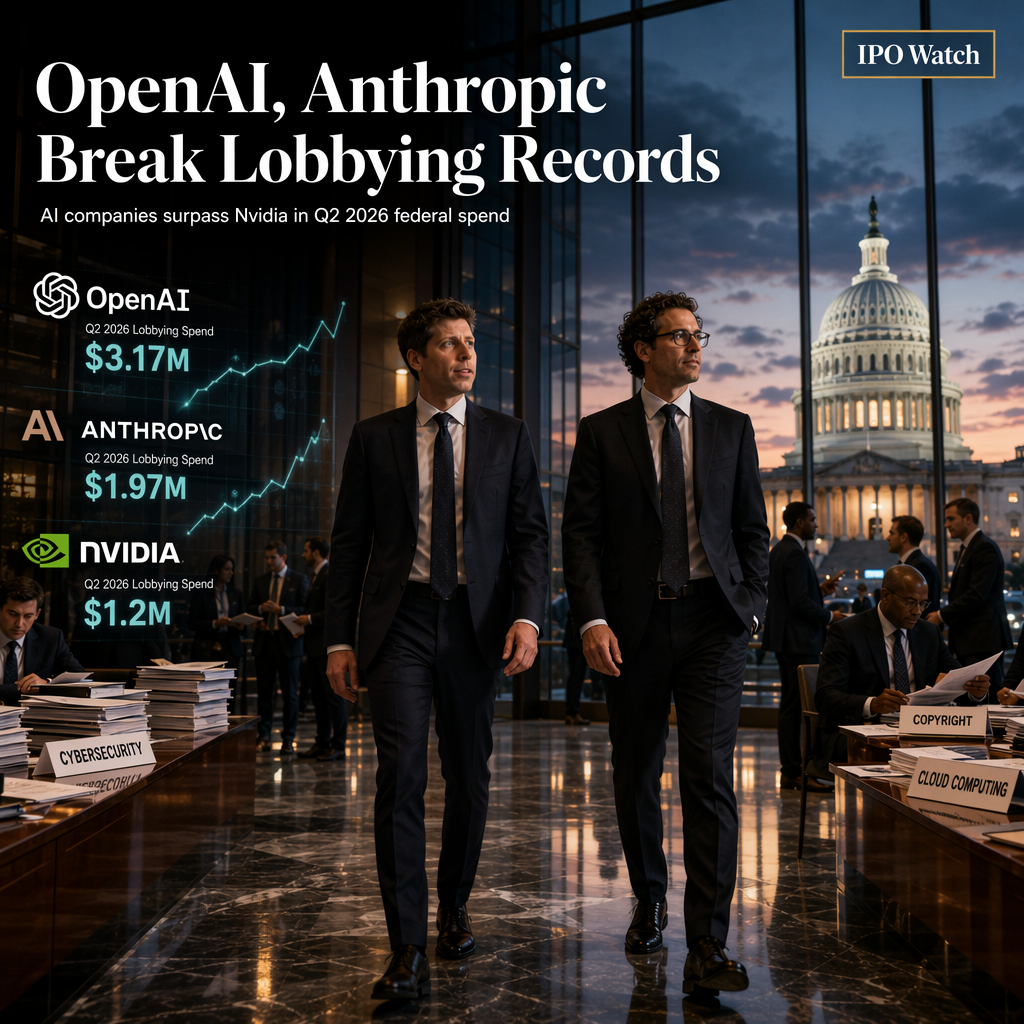
OpenAI and Anthropic, two leading artificial intelligence developers, significantly increased their federal lobbying expenditures in the second quarter of 2026, reaching record levels as the AI industry intensified efforts to influence Washington ahead of the midterm elections and their anticipated IPOs [1]. Together, the companies spent $3.17 million during the quarter, marking a 23% rise from the first three months of the year [1]. Specifically, Anthropic spent $1.97 million from April through June, up 26% from the previous quarter, while OpenAI spent $1.2 million, an increase of nearly 18% [1]. Their lobbying focused on issues such as cybersecurity, copyright, cloud computing, and defense procurement [1].
Anthropic's lobbying expenditure surpassed Nvidia's $1.25 million for the quarter and nearly matched Oracle’s $2 million total, while OpenAI came within $50,000 of Nvidia's spend [1]. Both companies also sharply increased their spending compared to the second quarter of the previous year, with Anthropic's more than doubling and OpenAI's nearly doubling [1].
A broader analysis of five 'Magnificent 7' tech companies—Meta, Amazon, Google, Microsoft, Apple, Nvidia, and Tesla—showed a combined $21.25 million spent on federal lobbying in Q2 2026, essentially unchanged from $21.27 million in Q1 [1]. Meta led this group with $5.99 million, though its spending fell 15% from the prior quarter. Amazon's lobbying was nearly unchanged at $4.36 million. Google and Microsoft increased their spending by 25% and nearly 13%, respectively, to $3.57 million and $2.69 million [1]. Collectively, these companies increased their lobbying spend by 7.7% compared to Q2 2025, reflecting the heightened focus on tech issues in Congress [1].
In contrast, major defense contractors reduced their combined lobbying expenditures compared to the previous quarter. The eight largest U.S.-based publicly traded defense contractors spent $19.68 million on federal lobbying in Q2 2026 [1].
CONCLUSION
OpenAI and Anthropic's record lobbying expenditures in Q2 2026 highlight the growing influence and ambitions of AI firms in Washington, especially as they approach potential IPOs. While established tech and defense companies still outspend them overall, the narrowing gap signals AI's rising prominence in policy debates. The market may interpret these moves as a sign of the sector's increasing regulatory engagement and strategic positioning.