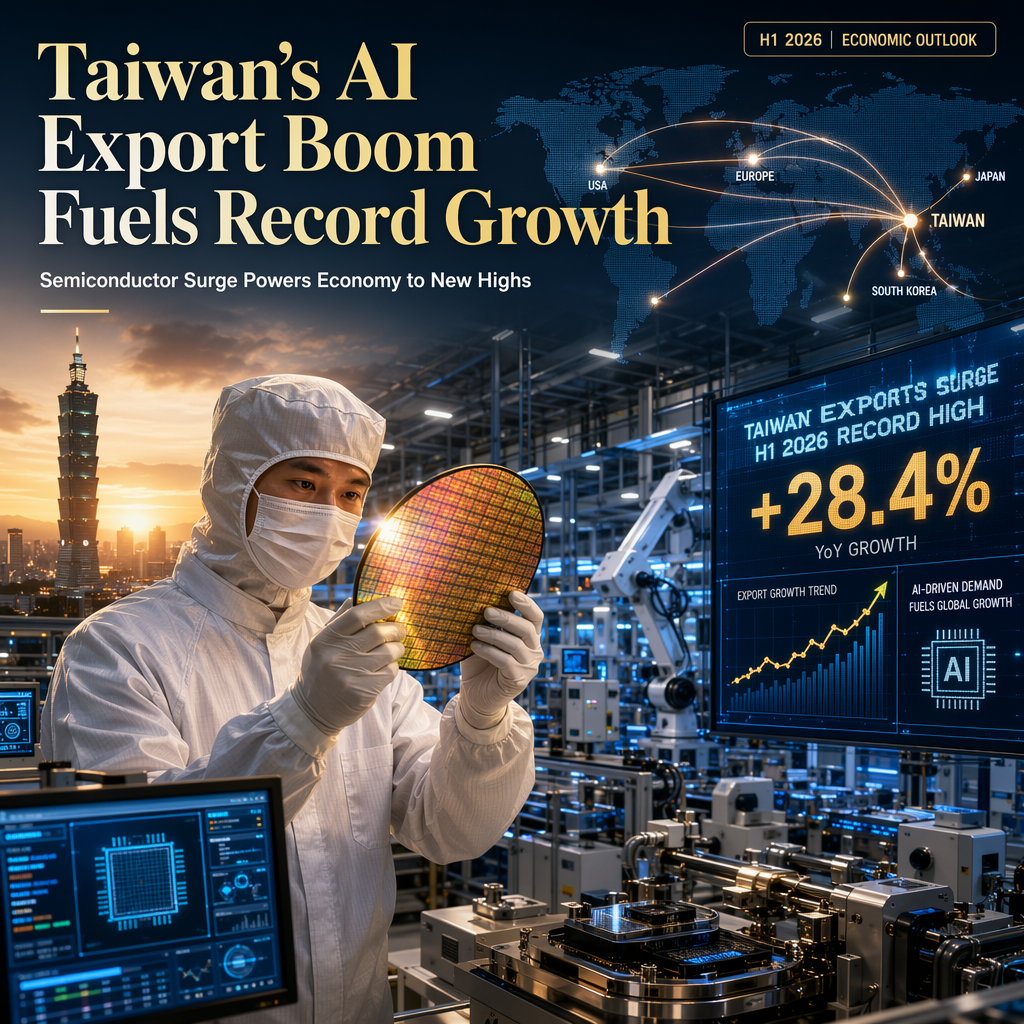
Taiwan's exports soared by nearly 50% in the first half of 2026, marking an unprecedented surge driven primarily by robust global demand for semiconductors and AI-related products [1]. This export boom is expected to propel Taiwan's GDP growth to its fastest pace since 2010, with officials raising the 2026 economic outlook in response to the AI-fueled expansion [1]. President Lai has prioritized transforming Taiwan into an 'AI island,' leveraging the nation's leadership in chip manufacturing and high-tech industries [1].
Analysts highlight that Taiwan's semiconductor sector, led by companies such as TSMC, is reaping significant benefits from increased global investments in artificial intelligence infrastructure and devices [1]. Market sentiment remains bullish for Taiwan's tech stocks, as reflected in elevated trading volumes and price levels, indicating strong investor confidence in the country's export-driven growth [1]. The only notable risks cited are a potential slowdown in global AI demand or supply chain disruptions [1].
Industry experts anticipate continued export growth, particularly as CPUs and memory chips become increasingly central to AI applications [1]. The outlook for the second half of 2026 remains positive, with technical indicators and chart analyses pointing to sustained upward momentum in Taiwan's export markets [1]. A senior official from the Ministry of Economic Affairs stated, "Taiwan is well-positioned to capitalize on the AI boom. Our exports and GDP growth are on track for record highs" [1].
Technical analysis further supports the optimistic outlook, showing upward trends in export values, with support levels holding firm and resistance expected only at peak demand or in the event of geopolitical uncertainty [1].
CONCLUSION
Taiwan's export-driven economy is experiencing record growth, fueled by the global AI boom and strong performance in the semiconductor sector. Market sentiment is highly positive, with continued momentum expected in the second half of 2026. Risks remain limited to potential shifts in global AI demand or supply chain issues.