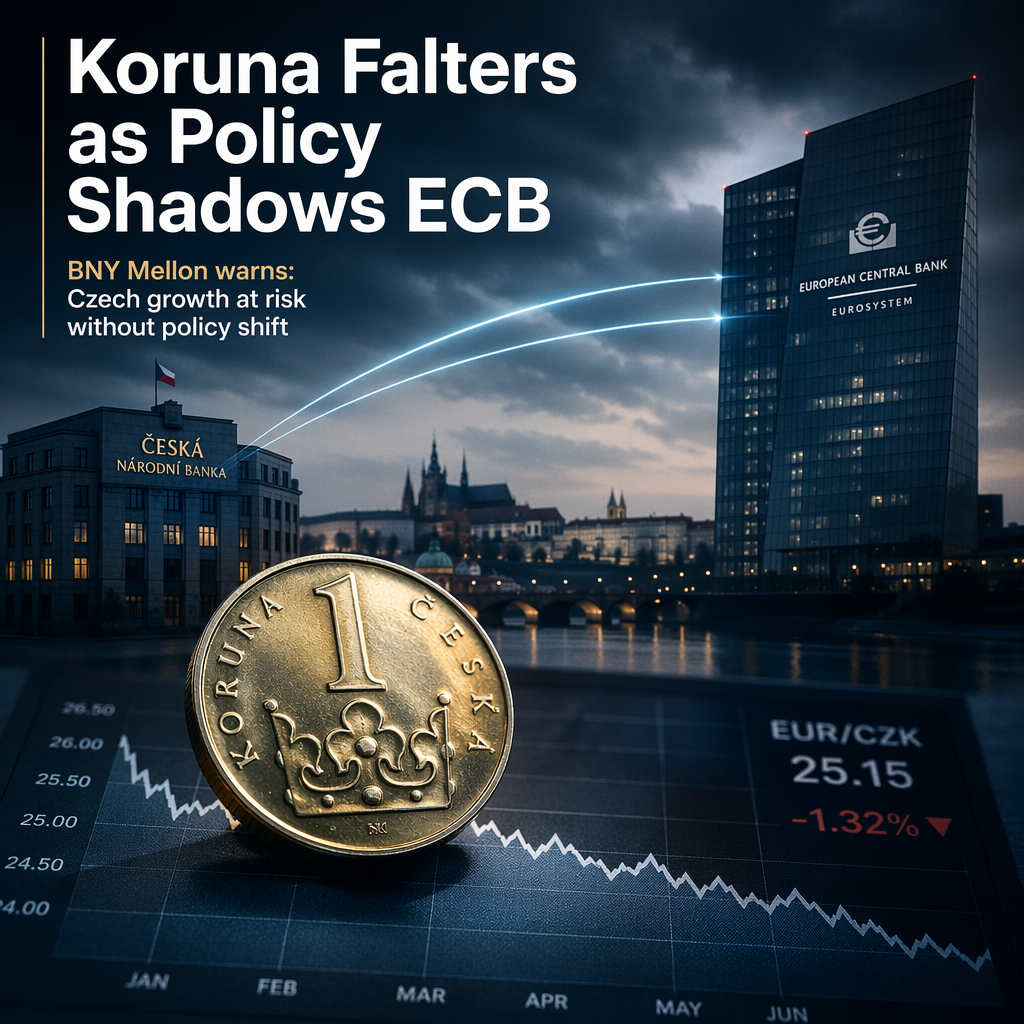
Geoff Yu at BNY Mellon notes that the Czech National Bank (CNB) has seen its policy expectations rise in tandem with those of the European Central Bank (ECB), but the Czech Koruna (CZK) continues to weaken on a nominal effective exchange rate (NEER) basis, drifting toward the lows of the year [1]. Yu highlights that smaller European economies, such as Czechia, which are integrated into the Eurozone supply chain, often align their monetary policy with the ECB. However, he warns that this alignment can be risky, especially if it results in sub-optimal policy for the domestic economy [1].
Despite a sharp rise in policy pricing in May, the CZK did not benefit, and the recent decline in inflation has further shifted policy expectations, yet failed to support the currency [1]. Yu argues that matching the ECB's policy stance may amplify growth headwinds for Czechia, particularly if the export channel is structurally weaker. He suggests that the CNB may need to consider a 'clean break' from the ECB's approach and that credible domestic stimulus could be rewarded by markets focused on structural growth [1].
Yu also points out that Czechia has avoided some of the fiscal excesses seen in other Central and Eastern European countries. In the current environment, he believes that credible stimulus measures could be positively received by the market, similar to how German assets have been repriced for 2025, potentially benefiting the euro [1].
CONCLUSION
The Czech Koruna's continued weakness, despite tighter CNB policy expectations, underscores the risks of closely tracking ECB policy. BNY Mellon suggests that a shift toward credible domestic stimulus could help support growth and market sentiment for Czechia.