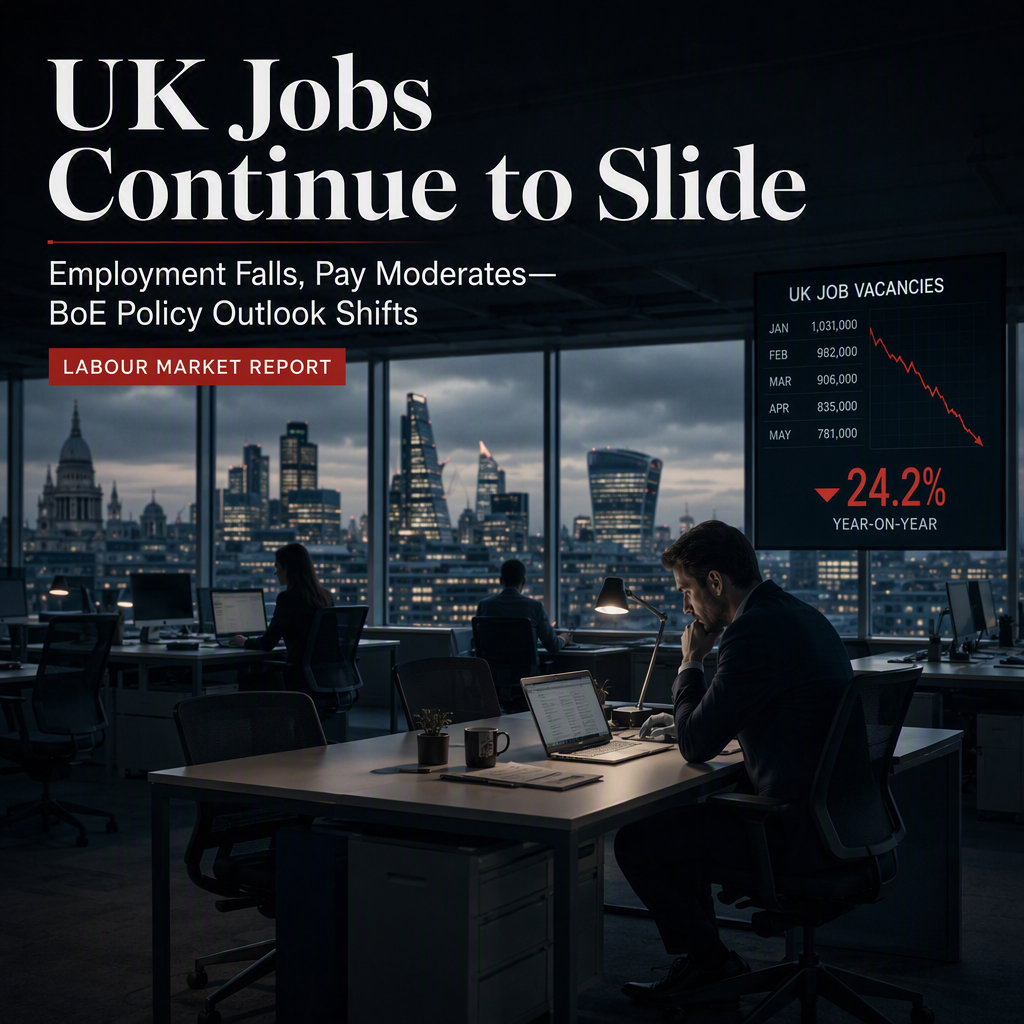
Deutsche Bank’s Chief UK Economist, Sanjay Raja, analyzed the latest UK labour market data, highlighting ongoing weakness in employment and a decline in job vacancies. The jobless rate remained steady at 4.9%, aligning with expectations, while HMRC payroll data indicated a notable 26,000 fall in August. However, Raja expects this figure may be revised higher in the future. The more reliable quarterly Workforce Jobs data also showed a decrease in spring, with a total fall of 48,000 jobs, including a reduction of 10,000 employee jobs in Q2 [1].
Pay indicators suggest some moderation, with Average Weekly Earnings (AWE) Private Regular Pay—a key metric for the Bank of England’s Monetary Policy Committee (MPC)—ticking up to 2.9% year-on-year for the three months to July. Despite these sluggish employment figures, economic growth is outpacing expectations, resulting in higher productivity as growth occurs with fewer employees [1].
Raja notes that while there are some signs of optimism in survey data, the overall picture remains one of a struggling labour market. He emphasizes that the current data may temporarily challenge the view that the labour market is bottoming out. For the MPC, the continued weakness in the labour market reinforces the perception that the Bank Rate remains restrictive, which could influence future monetary policy decisions [1].
CONCLUSION
The latest UK labour market data underscores persistent weakness in employment and moderating pay growth, despite stronger-than-expected economic output. This environment is likely to reinforce the Bank of England’s view that current interest rates remain restrictive, shaping the outlook for future policy decisions.